
1. 🏕️ The Short Answer
Independent wild and dispersed camping in Gabon is effectively impractical and heavily restricted for foreign tourists. While there is no single national law completely outlawing sleeping outdoors, the reality of dense, impenetrable rainforests, dangerous wildlife, and strict National Park regulations means you must almost always camp with an official guide, a licensed eco-tour operator, or secure explicit local permission.
2. 🌲 Wild & Dispersed Camping Rules
- Legality on Public Land: True independent wild camping is a legal grey area but is highly discouraged and rarely attempted by tourists. Much of Gabon’s untouched land is either protected national park territory, private oil concessions, or logging reserves.
- Rules and Limits: There are no formal duration limits or distance rules for wild camping because independent camping is not recognized as a standard tourist activity. If you wish to camp near a village or on rural land, you must formally introduce yourself to the local village chief or landowner to ask for permission.
- Enforcement: Law enforcement, military, and local communities will view an unaccompanied tourist camping in the bush with extreme suspicion. Gabon has numerous police checkpoints, and unauthorized camping exposes travelers to questioning, delays, or extortion by corrupt officials.
3. 🏞️ National Park & Protected Area Rules
- Permits and ANPN: Gabon’s 13 National Parks are strictly managed by the Agence Nationale des Parcs Nationaux (ANPN). You cannot self-drive into a park and pitch a tent. Entry requires paying daily park fees and being accompanied by official ANPN guides or trackers.
- Designated Sites & Booking: There is absolutely no independent camping infrastructure. Tourists can only experience overnight stays via “fly camping” expeditions arranged by specialist Libreville-based eco-operators. These must be booked well in advance.
- Strict Environmental Protocols: ANPN enforces rigorous health and safety rules. Campers must maintain a minimum distance of 40 meters from wild animals. Defecation must be in a 30cm deep hole at least 30 meters from water courses, and all rubbish must either be removed from the park or burned and buried in a 50cm hole. Bathing and washing clothes in national park rivers is highly restricted.
- Seasonal Closures: While parks don’t usually have absolute seasonal closures for camping, the heavy rainy seasons (roughly October to December and February to May) render many laterite park roads entirely impassable, effectively shutting down deep-forest camping access.
4. 🚐 Van Life & Overnight Vehicle Sleeping
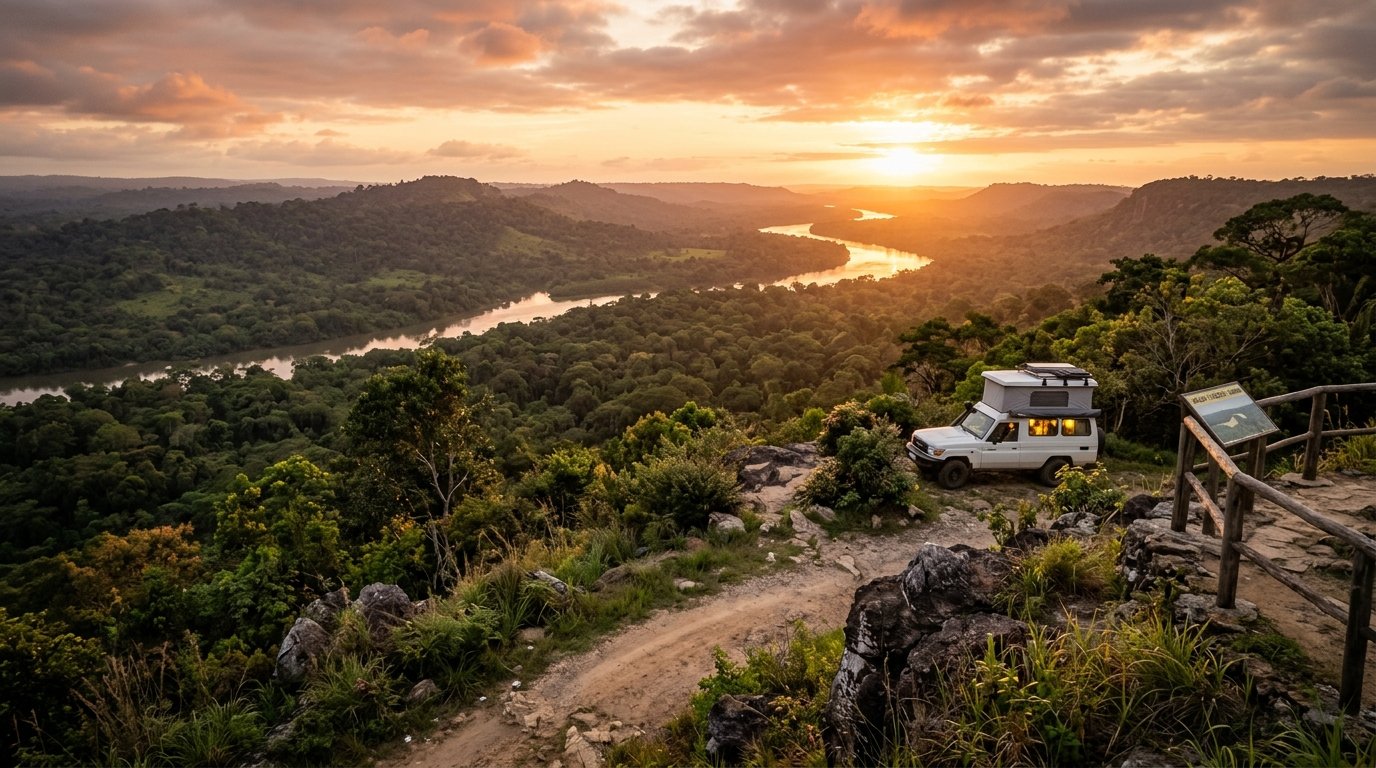
- Vehicle Sleeping Legality: Sleeping in your vehicle is not explicitly illegal, but Western-style “van life” does not exist in Gabon. Overland travelers in 4x4s with roof-top tents are the closest equivalent, but they face significant logistical hurdles.
- Parking vs. Camping: The law does not carefully distinguish between parking and camping, but local police will. Setting up a camp (chairs, awnings) on a roadside will immediately draw attention from authorities and locals.
- Designated Areas: There are no official campervan rest areas, aires, or public RV parks. Overlanders looking for a safe place to sleep in their vehicles typically ask permission to park overnight in secure compounds, such as Catholic missions, hotel parking lots, or guarded NGO facilities.
5. 🔥 Campfires & Practical Restrictions
- Campfires: Open campfires outside of guided expeditions are highly dangerous and strongly discouraged. In national parks, fires are only permitted under the direct supervision of your guide for cooking or burning combustible waste according to ANPN protocols.
- Wildlife Hazards: Campfires do not deter all wildlife; Gabon is home to forest elephants, leopards, and gorillas. Pitching a tent blindly in the forest can put you in the direct path of an elephant corridor.
- No-Camp Zones: Tourists must entirely avoid camping near the borders with Equatorial Guinea, Cameroon, and the Republic of Congo due to geopolitical sensitivities and anti-poaching military operations. Additionally, do not camp near active logging zones, diamond/gold mining areas, or coastal oil concessions (such as those around Port-Gentil and Gamba) without corporate clearance.
6. 🔗 Official Sources & Links
For the most accurate and up-to-date information, tourists should consult the official managing body for Gabon’s protected lands:
- Agence Nationale des Parcs Nationaux (ANPN) – The official government authority for all national parks and protected areas in Gabon.
Disclaimer: Land-use laws, national park fees, and tourist regulations in Central Africa change frequently. Enforcement can be arbitrary. Travelers should always verify current camping rules, visa requirements, and security conditions with their tour operator, their local embassy, and official Gabonese authorities prior to their trip.

Adrenaline junkie with a passion for exploring off-the-beaten-path destinations and finding unique ways to stay active. Expect stunning scenery, challenging workouts, awesome travel tips and a whole lot of fun. Let’s get sweaty and explore the world together!