
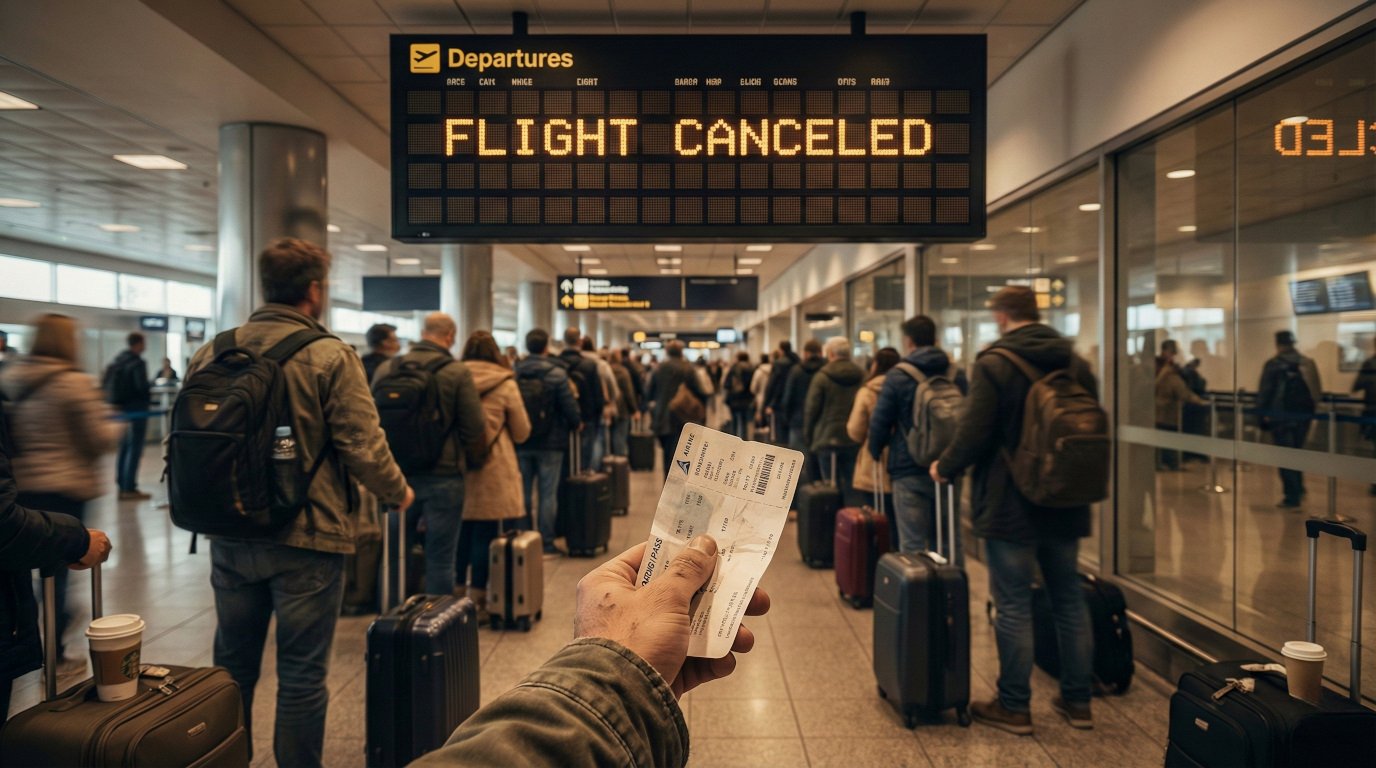
Let’s face it: travel delays are the absolute worst. After planning a trip, nothing is more frustrating than seeing that dreaded “Delayed” or “Canceled” status pop up on the airport screen.
But here’s the good news: depending on where you are flying, you might be entitled to hundreds of dollars in compensation—not just a measly food voucher. The key is knowing which set of rules applies to your flight.
The global system for passenger rights is split into two main groups: those that demand fixed cash compensation (like Europe and Canada) and those that only require a full refund (like the USA).
This guide breaks down your rights, so you can stop waiting around and start claiming what you’re owed. (And yes, services like AirHelp and Compensair exist precisely because navigating these rules can be tricky!)
1. Europe and Canada: The Cash Compensation Kings
If your flight takes off from, lands in, or is operated by an airline registered in the European Union (EU) or Canada, you are likely covered by the world’s most generous passenger protection laws. These rules are designed to give you a fixed sum of money for the time you lost, provided the delay was the airline’s fault.
The EU’s EC 261 Rule: Fixed Payouts by Distance
The European Union Regulation EC 261 is the gold standard. It applies if you depart from an EU airport (on any airline) or arrive at an EU airport (on an EU-registered airline).
The Big Rule: If you arrive at your final destination 3 hours or more late due and the cause was within the airline’s control (like a mechanical failure or staffing issue), you are owed compensation based on the distance of your flight.
Your Dual Entitlement:
The Right to Care: For delays over 2, 3, or 4 hours (depending on distance), the airline must give you free meals, refreshments, and access to communication. If you need to stay overnight, they must pay for your hotel and transport. You get this care regardless of why the flight was delayed.
Financial Compensation: This is the cash payout if the delay was the airline’s fault.
Flight Distance | Minimum Delay to Qualify | Compensation Amount |
|---|---|---|
Short-Haul (up to 1,500 km) | $3 hours | €250 (Approx. $270 USD) |
Medium-Haul (1,500 km to 3,500 km) | $3 hours | €400 (Approx. $430 USD) |
Long-Haul (over 3,500 km) | $3 hours | €600 (Approx. $645 USD) |
(Note: These are for delays that are the airline’s fault. If your flight is canceled, you have the right to a refund, a replacement flight, AND this compensation unless you were notified well in advance.)
Canada’s APPR: Payouts Based on Delay Time
Canada’s Air Passenger Protection Regulations (APPR) offer similar protection but calculate the compensation amount based on the total delay at your final arrival and the size of the airline.
Delay Threshold (Arrival) | Large Airline Compensation (CAD) | Small Airline Compensation (CAD) |
|---|---|---|
3 to< 6 Hours | $400 | $125 |
6 to< 9 Hours | $700 | $250 |
>9 Hours | $1,000 | $500 |
Crucially, Canadian airlines must offer compensation in cash, not just vouchers, unless the voucher is worth more than the required cash amount and has no expiration date.
The Airline’s Only Defense: “Extraordinary Circumstances”
Airlines don’t have to pay compensation if the delay was caused by “extraordinary circumstances” or things outside their control.
Examples of Extraordinary Circumstances (No Compensation):
Extreme weather (e.g., unexpected snowstorm).
Air traffic control strikes (not airline strikes).
Political unrest or terrorism.
Examples of Compensable Delays (The Airline Must Pay):
Most technical or mechanical faults.
Airline staff sickness or staff shortages.
Pilots or cabin crew striking (if they are the airline’s own staff).
Delays caused by a previous flight using the same aircraft (the ripple effect).
2. The United States: Focused on Refunds and Denied Boarding
The U.S. Department of Transportation (DOT) follows a different approach. They don’t force airlines to pay fixed compensation for simple delays (no matter how long). Instead, the rules focus on giving you a full refund when service fails entirely or paying high compensation for involuntary denied boarding.
The Refund Rule for Cancellations and Big Changes
If your flight is canceled or the airline makes a “significant change” to the schedule, you are entitled to a full refund, even if you bought a non-refundable ticket. You do not have to accept a voucher.
What is a “Significant Change”? The DOT says you are owed a full refund if you reject the alternative flight offered and the change includes:
Departure or arrival times delayed by more than 3 hours (domestic) or 6 hours (international).
A change in the departure or arrival airport.
Being downgraded to a lower class of service (e.g., from Business to Economy).
Denied Boarding Compensation (DBC)
This is the clearest exception for mandatory cash compensation in the US. If you are involuntarily “bumped” from an oversold flight, you are owed a payout based on how late your replacement flight is.
Delay in Arrival Time (Compared to Original) | Compensation (Based on One-Way Fare) | Financial Cap |
|---|---|---|
Domestic: 1 to 2 hours | 200% of the fare | Limited to $1,075 USD |
Domestic: Over 2 hours | 400% of the fare | Limited to $2,150 USD |
International: 1 to 4 hours | 200% of the fare | Limited to $1,075 USD |
International: Over 4 hours | 400% of the fare | Limited to $2,150 USD |
3. The Global Safety Net: The Montreal Convention (MC99)
This is an international treaty that covers most international flights worldwide. It’s important because it lets you claim for consequential financial losses—not just for inconvenience.
For example, if a delay caused you to miss a non-refundable connection, a pre-paid cruise, or an important business meeting where you lost money, you can use MC99 to recover those specific economic losses, up to about $8,800 USD per passenger. This is separate from any fixed compensation you might get from EC 261 or APPR.
4. Quick Checks for Other Regions
While the EU and Canada are the most common places for fixed payouts, other regions are catching up:
Jurisdiction | Delay/Cancellation Right | Compensation Notes |
|---|---|---|
Saudi Arabia (GACA/GCC) | Right to a full refund if the delay exceeds 2 hours. | Fixed compensation of about 50 to 150 SDRs (around $70 to $210 USD) for delays over 3 hours. |
India (DGCA) | Full refund if you refuse the offered alternative flight. | Compensation is mandated only if the airline fails to inform you of a cancellation at least 3 hours in advance. |
China (CAAC) | Airline must provide meals and accommodation for delays/cancellations at agreed stopping places, regardless of the cause. | Compensation is generally required for delays over 4 hours due to airline fault, but specific fixed amounts vary. |
5. Don’t Miss the Deadline: Claiming Time Limits
Getting compensation takes time, and airlines are not going to send you a check automatically. You must file a formal claim.
This is the biggest trick in the system: The time you have to file a claim depends on the country you are claiming in! If your flight falls under EU rules, check the country of departure or arrival for the longest window.
Jurisdiction Governing Claim | Statutory Time Limit |
|---|---|
United Kingdom, Ireland | 6 Years |
France, Greece, Spain | 5 Years |
Germany, Austria, Denmark | 3 Years |
Canada (APPR) | 1 Year |
Your Strategy | File ASAP! |
How to Get Your Money
While you can file a claim directly with the airline, many travelers find that their claims are delayed or denied unfairly.
This is where specialized services come in. If you want to avoid the paperwork and legal back-and-forth, companies like AirHelp and Compensair will handle the entire claim process for you, including any legal action, for a percentage of the final payout. They are experts at navigating the “extraordinary circumstances” defense and ensuring you get what you are owed.
Next time you are stuck waiting, remember to document everything: take pictures of the departure board, keep your boarding pass, and save all receipts for any unexpected expenses. Knowing the difference between the EU’s distance-based rules and the US’s refund-first model is the first step toward getting paid. Happy (and compensated!) travels!

Adrenaline junkie with a passion for exploring off-the-beaten-path destinations and finding unique ways to stay active. Expect stunning scenery, challenging workouts, awesome travel tips and a whole lot of fun. Let’s get sweaty and explore the world together!