
1. 🏕️ The Short Answer
For foreign tourists, wild or dispersed camping in Japan is technically illegal and highly restricted on most public and private land. To camp legally, you must stick to thousands of designated, often inexpensive, public and private campgrounds, or utilize the extensive network of roadside rest areas (Michi-no-Eki) specifically for discrete overnight vehicle sleeping, not traditional camping.
2. 🌲 Wild & Dispersed Camping Rules
- Is camping outside official campsites legal for tourists on public land? No. Unlike Scandinavian countries with “right to roam” laws, Japan does not have a legal framework permitting wild camping. Most land is either privately owned, state-owned, or managed by prefectural authorities. Pitching a tent on beaches, riverbanks, or public land without explicit permission is legally prohibited.
- Are there duration limits or distance rules? Because wild camping is generally prohibited, there are no official dispersed camping distance rules. However, Japan has a quiet tradition of “urban bivouacking” or discrete sleeping (nojuku) for long-distance cyclists or hikers. While occasionally tolerated in remote areas by locals who respect self-propelled travelers, it remains a legal grey area. Tourists are strongly advised to use official campgrounds to avoid police intervention.
- Is this actively enforced? Enforcement by police or landowners is generally polite but firm. You will likely be asked to pack up and move along. It is highly recommended to use Japan’s network of free or low-cost municipal campsites rather than attempting to wild camp.
3. 🏞️ National Park & Protected Area Rules
- Do national parks have a separate camping permit system? Japan National Parks do not use a generalized dispersed backcountry permit system. Camping is strictly confined to designated camping areas (kyampu-jo) managed by the park or private operators.
- Is camping restricted to designated sites only? Yes, you cannot pitch a tent wherever you want in a National Park. You must use official campsites. Many popular spots (especially around Mt. Fuji or the Japanese Alps) require advance reservations, particularly during Golden Week (early May) and summer school holidays (July-August). Some remote sites operate on a first-come, first-served basis.
- Are there seasonal closures? Many national park campgrounds close during the winter months (November to April) due to heavy snow. Visitors must also stay alert for spontaneous closures due to volcanic activity, bear sightings (especially in Hokkaido and the Alps), and weather warnings.
4. 🚐 Van Life & Overnight Vehicle Sleeping
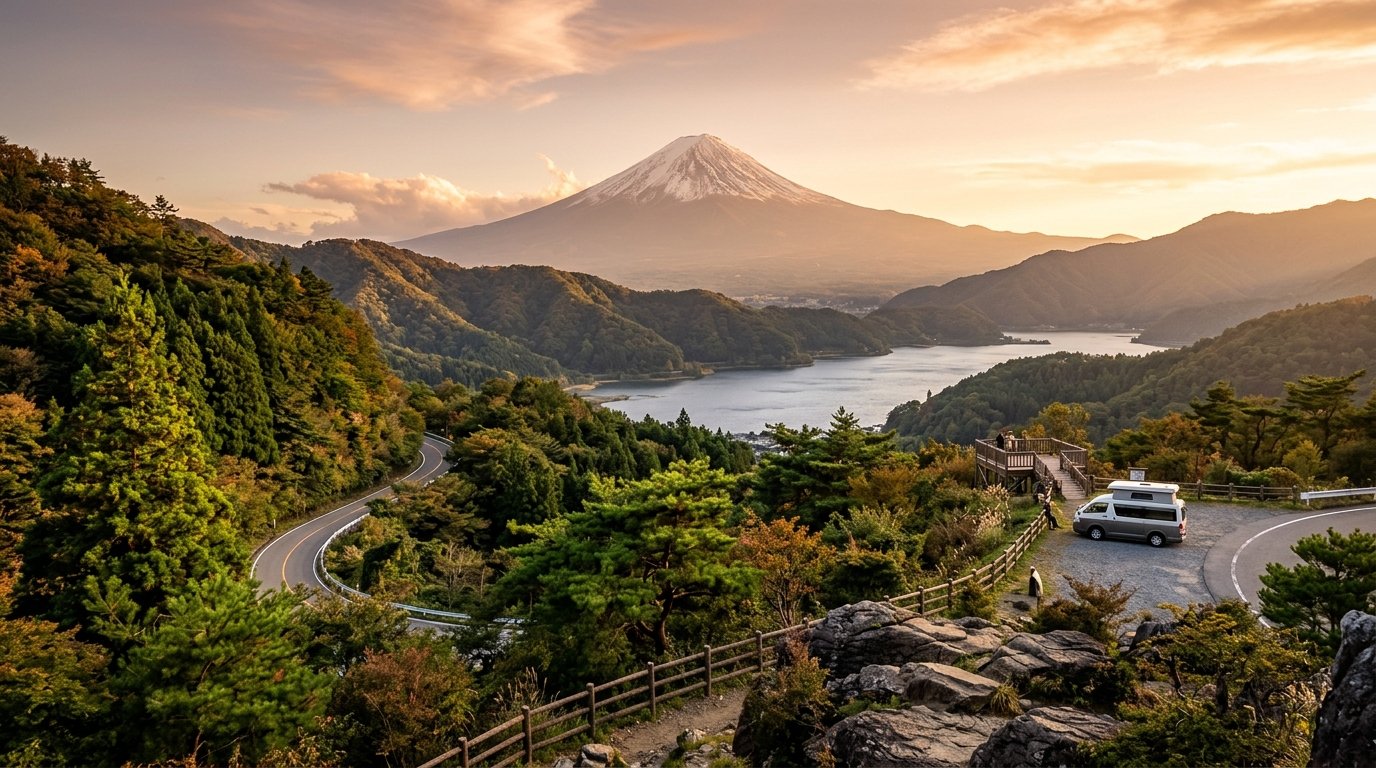
- Is it legal to sleep overnight in a vehicle? Sleeping in your campervan or car (shachuhaku) is generally legal and widely practiced in Japan.
- Does local law distinguish between parking and camping? Japanese law strongly distinguishes between parking/resting and camping. At public rest areas, you are only allowed to sleep inside your vehicle. Setting up tents, awnings, camping chairs, or cooking outside your vehicle is strictly prohibited and highly frowned upon.
- Are there designated overnight areas?
- Michi-no-Eki (Roadside Stations): Japan has over 1,200 of these incredible facilities offering 24/7 free parking and restrooms. Overnight resting is widely tolerated, though a small handful explicitly ban it. You must stay quiet, limit your stay to one night, avoid idling your engine, and keep all activities inside your van.
- RV Parks (Auto-campgrounds): For a small fee, these provide power hookups, waste disposal, and allow outside cooking.
- SA/PA (Service Areas / Parking Areas): Located on toll expressways, these are strictly for resting to prevent fatigue. You can sleep in your car, but it is not a destination for multi-night camping.
5. 🔥 Campfires & Practical Restrictions
- Are open campfires allowed? Open ground fires (jikabi) are universally banned in Japan’s wild spaces and National Parks. Even at designated campsites, lighting a fire directly on the ground is almost never allowed. You must use a raised fire pit (takibidai) or fire pan. Many hikers use small gas stoves for cooking, which is permitted on trails, but fire danger is taken very seriously.
- Key no-camp zones: Avoid setting up anywhere near shrines, temples, cemeteries, private agricultural fields, and military installations. Additionally, setting up a tent in urban parks or near residential neighborhoods will quickly draw complaints and police attention.
6. 🔗 Official Sources & Links
To verify information, book campsites, and check park alerts, please refer to the following official resources:
- Japan National Tourism Organization (JNTO) – Official Camping Guide
- Ministry of the Environment – National Parks of Japan
Disclaimer: Land-use laws, national park regulations, and local attitudes toward tourism can change rapidly. This guide provides a general overview for recreational travelers, but you should always verify the latest rules with local authorities, park rangers, or official tourism boards before your trip.

Adrenaline junkie with a passion for exploring off-the-beaten-path destinations and finding unique ways to stay active. Expect stunning scenery, challenging workouts, awesome travel tips and a whole lot of fun. Let’s get sweaty and explore the world together!