
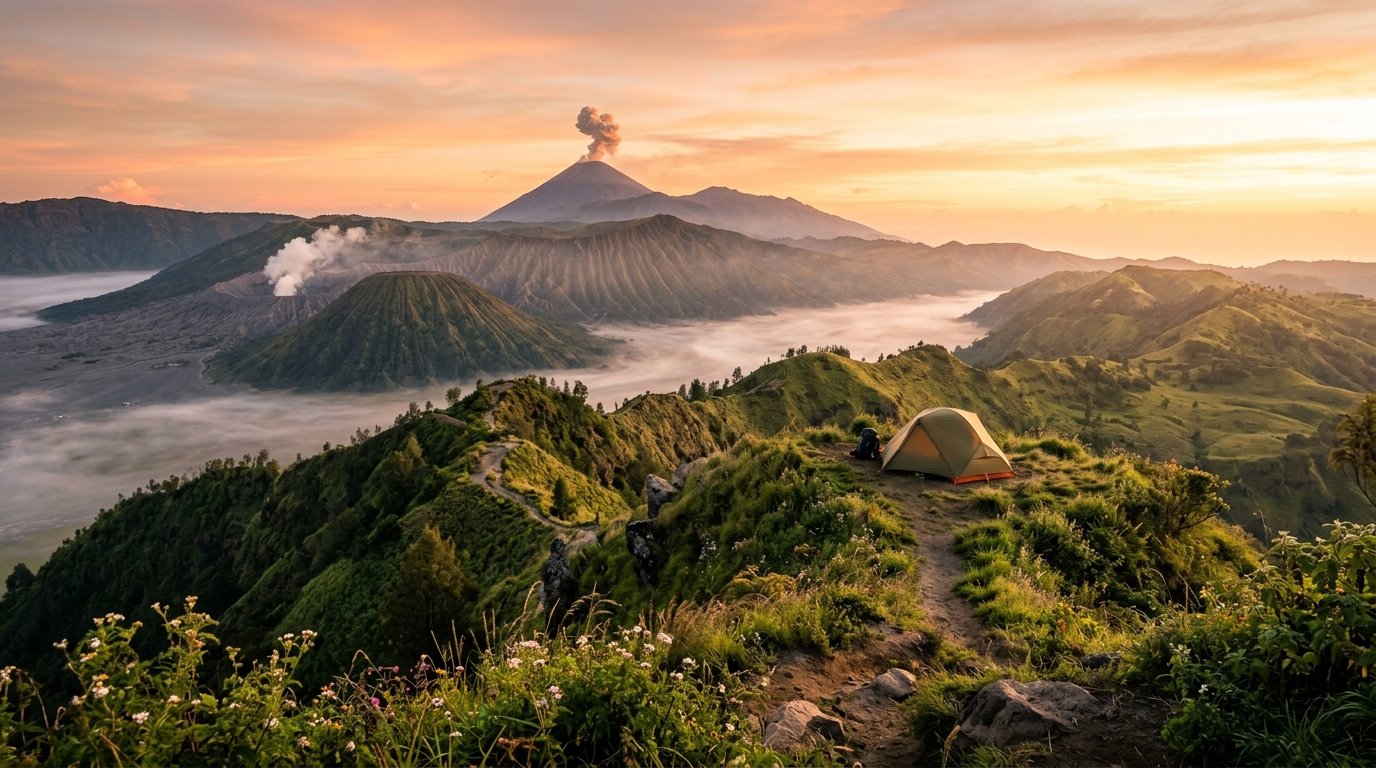
1. 🏕️ The Short Answer
Wild camping and van life in Indonesia exist in a legal grey area but are highly impractical and culturally uncommon for foreign tourists. While there is no explicit national law banning you from pitching a tent in the wild, the dense population, complex local land rights, and harsh tropical terrain mean true wild camping is rarely feasible. Tourists are strongly advised to stick to official national park campsites (which require permits) or to ask a local village head for permission to camp on their land.
2. 🌲 Wild & Dispersed Camping Rules
- Legality on Public Land: True “public land” as understood in Western countries does not strictly exist here. Land is usually either protected by the Ministry of Environment and Forestry, or falls under local indigenous and village (Adat) jurisdiction. While dispersed camping is not codified as a crime, pitching a tent without permission is heavily frowned upon.
- Duration and Distance Rules: Because wild camping is not a recognized or formalized recreational activity in Indonesia, there are no statutory distance or duration limits. Any camping outside of commercial sites is entirely a matter of local negotiation rather than written law.
- Enforcement: You are highly unlikely to be ticketed by police for wild camping. Instead, you will almost certainly be approached by curious locals or the village chief (Kepala Desa). The standard etiquette is to ask a rural homestead or village leader for permission to set up your tent. More often than not, locals will be hospitable and may even insist you sleep inside their home for safety.
3. 🏞️ National Park & Protected Area Rules
- Permits: Indonesia’s national parks (such as Mount Rinjani, Bromo Tengger Semeru, and Komodo) are strictly regulated. Foreign tourists must pay entry fees and obtain specific trekking and camping permits.
- Designated Sites Only: In protected areas, wild camping is strictly forbidden. You must camp only at designated sites or official rest posts (Pos). Furthermore, many national parks mandate that foreign tourists hire registered local guides and porters for overnight treks.
- Seasonal Closures: Closures are frequent and aggressively enforced. Parks often close during the wet monsoon season (typically January to March) due to dangerous landslides, and trails can be shut down with zero notice due to active volcanic activity or forest fire risks.
4. 🚐 Van Life & Overnight Vehicle Sleeping
- Sleeping in Vehicles: There is no federal traffic law that makes sleeping in a parked vehicle overnight explicitly illegal in Indonesia. However, Western-style “van life” is virtually non-existent due to heavy traffic, narrow roads, and steep, rugged terrain.
- Parking vs. Camping: The law does not draw a hard distinction because recreational RV camping is so rare. Pulling over on the side of a busy road to sleep is largely viewed as a safety hazard rather than a camping violation.
- Designated Areas: There is no established network of RV parks, free campsites, or “aires”. Overlanders traversing islands like Java or Sumatra typically rely on large 24-hour gas stations (SPBU), toll road rest areas, or paying a small fee to park securely in the lot of a local guesthouse.
5. 🔥 Campfires & Practical Restrictions
- Campfire Rules: Open campfires are heavily restricted and closely monitored. Inside national parks, fires are strictly banned outside of official, designated fire rings to prevent devastating dry-season forest fires. In rural areas, you should never light a fire unless you have explicit permission from the landowner.
- No-Camp Zones: Tourists should completely avoid attempting to camp near military zones, sensitive border regions (such as parts of Papua and Kalimantan), or highly conservative regions (like Aceh, which operates under Sharia law). Setting up an unauthorized camp in these areas as a foreigner can attract severe suspicion from authorities.
6. 🔗 Official Sources & Links
Because local regulations and park access change frequently due to weather and volcanic activity, always verify requirements with official sources before your trip:
Disclaimer: Land-use laws, national park regulations, and entry requirements in Indonesia change frequently. The information in this guide is for educational purposes and should be verified with local Indonesian authorities, your hired guide, or the specific National Park office prior to your trip.

Adrenaline junkie with a passion for exploring off-the-beaten-path destinations and finding unique ways to stay active. Expect stunning scenery, challenging workouts, awesome travel tips and a whole lot of fun. Let’s get sweaty and explore the world together!