
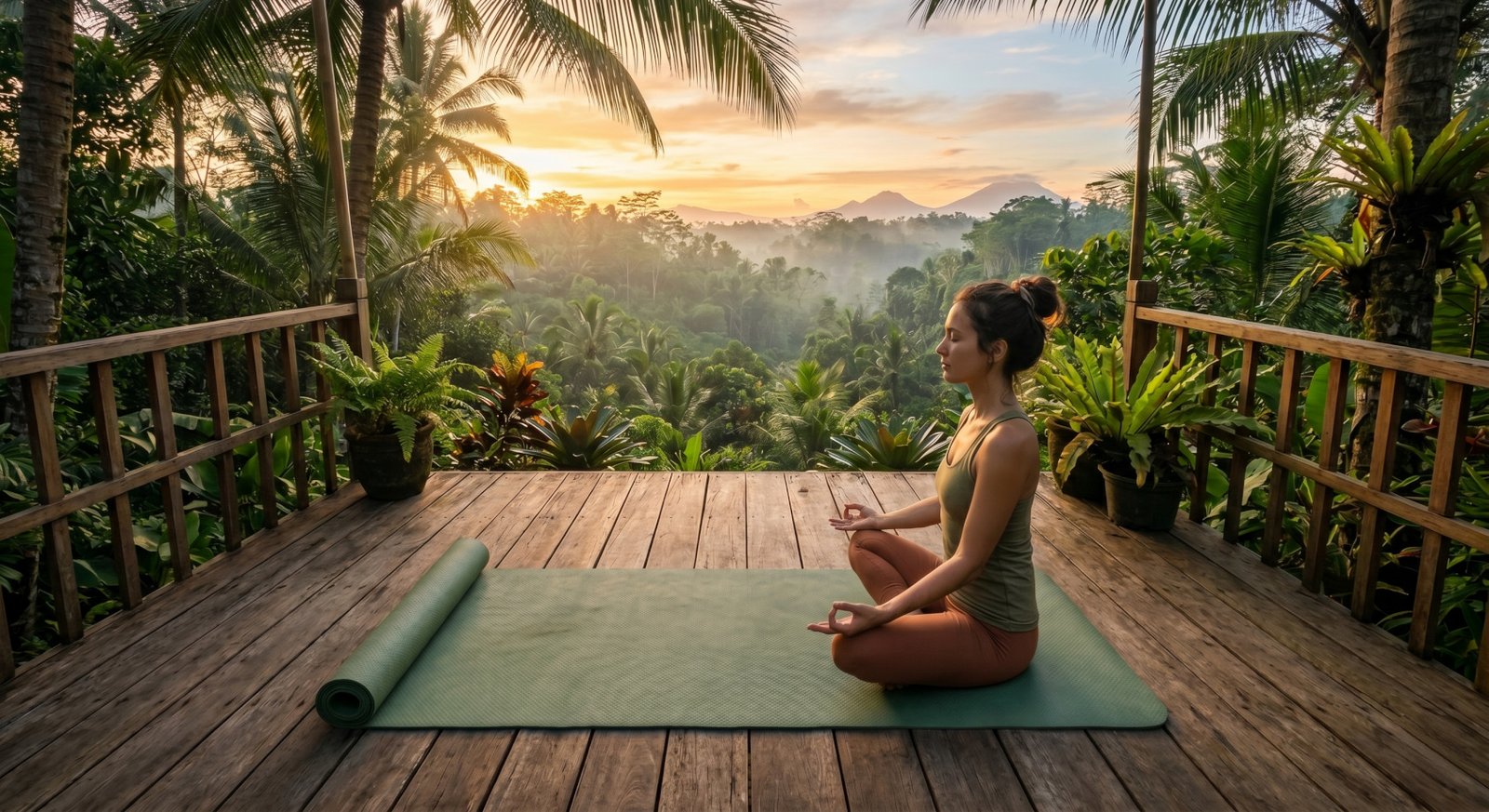
A week away feels good. A month changes things.
You've probably taken a yoga class after a stressful week and felt the difference it made. Now imagine that feeling — but stretched across 30 days. No laptop pings, no commute, no "I'll get back to that later." Just you, a mat, and a structured program designed to actually shift something.
A month long yoga retreat is not a vacation. It's a full reset — and for the right person at the right time, it's one of the most useful things you can do for your health. This guide covers everything: the different types of retreats, where to go, how much it costs, what a typical day looks like, and how to choose the right one for what you actually need.
The 4 Main Types of Month Long Yoga Retreats
Not all 30-day retreats are the same. The category you choose shapes every single day — from how early you wake up to what you eat to whether you're allowed to talk. Here's how they break down.
Which type is right for you? If you want a skill and a structure, go with YTT. If your nervous system is fried, consider silent meditation or Ayurveda. If you have a specific health goal and budget to match, the medical wellness route gives you data, supervision, and measurable results.
There's also a newer category gaining ground: retreats that blend yoga with plant medicine ceremonies (like Ayahuasca), primarily in Peru, Costa Rica, and parts of Europe where it's legally permitted. These are intensive, require careful vetting, and are not something to book casually — but they exist and are growing quickly.
Best Destinations for a Month Long Yoga Retreat
Where you go changes everything — the cost, the teaching style, the food, the general vibe. Here's a clear breakdown of the main regions and what they offer.
| Destination | Vibe | Best For | Monthly Budget Range |
|---|---|---|---|
| India Rishikesh, Mysore, Goa, Kerala |
Traditional | Authentic lineage, philosophy-heavy YTT, Ayurveda, ashram living | $350–$2,500 |
| Bali, Indonesia Ubud, Canggu |
Eco-Luxury | YTT, diverse yoga styles, digital nomads, community feel | $1,200–$4,500 |
| Thailand Koh Samui, Koh Phangan |
Eco-Luxury | Medical detox programs, Ashtanga, dynamic fitness-meets-yoga | $1,500–$31,000+ |
| Costa Rica Osa Peninsula, Nicoya |
Adventure | YTT with nature immersion, surf and yoga combos, eco retreats | $2,500–$6,000 |
| Sri Lanka | Traditional | Panchakarma Ayurveda, restorative yoga, deep detox | $1,800–$7,000 |
| Mexico Mazunte, Tulum |
Contemplative | Silent meditation, spiritual immersions, non-dual philosophy | $1,500–$4,000 |
| Europe Portugal, Spain, Austria |
Boutique | Biohacking + yoga combos, small group retreats, clinical wellness | $3,000–$15,000 |
India: The Original
Rishikesh is called the "Yoga Capital of the World" for good reason. Ashrams here have been running for decades. You live simply — shared rooms, vegetarian meals, early mornings — and that austerity is the point. The focus is pure: philosophy, practice, tradition. It's the cheapest option globally, and for many practitioners, the most profound.
Bali: The Global Favorite
Ubud and Canggu have become the default choice for many Western practitioners. Places like the Yoga Barn offer a huge variety of classes daily, organic food, and enough variety to keep a month feeling fresh. The community of like-minded people you'll meet here is often cited as one of the biggest highlights.
Costa Rica: Nature as Medicine
The "Pura Vida" approach to wellness means yoga gets woven into everything — surfing, jungle hikes, waterfall swims. Centers like Blue Osa on the remote Osa Peninsula offer 28-day teacher training programs that also function as genuine outdoor adventures. Costa Rica sits in the Nicoya Peninsula Blue Zone, one of the world's regions with the highest rates of longevity. That context matters.
What a Typical Day Looks Like
This is what many people want to know most. A month long retreat isn't a lazy schedule — most programs are deliberately full. Here's what a day in a 200-hour YTT or contemplative retreat typically looks like.
Heads up: That schedule is 14–16 hours of engagement daily. It sounds brutal on paper, and the first week often is. But most participants report that after day 10 or so, the rhythm starts feeling natural — even energizing. Your nervous system adjusts.
Silent meditation retreats run differently — more hours of seated practice, less movement, almost no socializing. A program like the 30-Day Alchemy of Being at Hridaya Yoga in Mazunte, Mexico, structures the day around multiple long meditation blocks, personal yoga practice, self-study, and rest. The goal is psychological depth rather than physical transformation.
How Much Does a Month Long Yoga Retreat Cost?
The range is enormous — from under $500 a month at an Indian ashram to over $30,000 at a luxury medical resort in Thailand. Here's an honest breakdown so you can plan realistically.
Mid-range YTT programs — by far the most common choice — typically include accommodation, three meals a day, all course materials, and certification. Blue Osa in Costa Rica, for example, argues that their 28-day 300-hour program (priced around $4,490–$5,990) works out cheaper than buying each element separately — because when you price 28 nights of accommodation, 84 organic meals, full certification tuition, daily spa access, and lifetime mentorship individually, the total easily exceeds $12,000.
At the top of the market, luxury medical wellness programs at places like Absolute Sanctuary in Koh Samui can run between $13,500 and $31,000 for a single person for 30 days. That covers 24/7 clinical supervision, advanced body composition analysis, daily specialized treatments, and a fully personalized nutrition protocol. It's a different category entirely.
What's usually included: Accommodation, daily yoga or meditation sessions, three meals a day, training materials (for YTTs).
What's often extra: Flights, travel insurance, airport transfers, personal massages or spa add-ons, off-site excursions, tips for staff, and personal spending money. Always confirm exactly what's included before you book.
One option more people are using now: if you work remotely, some Bali retreat centers let you stay for a full month on an "unlimited yoga" package while you continue working. You attend morning and evening classes, eat organic meals, and maintain your income. It's a legitimate way to fund your healing time.
Who Is a Month Long Retreat Actually Right For?
Being honest here is more useful than being encouraging. A 30-day retreat is genuinely not for everyone. But for certain people and situations, it's hard to think of anything more valuable.
It tends to work well if you are...
Experiencing serious burnout. A week off doesn't shift the physiological patterns behind chronic stress. A month with a structured daily routine — early sleep, whole food, no decision fatigue, consistent movement — can genuinely reset the baseline.
In a major life transition. Job change, relationship ending, loss, identity shift — extended retreats create the time and space for that processing to actually happen, rather than just being deferred again.
Wanting to get serious about yoga. A YTT isn't just for teachers. The fastest way to deeply understand a practice is full immersion — 30 days of twice-daily practice with expert instruction will do more than three years of weekly classes.
Working remotely or on sabbatical. If you have flexibility in how and where you work, embedding yourself in a retreat environment while staying partially employed is increasingly feasible.
Worth being upfront about: If you're dealing with significant mental health challenges, talk to your doctor before booking anything, especially a silent retreat. Extended silence is powerful — but it's not a substitute for professional care, and for some conditions it's not the right fit. Good retreat centers will ask about your mental health history as part of enrollment.
How to Choose the Right Month Long Retreat
With hundreds of options globally, narrowing it down can feel overwhelming. These questions cut through the noise.
1. What is your single most honest goal?
Write it down. "Get healthier" is too vague. "Address my chronic lower back pain" is a goal. "Stop feeling disconnected from my body" is a goal. "Get a yoga certification I can teach from" is a goal. Your answer determines the category of retreat before you look at a single center.
2. What is your actual budget — including flights?
Add flights, insurance, and $200–$300 in personal spending money to whatever the retreat costs. That's your real number. Don't commit until you've done that math.
3. What level of comfort do you need to function well?
Some people thrive in spartan ashram conditions — shared bathrooms, simple food, basic beds. Others genuinely don't, and that's fine. Be honest with yourself before you book a 30-day ashram stay for the savings. A retreat you leave early costs more than one that costs a bit more to begin with.
4. Check instructor credentials before anything else
For YTTs, look for Yoga Alliance registered schools and confirm instructors hold recognized certifications. The top-rated schools — like Soma Yoga Institute (4.89/5 on Yoga Alliance, led by certified yoga therapists) or Yoga Farm Ithaca (4.89/5 with 1,100+ reviews) — have those credentials publicly listed and verifiable.
5. Read reviews that mention the hard parts
Any review that says only positive things is probably edited or curated. Look for reviews that mention what was difficult, what surprised the person, what they'd do differently. Those are the ones that give you an accurate picture of what you're signing up for.
What to Pack for a Month Long Yoga Retreat
Less than you think. Most retreat centers have laundry facilities, and the lifestyle is deliberately simple. Here's what actually matters.
What to leave behind: your laptop (unless you're working remotely), more than two pairs of "going out" clothes, and any expectation that it will feel like a holiday. It won't — it'll be better than that, but it'll also be harder.
Common Questions About Month Long Yoga Retreats
For most contemplative and wellness retreats, no. They're designed for all levels. For a 200-hour YTT, you need some existing practice — typically at least six months of regular yoga — but you don't need to be advanced. For 300-hour advanced training, you'll need the 200-hour already completed. Always check the specific requirements when you inquire.
It depends entirely on the retreat type. YTTs generally allow phones during free time. Silent meditation retreats often require you to hand devices in on arrival. Most centers are moving toward very limited screen time as a deliberate part of the program — and most alumni say that's one of the things they appreciated most in hindsight.
Yes — solo travel to retreats is incredibly common and most centers are specifically set up for it. You'll meet your cohort on day one and build close bonds fast. Many people who attend solo describe it as one of the most socially rich experiences of their lives, precisely because everyone there is going through something meaningful at the same time.
Check the cancellation and early departure policy before booking. Most centers have different refund policies depending on how far in advance you cancel. For genuine emergencies, centers are generally human about it — but read the fine print, and make sure your travel insurance covers trip interruption.
Very. Multiple daily practice sessions, long study hours, and the emotional intensity of deep immersion all compound each other. Most programs recommend arriving in reasonable physical condition and building your practice in the months before. The first week is typically the hardest. Your body adapts, but don't underestimate the demand — it's one of the reasons results are so significant.
For YTTs, check Yoga Alliance registration directly on their website — don't just take the school's word for it. For wellness retreats, look for verifiable instructor credentials, transparent pricing, and reviews on independent platforms like BookRetreats or BookYogaRetreats. If a retreat can't clearly tell you who the teachers are and what their qualifications are, that's a red flag.
The Bottom Line
A month long yoga retreat is a real investment — in time, money, and energy. It's also one of the few things that tends to deliver what it promises, when you choose the right type for your actual goals and go in with realistic expectations.
Traditional ashrams in India offer the deepest and most affordable experience, especially for those serious about yoga philosophy. Southeast Asia — particularly Bali and Thailand — gives you the widest range of styles and comfort levels. Costa Rica brings in nature and adventure. And the luxury medical retreats in Thailand or Europe are genuinely transformative for people with specific health goals and the budget to match.
The most common thing people say after a month long retreat is: "I wish I had done this sooner." The second most common is: "The first week was so much harder than I expected." Both things can be true at once. Plan well, choose carefully, and then go.

Adrenaline junkie with a passion for exploring off-the-beaten-path destinations and finding unique ways to stay active. Expect stunning scenery, challenging workouts, awesome travel tips and a whole lot of fun. Let’s get sweaty and explore the world together!