
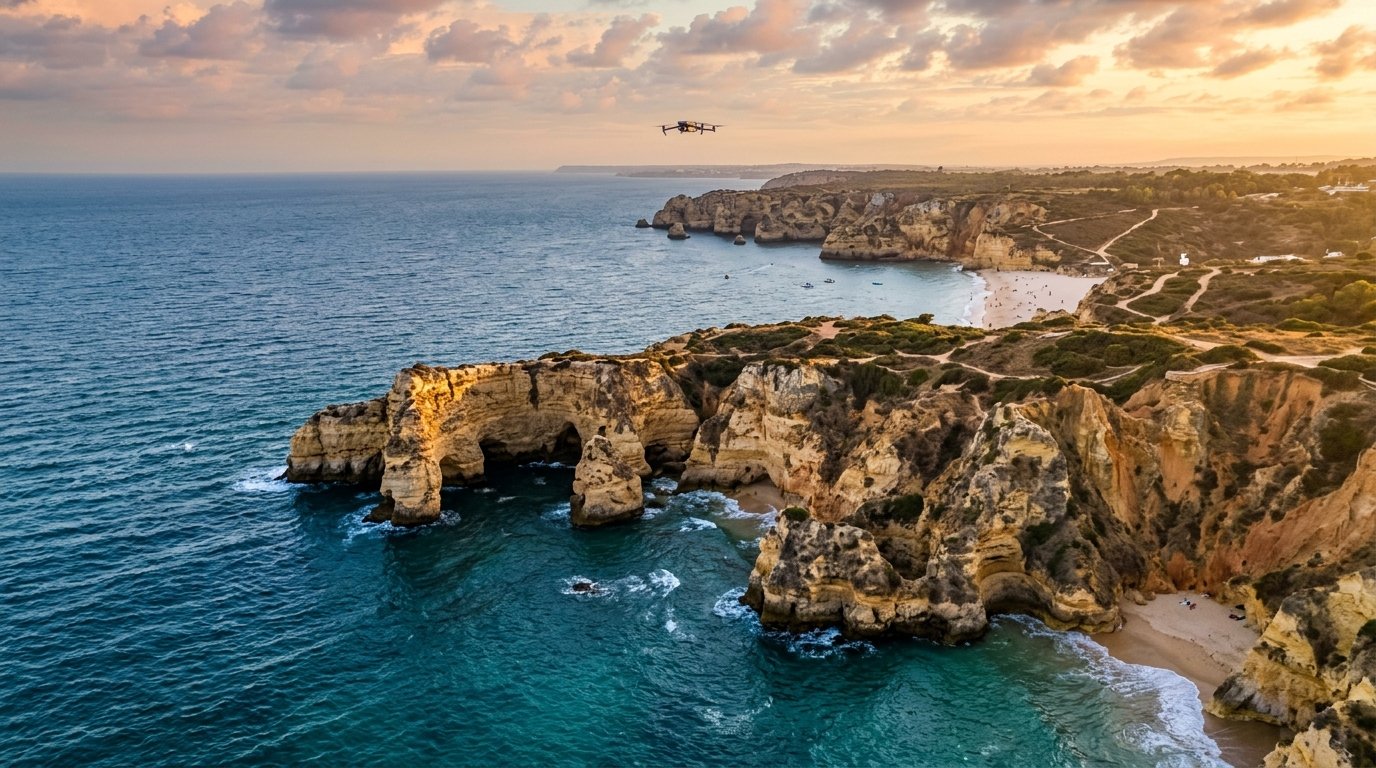
1. 🚦 The Short Answer
Recreational drones are legally allowed in Portugal, but tourists face strict administrative hurdles. While general flying is governed by standard European Union (EASA) rules, capturing any aerial photos or videos requires mandatory, pre-approved clearance from the Portuguese military.
2. 🛃 Customs & Importation Rules
- Airport Customs: Foreign tourists can legally bring recreational drones into Portugal without special customs paperwork.
- Declarations: No specific border declarations are needed for standard, personal-use drones.
- Confiscation Risk: Customs will not confiscate your drone upon arrival just because you lack a flight permit. However, standard airline safety rules apply, meaning all lithium drone batteries must be packed securely in your carry-on luggage.
3. 📝 Registration & Permit Process for Tourists
- Step 1: EASA Registration: Non-EU tourists must register as a Drone Operator via Portugal’s Civil Aviation Authority (ANAC) before flying. If you are an EU resident or already hold a valid operator ID from another EU country, your home registration is legally recognized in Portugal.
- Step 2: Photography Permit (AAN): To legally use your drone’s camera, you must register on the Autoridade Aeronáutica Nacional (e-AAN) portal. You must upload a signed declaration, map out your intended flight areas, and request authorization for specific dates.
- Cost and Time: Both the ANAC registration and the AAN permit are free. However, the e-AAN approval process can be frustrating and slow. Tourists should submit their flight requests at least 2 to 3 weeks before arriving.
4. 🚫 Key Flight Rules & Restrictions
- Operational Limits: You must keep the drone within your Visual Line of Sight (VLOS) at all times and never exceed a maximum altitude of 120 meters (400 feet). Never fly directly over crowds of people.
- Sub-250g Drones (e.g., DJI Mini): Micro-drones under 250g do not require you to take a pilot competency exam. However, because they are equipped with cameras, operator registration and AAN photography permits are still strictly required.
- Heavier Drones: Drones weighing over 250g require the pilot to hold a valid EASA A1/A3 certificate of competency.
- No-Fly Zones: Flights are completely banned near airports, heliports, and military bases. Furthermore, flying in National Parks requires a separate environmental permit from the forestry department (ICNF), and flying over public beaches or coastlines often requires National Maritime Authority (AMN) approval.
5. 🔗 Official Sources & Links
Travelers should submit applications and verify all airspace maps directly through these official Portuguese portals:
Disclaimer: Aviation regulations change frequently. Travelers must double-check current laws and local geographical flight zones using official local resources before flying to avoid fines or confiscation by local police.
Adrenaline junkie with a passion for exploring off-the-beaten-path destinations and finding unique ways to stay active. Expect stunning scenery, challenging workouts, awesome travel tips and a whole lot of fun. Let’s get sweaty and explore the world together!