
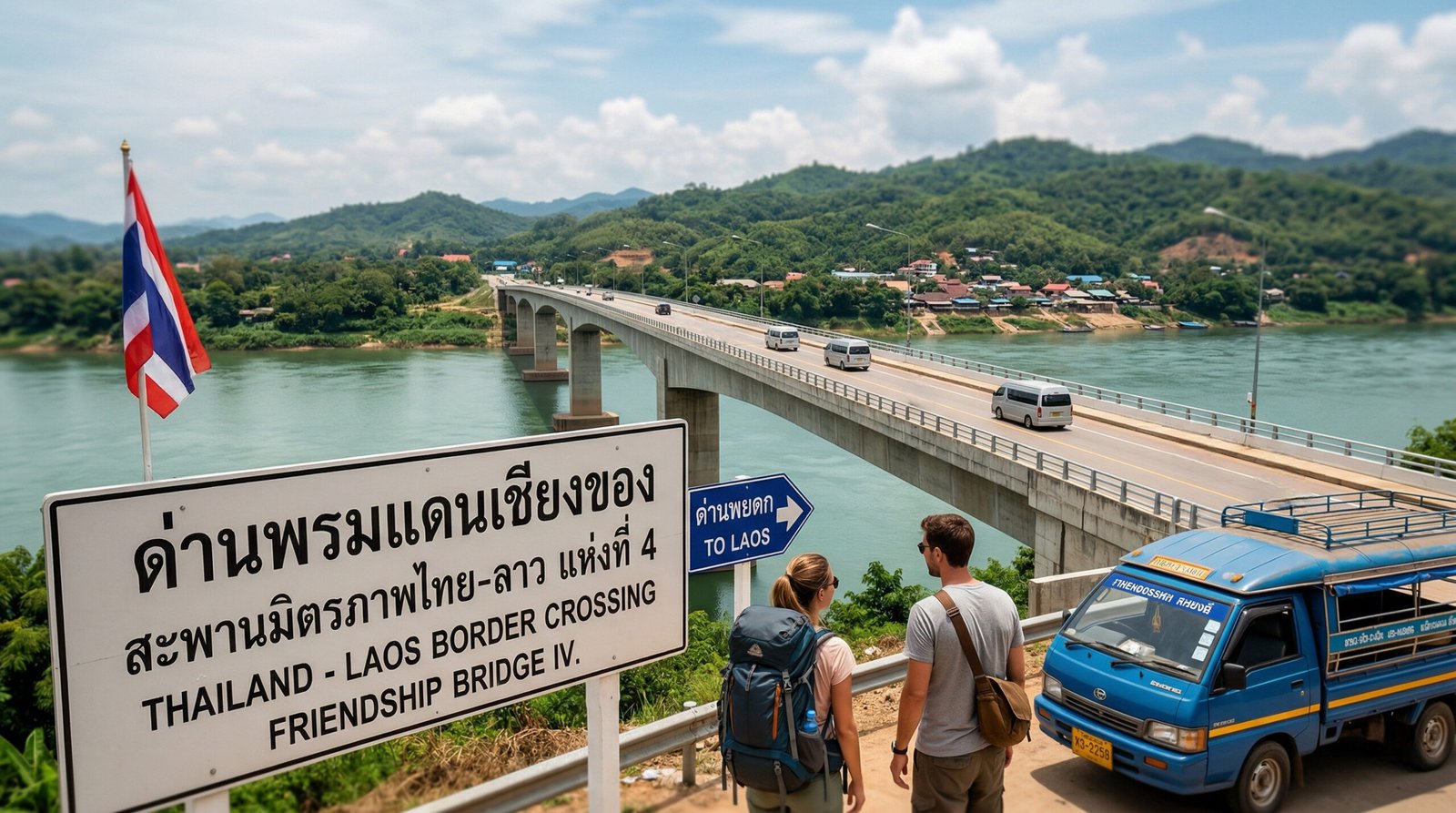
If you are planning to take the famous slow boat to Luang Prabang or go on a Gibbon Experience or just need to do a Thai visa run, you will likely pass through the Fourth Thai-Lao Friendship Bridge. This bridge crosses the Mekong River, connecting Chiang Khong in northern Thailand to Huay Xai in Laos.
Getting across this border involves a few steps, mandatory bus rides, and some very strict rules about the cash you bring. This guide breaks down exactly how to get there, what it costs, and how to avoid common traps.
How to Get to the Border from Chiang Mai
Chiang Mai is about 272 to 280 kilometers from the border. The drive goes through winding mountain roads, and you have a few ways to make the trip depending on your budget.
The GreenBus (Public Transit)
GreenBus is the main company running large buses from Chiang Mai’s Arcade Bus Station (Terminal 3) to the Chiang Khong local station.
VIP Class: This is the best choice for the 6-hour ride. The bus only has 33 seats arranged in a 1-2 layout, giving you plenty of legroom. Tickets cost 550 THB. You get air conditioning, snacks, water, USB charging, and a toilet on board. Tip: Try to book seats 2A or 2B for the smoothest ride, and avoid Row 1 because there is no space to stretch your legs. The bus usually leaves at 8:30 AM.
Express Class: This is a standard bus with 40 seats in a 2-2 layout. It costs between 380 and 434 THB. It does not always have a toilet, which means extra stops and a longer trip (almost 7 hours). These leave around 8:30 AM and 9:30 AM.
Note: The GreenBus drops you in Chiang Khong town. From there, you need to pay 50 to 100 THB for a tuk-tuk to drive you the last few kilometers to the actual border checkpoint.
Shared Minivans and Private Rides
If you want to skip the bus station, many travel agencies offer minivans that pick you up right at your hotel.
Shared Minivans: These cost 899 to 1,050 THB. They pick you up between 6:30 AM and 9:30 AM. They usually include a quick stop at the White Temple in Chiang Rai and drop you directly at the border crossing by 3:00 PM.
Private Taxis and Vans: You can hire a standard SUV for 3,100 to 3,800 THB. For a luxury van, expect to pay around 7,500 to 7,800 THB.
Chiang Mai to Border Transport Options
Transport Mode | Operator | Departure Time | Time it Takes | Cost | Drop-off Location |
|---|---|---|---|---|---|
Public Bus – VIP | GreenBus | 08:30 AM | 5h 40m | 550 THB | Chiang Khong Town |
Public Bus – Express | GreenBus | 08:30, 09:30 AM | ~7 hours | 380 – 434 THB | Chiang Khong Town |
Shared Minivan | Local Agencies | 06:30 – 09:30 AM | 5 – 6 hours | 899 – 1,050 THB | Directly at Border |
Private SUV | Independent | On Demand | 4.5 – 5 hours | 3,100 – 3,800 THB | Directly at Border |
Luxury Van | Private Firms | On Demand | 5 hours | 7,500 – 7,800 THB | Directly at Border |
How to Get to the Border from Chiang Rai
Chiang Rai is much closer to the border, sitting just 100 kilometers away. The trip is faster but relies on older transport networks.
The Local Red Bus
The most popular way to get there is the non-air-conditioned “red bus” from Chiang Rai Bus Terminal 1. They leave every 30 to 60 minutes starting at 6:00 AM. The trip takes about 2 to 2.5 hours because the bus stops constantly to pick up people and packages.
The Red Bus Pricing Trick: The standard fare to Chiang Khong town is 65 to 90 THB. But if you tell the ticket collector you want to go to the border, they will drop you at the highway junction before town and charge you 140 THB. This sounds like a rip-off, but it actually saves you time. From that junction, waiting tuk-tuks will take you straight to immigration for 50 THB. If you ride all the way into town for the cheaper fare, you will have to pay a 150 THB tuk-tuk fare to drive all the way back to the border.
Chiang Rai to Border Transport Options
Transport Mode | Departure Frequency | Time it Takes | Cost | Drop-off Location |
|---|---|---|---|---|
Local Red Bus (to town) | Every 30-60 mins | 2.5 hours | 65 – 90 THB | Chiang Khong Town |
Local Red Bus (to border) | Every 30-60 mins | 2 hours | 140 THB | Highway Junction |
Shared Minivan | Scheduled AM/PM | 2 – 3 hours | 500 – 700 THB | Directly at Border |
Private Taxi | On Demand | 1.5 hours | 1,100 – 1,500 THB | Directly at Border |
The Step-by-Step Border Crossing Process
Once you arrive at the giant Thai immigration building, the real process begins.
Phase 1: Exiting Thailand
Walk inside and hand the officer your passport. Your passport needs at least six months of validity and two to four blank pages left. If you have a paper departure card (TM6), hand that over too.
Leaving Thailand is free. However, if you have stayed past your visa date, you will have to pay an overstay fine of 500 THB per day in cash before they stamp you out.
Driving across? You need your original vehicle registration (the Green Book), copies of your passport and car pages. Thailand and Laos only allow motorcycles with engines 250cc or larger to cross. Small scooters are not allowed.
Phase 2: The Mandatory Bridge Shuttle
You are not allowed to walk or ride a bicycle across the 2.48-kilometer bridge. Everyone must buy a ticket for the official shuttle bus to cross the “no man’s land” over the Mekong River.
Standard Fare: 20 THB.
Weekend/Overtime Fare: 25 THB on weekends, holidays, before 8:00 AM, and after 4:00 PM.
Night Fare: Sometimes 40 THB after 6:00 PM.
Luggage: Drivers sometimes ask for an extra 25 THB if you have a massive backpack.
The bus does not run on a schedule. It only leaves when the driver decides it is full enough, which can take 15 to 30 minutes.
Phase 3: Entering Laos (And the Pristine Cash Rule)
When you get off the bus on the Laos side (Huay Xai), head to the immigration windows.
If you are from an ASEAN country or hold a passport from Japan, South Korea, Russia, Switzerland, and a few others, entry is free. You just fill out an arrival card.
For most Western tourists (US, UK, EU, Canada, Australia), you need a visa.
e-Visa: You can apply online three days before for $50 USD. It saves time at the window.
Visa on Arrival (VoA): You can buy your visa right there at the window. The standard price is a flat $40 USD.
The Pristine Cash Warning: The Laos border guards are incredibly strict about US dollar bills. Your $40 must be in absolutely perfect condition. If the bills have tears, ink marks, folds, or a crease down the middle, the guards will reject them.
If your dollars are rejected, the guards will force you to pay in Thai Baht at a terrible exchange rate. They will charge you 1,500 to 2,000 THB. Based on normal exchange rates, 2,000 THB is about $55 to $60 USD. You lose a lot of money just because your bill had a fold in it. Bring perfect US dollars from a bank in Chiang Mai or Chiang Rai before you leave.
Other small fees you might face at the Laos window:
No Photo Fee: 40 to 80 THB if you forget to bring a physical passport photo.
Overtime Fee: $1 USD or 40 THB if you arrive on a weekend, holiday, or outside regular 8:00 AM to 4:00 PM hours.
Bring a pen with you to fill out the forms so you don’t have to wait to borrow one.
The Final Entry Fee: Just before you walk out of the border post on the Laos side, there is one last counter. You must pay a small entry fee here. It usually costs 40 THB or 10,000 LAK. After you pay, they give you a little paper ticket, and you are finally free to leave the building.
Getting into Huay Xai Town
The Laos border complex is a few kilometers outside of town. You will find a group of tuk-tuks waiting. They charge exactly 100 THB per person to go to the slow boat pier or town center. They strongly prefer Thai Baht over their own currency (Lao Kip). Like the bridge shuttle, they wait until the truck is totally full before leaving. If you are rushing to catch the morning slow boat (which costs about 400,000 LAK), you can pay 100,000 LAK to charter the whole truck to leave immediately.
Doing a Visa Run? Read This First
For years, people living in Thailand used this bridge for “border runs.” They would cross into Laos, turn right around, and come back to Thailand the same day to get a fresh visa stamp.
This is no longer allowed. As of late 2024, if you cross this border, you must stay at least two nights in Laos before returning to Thailand.
If you book a border run van from Chiang Mai, it now takes three days. You leave Monday morning, find your own hotel in Huay Xai for Monday and Tuesday night, and the van picks you up on Wednesday afternoon to take you back to Chiang Mai. The van transport costs about 2,200 THB. You need to bring another 2,000 to 2,400 THB to cover the Laos visa, shuttle buses, food, and your hotel.
When you return, Thai immigration might ask to see an outward flight ticket, your Thai address registration (TM30), and physical proof that you have 10,000 THB in cash on you. You can generally only do this overland border run twice a year.
Where to Park Your Car or Motorbike in Chiang Khong
Since taking a Thai vehicle into Laos requires a lot of paperwork, almost everyone leaves their car or bike on the Thai side.
Public Border Lot: There is free parking right in front of the Thai immigration building. It is open to the sky, and leaving your car here for a few days is absolutely fine. Many travelers leave vehicles here for up to five days with no issues. It is very convenient because you park right next to the crossing. Just drive Past the first Border gate and there will be a smaller car park on the left and larger one with some covered parking on the right.
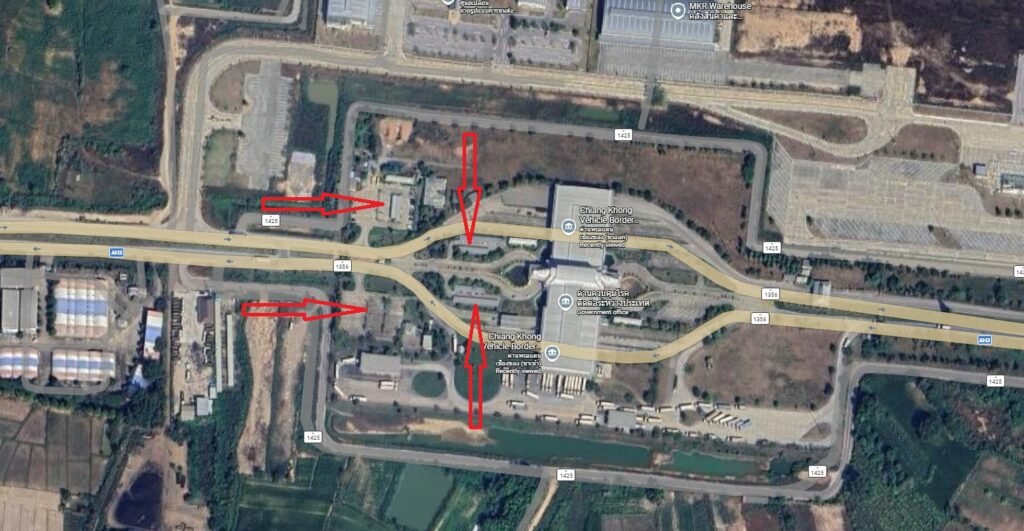
Nearby Hotels: A great second choice is to contact hotels around the border. Many will let you park your car on their property while you visit Laos. They might charge you a small fee, but it gives you a safe spot to leave your vehicle.
Other Companies (Check First): You might read online about companies like AA Inter Tour and Expat Auto CM offering parking. Based on recent trips, it is highly likely they do not have facilities at this border anymore. Treat them as backup ideas only, and always call them before you go.
Parking Options Summary
Parking Location | Time Frame | Cost | Perks |
|---|---|---|---|
Public Border Lot | Short to Medium (Few Days) | Free | Very close to the entrance, fine for leaving your car for a few days. |
Nearby Hotels | Flexible | Small Fee | Secure parking on hotel grounds. |
AA Inter Tour / Expat Auto CM | Variable | Varies | Backup choices, but highly likely unavailable at this border. |
Crossing at Friendship Bridge IV takes some patience, but if you have pristine US dollars, small Thai Baht bills for the shuttles, and a solid plan for your transport, it is a very straightforward trip.

Adrenaline junkie with a passion for exploring off-the-beaten-path destinations and finding unique ways to stay active. Expect stunning scenery, challenging workouts, awesome travel tips and a whole lot of fun. Let’s get sweaty and explore the world together!