
FitcationHQ
  • Home
  • Travel Planning
  • Destinations
    • Africa
      • Egypt
      • Kenya
      • Morocco
      • Mozambique
      • Namibia
      • Rwanda
      • South Africa
      • Tanzania
    • Asia
      • Bhutan
      • Cambodia
      • China
      • Indonesia
      • Laos
      • Malaysia
      • Maldives
      • Nepal
      • Thailand
      • Turkmenistan
    • Europe
      • Bulgaria
      • Croatia
      • Georgia
      • Greece
      • Iceland
      • Ireland
      • Italy
      • Montenegro
      • Norway
      • Portugal
      • Scotland
      • Turkey
    • Middle East
      • Jordan
      • UAE
    • North America
      • Canada
      • USA
    • Oceania
      • New Zealand
    • South America
      • Argentina
      • Bolivia
      • Chile
      • Costa Rica
      • Ecuador
      • Peru
  • Travel Tips
    • Budget Travel
    • Family Travel
    • Food and Dining
    • Health and Wellness
    • Luxury Travel
    • Packing
    • Safety
    • Solo Travel
    • Transportation
    • Travel Insurance
    • Sustainable Travel
    • Visa and Immigration
  • Travel Gear
    • Luggage
    • Clothing
    • Photography Gear
    • Security Gear
    • Travel Accessories
    • Travel Electronics
FitcationHQ
The 10 Hottest Travel Accessories
Travel AccessoriesTravel Gear

The 10 Hottest Travel Accessories in 2025

by Travel Geek April 16, 2025
written by Travel Geek

Travel is roaring back, but the savvy globetrotter knows it’s not just about where you go, but how you get there. Forget frantic packing and airport chaos; today’s travel is about seamless journeys, optimized carry-ons, and arriving in style. The market is flooded with gadgets and gear promising smoother sailing, but which ones actually deliver? Cutting through the noise requires more than just scrolling – it demands data.

This isn’t just another list; it’s a data-driven deep dive into what’s genuinely trending right now. We’ve analyzed the digital breadcrumbs: scouring viral TikToks lighting up For You Pages , dissecting Amazon’s real-time Best Seller lists, New Releases, and Movers & Shakers across travel categories , consulting recent expert roundups from dedicated travel sites , and tracking search engine whispers.

The result? A definitive ranking of the 10 travel accessories demonstrating the strongest signals of current popularity, innovation, and problem-solving prowess. Get ready to upgrade your travel game – these are the pieces making waves and earning their place in the modern traveler’s arsenal.

Before we dive deep, here’s a quick snapshot of the accessories currently dominating the travel landscape:

Convertible Garment Duffel Bag
Compression Packing Cubes
Apple AirTag
Universal Travel Adapter (with USB-C)
Noise-Canceling Headphones
Portable Charger / Power Bank
Specialized Travel Pillow (Trtl style)
Collapsible Water Bottle
Travel-Sized Toiletry Bottles (Silicone)
Carry-On Luggage (with Front Pocket)

The Elite List: This Month’s Top 10 Travel Accessory Power Players

Now, let’s unpack why these 10 items are capturing the attention of travelers everywhere.
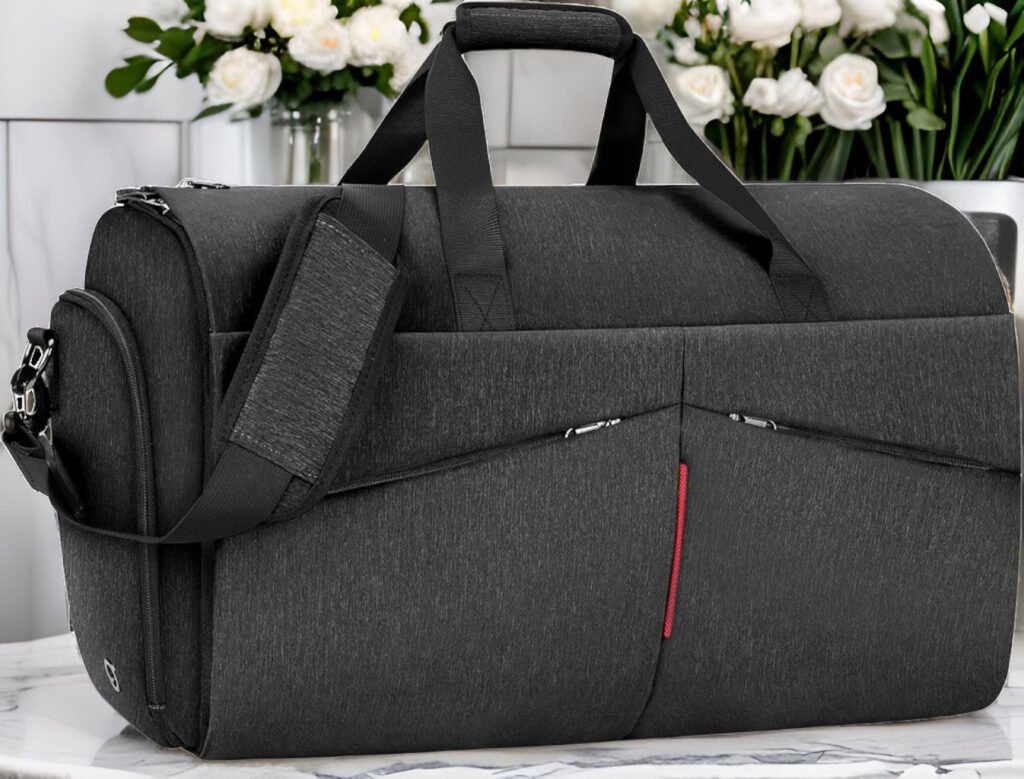
Convertible Garment Duffel Bag

Rank #1: Convertible Garment Duffel Bag 

  • The Buzz: If your TikTok feed hasn’t yet served you a mesmerizing video of a duffel bag magically unfurling into a garment bag, consider this your official heads-up. Brands like Emmafy and JenniBag have achieved viral status with millions of views and shares, showcasing the bag’s dual functionality. This isn’t just social media hype; these bags are selling rapidly on platforms like TikTok Shop and Amazon, with numerous brands like Dagne Dover, Modoker, and SEYFOCNIA entering the space. They tap into a universal travel frustration: arriving with beautifully packed outfits reduced to a wrinkled mess.   
  • What It Actually Does: This ingenious design combines a traditional cylindrical duffel bag with a flat garment bag. When laid flat, you can hang suits, dresses, or shirts inside, keeping them protected and minimizing creases. Zipped up, it transforms into a spacious duffel (often around 45L capacity) for packing shoes (frequently in a dedicated compartment), toiletries, and other essentials for a 1-3 night trip. Many are designed to meet carry-on size requirements, making them perfect for short business trips, weekend weddings, or any getaway where looking sharp upon arrival is key. They often feature durable, sometimes water-resistant materials and multiple carrying options (handles, shoulder straps).   
  • The Expert Take & Deeper Insights: The explosive popularity of the convertible garment duffel perfectly illustrates how functionality can become viral when presented visually. The satisfying transformation and the clear solution to the wrinkle problem make for compelling social media content. This visual proof drives awareness and desire far beyond traditional advertising. Furthermore, this bag is a prime example of the trend towards carry-on optimization. By combining two functions into one carry-on compliant item, it directly addresses the desire to avoid checked bag fees and potential lost luggage, offering a smarter way to pack for short trips requiring formal wear. It embodies the move towards multi-functional gear that simplifies the travel process.

Compression Packing Cubes

Rank #2: Compression Packing Cubes

  • The Buzz: Compression packing cubes aren’t just popular; they’re dominating. They consistently rank at the very top of Amazon’s Best Sellers list for Travel Packing Organizers, with brands like BAGAIL, BAGSMART, and Veken showing staggering sales figures – often tens of thousands bought in the past month. They are frequently recommended by travel experts and bloggers as essential gear. Users rave about their ability to organize and, crucially, save precious luggage space.   
  • What It Actually Does: Like regular packing cubes, these zippered fabric containers help organize clothing within a suitcase. The key difference lies in a second, outer zipper. Once packed, zipping this outer zipper compresses the cube and its contents, significantly reducing bulk. This allows travelers to fit more into their carry-on or checked luggage, keep items neatly contained, and easily separate clean clothes from dirty laundry. They come in various sizes and sets, often made from lightweight but durable materials.   
  • The Expert Take & Deeper Insights: Compression packing cubes are a cornerstone of the modern carry-on ecosystem. As travelers increasingly aim to fly with only hand luggage to save time and money, tools that maximize every square inch become indispensable. The demonstrable space-saving benefit makes them incredibly appealing. Their popularity also signals a broader trend towards hyper-organization in travel. It’s no longer enough to just throw things in a bag; travelers desire compartmentalization and order, transforming the suitcase into a portable, organized closet. The sheer volume of sales and positive reviews indicates this is a practical solution that genuinely enhances the packing experience.

Apple AirTag 

Rank #3: Apple AirTag 

  • The Buzz: The anxiety surrounding lost luggage is a common travel woe. Apple AirTags have emerged as a popular tech solution, frequently recommended by travel experts and solo travel communities as a must-have for peace of mind. Their effectiveness is bolstered by increasing integration with airlines like United, Delta, and Air Canada, allowing passengers to share AirTag location data with airline agents during lost luggage claims, potentially speeding up recovery.   
  • What It Actually Does: These small, coin-shaped devices utilize Apple’s vast “Find My” network, leveraging nearby iPhones, iPads, and Macs to anonymously relay the AirTag’s location back to the owner’s device. This allows travelers to see their luggage’s approximate location in real-time (or its last known location) on a map. They feature user-replaceable batteries lasting up to a year and are water-resistant. Their compact size makes them easy to slip into any bag or attach via various holders.   
  • The Expert Take & Deeper Insights: The rise of AirTags as a travel accessory directly correlates with traveler concerns about airline baggage handling and the desire for greater control and visibility. While not foolproof (they rely on proximity to other Apple devices), they offer significantly more information and peace of mind than the traditional “hope and pray” method of tracking lost bags. This trend highlights how consumer technology is being adapted to solve specific travel pain points and reflects a growing demand for security-enhancing travel gear. The willingness of airlines to integrate this data further validates their utility.

Universal Travel Adapter (with USB-C)

Rank #4: Universal Travel Adapter (with USB-C)

  • The Buzz: In our hyper-connected world, keeping devices charged while abroad is non-negotiable. Universal travel adapters are consistently ranked as essential items in travel guides. The TESSAN brand, in particular, holds the #1 Best Seller spot in European Plug Adapters on Amazon, indicating massive consumer trust and sales volume. The inclusion of multiple USB ports, especially the faster-charging USB-C, is now a standard expectation.   
  • What It Actually Does: A single universal adapter replaces a pouch full of country-specific plugs. These compact devices typically feature slidable prongs or interchangeable heads to fit outlets in numerous regions (often 150+ countries). Crucially, modern versions incorporate multiple USB-A and USB-C ports, allowing simultaneous charging of phones, tablets, headphones, and other gadgets alongside a primary device like a laptop.   
  • The Expert Take & Deeper Insights: Like portable chargers and noise-canceling headphones, the universal travel adapter has transitioned from a niche accessory to a baseline essential for international travel. Our reliance on multiple electronic devices makes a multi-port solution indispensable. The prevalence of USB-C ports reflects the current standard in charging technology, ensuring compatibility with the latest gadgets. Its high ranking and consistent recommendation underscore its fundamental role in enabling a smooth, connected travel experience globally.

Noise-Canceling Headphones

Rank #5: Noise-Canceling Headphones 

  • The Buzz: The drone of airplane engines, chatty seatmates, airport announcements – travel can be an assault on the senses. Noise-canceling headphones are universally lauded as a solution, appearing in nearly every “must-have” travel list and expert recommendation. Brands like Bose, Sony, and Anker’s Soundcore are frequently cited for their effectiveness and comfort. They are considered crucial for enhancing comfort and enabling rest, especially on long-haul flights.   
  • What It Actually Does: Active Noise Cancellation (ANC) technology uses microphones to detect ambient sounds and generates opposing sound waves to effectively neutralize them, creating a quieter listening environment. This allows travelers to enjoy music, podcasts, or movies without cranking the volume, or simply find peace and quiet to relax or sleep. Most popular travel models are wireless (Bluetooth), comfortable for extended wear, and boast long battery life.   
  • The Expert Take & Deeper Insights: Noise-canceling headphones exemplify the trend of “comfort commodification” in travel. Travelers are increasingly willing to invest in products that mitigate the inherent discomforts of flying or transit. These headphones offer a purchasable escape, transforming a potentially stressful environment into a personal sanctuary. Their consistent high ranking and recommendation solidify their status as a standard piece of tech gear for the modern traveler, almost as essential as a phone or passport for enduring long journeys.

Portable Charger / Power Bank

Rank #6: Portable Charger/Power Bank

  • The Buzz: The dreaded low-battery warning is a modern traveler’s nightmare. Portable chargers (or power banks) are the ubiquitous solution, featured prominently in virtually all travel essential guides and recommendations. Brands like Anker are frequently highlighted for their reliability and capacity. Their necessity is driven by our heavy reliance on smartphones for everything from boarding passes and navigation to entertainment and communication.   
  • What It Actually Does: These compact batteries store power, allowing users to recharge smartphones, tablets, headphones, and other USB-powered devices multiple times while on the go, away from wall outlets. Capacities vary, but popular travel models often offer around 10,000mAh or more, balancing portability with sufficient charging power.   
  • The Expert Take & Deeper Insights: The portable charger is another non-negotiable tech essential for contemporary travel. Its popularity isn’t driven by novelty but by sheer necessity. As devices become more integral to the travel experience – managing bookings, navigating unfamiliar cities, capturing memories – the need for reliable backup power becomes paramount. It’s a fundamental tool for ensuring connectivity and functionality throughout a journey, reflecting our deep integration with digital technology.
Specialized Travel Pillow

Rank #7: Specialized Travel Pillow (Trtl style) 

  • The Buzz: Getting quality sleep on a plane or train can feel impossible. While traditional U-shaped pillows are common, innovative designs like the Trtl pillow are gaining significant traction and positive reviews for their unique approach to neck support. It’s frequently recommended by travel bloggers and appears in curated lists of effective travel comfort items. Its perceived effectiveness over standard pillows drives its popularity.   
  • What It Actually Does: Unlike inflatable or bead-filled pillows, the Trtl pillow uses an internal support system (often described as a brace) wrapped in soft fleece, resembling a scarf. This design aims to provide more structured, ergonomic support for the head and neck, preventing the dreaded head-bob and subsequent soreness. It’s also generally more compact and lighter than traditional neck pillows, making it easier to pack.   
  • The Expert Take & Deeper Insights: The Trtl pillow and similar specialized designs represent innovation within the “comfort commodification” trend. They address the specific biomechanical challenges of trying to sleep upright in a cramped seat, offering a more engineered solution than basic cushioning. Their growing popularity suggests travelers are seeking out, and willing to pay for, products that promise genuinely better rest during transit. While comfort is subjective, the positive buzz around these specialized pillows indicates they are effectively meeting a need for many travelers seeking to arrive more refreshed.
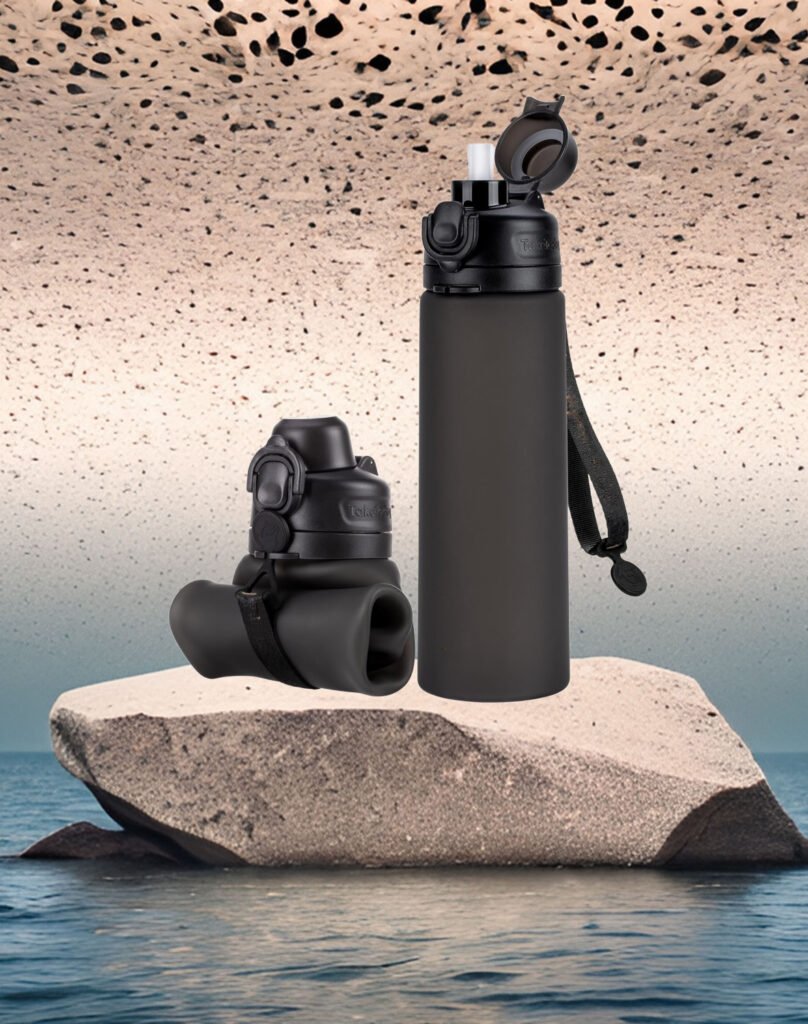
Collapsible Water Bottle

Rank #8: Collapsible Water Bottle

  • The Buzz: Staying hydrated while traveling is crucial, but carrying a bulky empty water bottle is inconvenient, and constantly buying single-use plastic bottles is wasteful and expensive. Collapsible water bottles offer a smart solution, appearing in travel essential lists that emphasize practicality and sustainability. Brands like Hydaway are noted for their designs.   
  • What It Actually Does: Made from flexible materials like food-grade silicone, these bottles function like regular water bottles when full but can be compressed, rolled, or folded down to a fraction of their size when empty. This makes them easy to stash in a pocket or bag after passing through airport security, ready to be refilled at a water fountain, saving money and reducing plastic consumption.   
  • The Expert Take & Deeper Insights: The collapsible water bottle taps into two significant trends: the desire for more sustainable travel practices and the need for space-saving gear, particularly for carry-on travelers. It’s a simple yet effective innovation that addresses both environmental concerns and practical packing challenges. Its inclusion in travel lists highlights a growing awareness among travelers about reducing their environmental footprint while also seeking convenient, cost-effective solutions.

Travel-Sized Toiletry Bottles

Rank #9: Travel-Sized Toiletry Bottles (Silicone)

  • The Buzz: Navigating TSA liquid rules and preventing shampoo explosions in luggage are perennial travel challenges. Reusable, travel-sized toiletry bottles, especially leak-proof silicone versions, are consistent best-sellers on Amazon and frequently recommended as essential. Their high sales volume and positive reviews underscore their practicality for carry-on travel.   
  • What It Actually Does: These small bottles (typically 3oz/100ml or less to comply with TSA regulations) allow travelers to decant their preferred shampoo, conditioner, lotion, or other liquids from larger containers. Silicone options are popular for being squeezable (getting every last drop), durable, and often featuring leak-proof cap designs. Sets often come with labels or varying colors for easy identification.   
  • The Expert Take & Deeper Insights: These bottles are a key component of efficient carry-on packing, enabling travelers to bring their favorite products without checking a bag or relying on potentially subpar hotel toiletries. Their popularity reflects the micro-organization trend extending to managing liquids effectively and preventing messy spills. The shift towards reusable silicone bottles also aligns loosely with sustainability efforts, reducing reliance on single-use travel-sized products. They solve a practical problem simply and reliably.
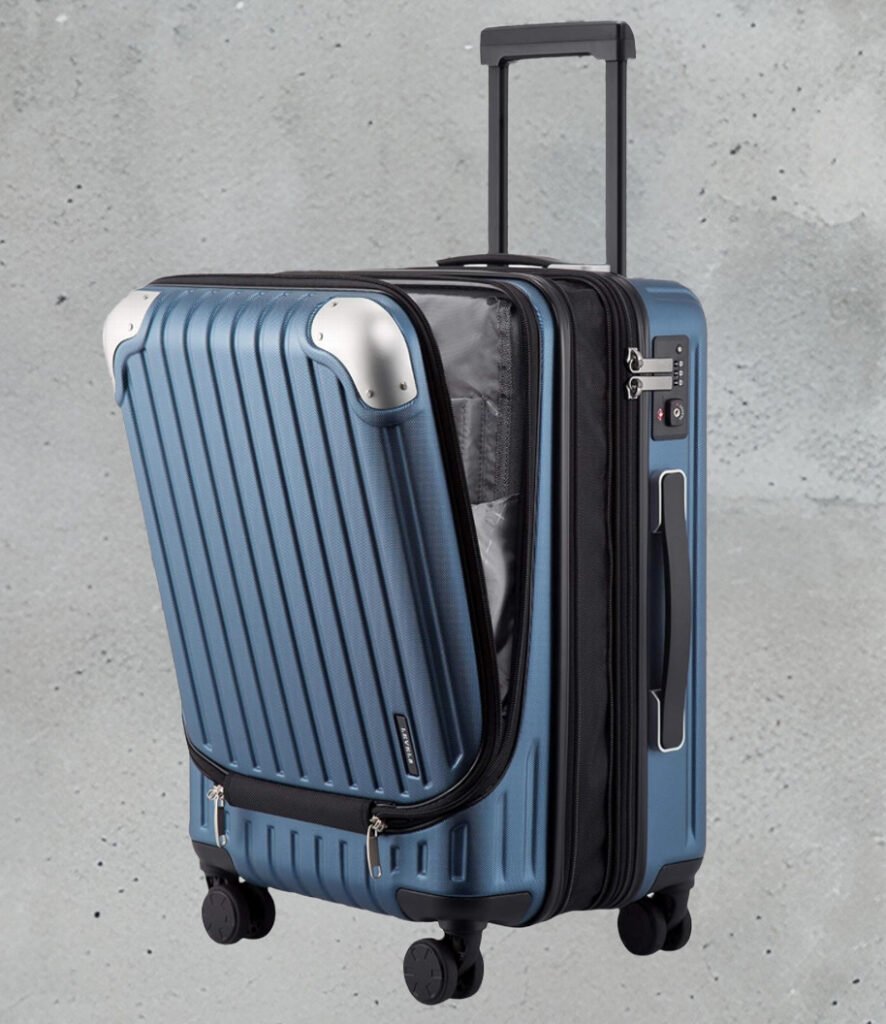
Carry-On Luggage

Rank #10: Carry-On Luggage (with Front Pockets/Organization)

  • The Buzz: While luggage itself is always essential, specific features are driving current trends in carry-ons. Models boasting easy-access front pockets (often for laptops) and enhanced internal organization are garnering positive reviews on platforms like TikTok and ranking well on Amazon. Brands like Travelers Club, Samsonite, KROSER (noted for USB ports), and various new releases emphasize these convenient features. Travelers appreciate the ability to quickly grab essentials without fully opening their suitcase.   
  • What It Actually Does: Beyond meeting airline size restrictions (typically around 22x14x9 inches), these trending carry-ons incorporate design elements focused on accessibility and organization. This includes external zippered compartments perfect for laptops, tablets, or documents, making security checks smoother. Some also feature built-in USB ports for charging devices (requiring an internal power bank) and thoughtfully designed interior pockets and dividers.   
  • The Expert Take & Deeper Insights: The focus on organizational features in carry-on luggage ties directly into the broader carry-on optimization and hyper-organization trends. Travelers want their essential items readily accessible during transit, not buried under layers of clothes. The front pocket addresses the common need to quickly access electronics or documents at the airport. Features like USB ports represent the ongoing integration of technology into travel gear. This trend shows luggage evolving from a simple container to a more functional, organized travel tool designed around the realities of modern air travel.

Beyond the Top 10: Honorable Mentions & Whispers of What’s Next

While the top 10 represent the strongest consolidated trends, other accessories are making noise:

  • Almost Famous: Customizable Luggage (like Roam ) appeals to travelers seeking personalization. Certain Carryall Bags (e.g., Dagne Dover Landon , Free People Quilted Carryall ) are popular for weekend trips, blending style and capacity. RFID-Blocking Wallets and Portable Door Locks cater to security-conscious travelers.   

  • Emerging Themes: Several broader currents are shaping the future of travel accessories:

    • Multi-functionality: The success of the garment duffel underscores a demand for gear that does more with less. Think scarves that double as blankets or backpacks that convert to duffels. Efficiency is key.   
    • Sustainability: Conscious consumerism is influencing travel purchases. Reusable water bottles , products made from recycled materials , and even Amazon’s sustainability filters point towards a growing desire for eco-friendly gear.   
    • Hyper-Organization: The obsession with order goes beyond packing cubes to encompass highly compartmentalized toiletry bags , makeup organizers , and even car organizers for road trips. Travelers want a place for everything.   
    • Tech Integration: Power banks and headphones are standard, but the future includes smarter luggage with tracking , portable Wi-Fi hotspots , and electronic bag tags simplifying check-in. Luggage is becoming part of the connected ecosystem.   
    • Personalization & Style: Travel gear is increasingly seen as an extension of personal style. Customizable options , a wide array of colors and patterns in popular items like packing cubes and adapters , show that aesthetics matter alongside function.   

Staying current with travel accessory trends isn’t about chasing every new gadget. It’s about understanding how innovation is addressing the real friction points of travel – saving space, staying organized, keeping devices charged, enhancing comfort, and ensuring peace of mind. The items gaining traction right now often do so because they offer clever, practical solutions to common problems.

Ultimately, the best travel accessory is the one that genuinely makes your journey smoother, more comfortable, and less stressful. Consider your travel style, your destinations, and your personal pain points. Use this list as a guide to identify the trends and tools that resonate most with your needs. Pack smart, embrace the innovations that serve you, and prepare for your most seamless and stylish adventures yet.
April 16, 2025 0 comments
0 FacebookTwitterPinterestEmail
Your Essential Guide to Thailand Travel Costs in 2025
AsiaDestinationsThailand

Your Essential Guide to Thailand Travel Costs in 2025

by Travel Geek April 14, 2025
written by Travel Geek

Thailand continues to enchant travelers with its stunning landscapes, vibrant culture, rich history, and world-renowned cuisine. It remains a destination celebrated for offering remarkable value across the entire budget spectrum, from backpacker hostels to opulent resorts. However, as global travel patterns normalize and the tourism industry rebounds, the cost landscape for visiting Thailand in 2025 presents notable shifts that prospective visitors must consider.   

The most significant change demanding attention is a widely reported and substantial increase in accommodation costs, particularly in popular tourist destinations. This surge, driven by a confluence of factors including recovered demand and strategic pricing by hotels, stands as the primary budget disruptor for 2025. While overall economic inflation in Thailand is projected to remain relatively moderate , the specific costs impacting tourists, especially for lodging, are outpacing general inflation metrics.   

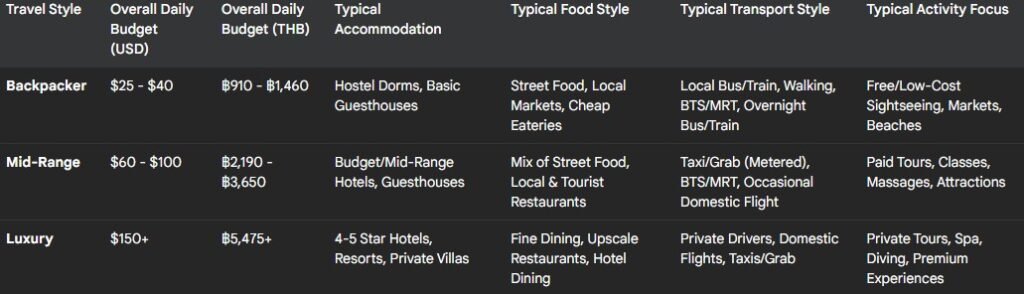
Based on current data and projections, here is a snapshot of estimated average daily budgets per person for 2025:

  • Backpacker: $25 – $40 USD (approximately ฿910 – ฿1,460 THB). This range reflects the need for careful spending, acknowledging that while the lower end is achievable through strict adherence to budget principles like prioritizing street food and dorms , general cost awareness pushes the comfortable average slightly higher.   
  • Mid-Range: $60 – $100 USD (approximately ฿2,190 – ฿3,650 THB). This bracket sees a significant adjustment upwards, primarily driven by the increased cost of private guesthouse rooms and mid-tier hotels, especially in sought-after locations.   
  • Luxury: $150+ USD (approximately ฿5,475+ THB). This serves as a starting point, offering access to high-end resorts and premium experiences. Costs in this category can escalate rapidly depending on the level of indulgence, with top-tier resorts easily exceeding $300-$400 per night.   

The core message for planning a Thailand trip in 2025 is clear: awareness and proactive budgeting are paramount. While the country still offers exceptional value compared to many Western destinations , understanding the evolving cost structure, particularly for accommodation, is essential for a smooth and financially comfortable journey.

Understanding Thailand’s 2025 Travel Cost Landscape: Key Factors to Consider

Several interconnected factors are shaping the financial realities of traveling in Thailand in 2025. Understanding these dynamics provides crucial context for effective budget planning.

The Post-Pandemic Rebound & Tourism Boom: Thailand’s tourism sector is experiencing a robust recovery following the global pandemic. Tourist arrivals have surged, driven by pent-up demand and government initiatives aimed at facilitating travel, such as visa exemptions for numerous countries and streamlined entry procedures. This resurgence is evident in high hotel occupancy rates returning towards pre-pandemic levels and is a primary driver of demand across accommodation, dining, and activity sectors. The government continues to view tourism as a key economic engine, investing in infrastructure like ports and rail systems to support future growth.   

Inflation Context: While global inflation has been a significant concern, Thailand’s overall inflation picture appears relatively subdued heading into 2025. Official forecasts project headline Consumer Price Index (CPI) inflation to be around 1.0% to 1.3% for 2025, staying within the Bank of Thailand’s target range of 1-3%. This follows a notably low average inflation rate of just 0.4% in 2024. Factors contributing to this moderate outlook include declining global energy and food prices, as well as domestic measures like energy subsidies and price controls.   

However, this low headline figure doesn’t tell the whole story for tourists. While the broad basket of goods measured by the CPI shows modest increases, specific items and services crucial for travelers are experiencing sharper price hikes. There have been reported increases in the cost of consumer goods like coffee , and fuel and energy costs remain a factor influencing transport and operational expenses. The disparity arises because the overall CPI encompasses many non-tourism related goods and services whose prices might be stable or controlled. In contrast, sectors facing high tourist demand, particularly accommodation, are seeing price increases significantly outpacing the general inflation rate. This phenomenon means that travelers will likely experience a higher effective inflation rate on their specific basket of travel-related purchases than the national average suggests. Relying solely on low headline inflation figures for budgeting could lead to underestimation of actual travel costs.   

The Elephant in the Room: The 2025 Hotel Price Surge: The most dramatic cost shift impacting Thailand travel budgets for 2025 is the significant increase in hotel prices. Anecdotal reports and forum discussions consistently point to prices doubling or even tripling compared to recent years, particularly for the upcoming high season. This isn’t just traveler perception; industry data confirms the trend. A report by SiteMinder revealed that Thai hotel Average Daily Rates (ADR) surged by 15% year-on-year in 2024, the highest growth globally, reaching an average of 5,377 baht (~$147 USD) and peaking at 6,460 baht (~$177 USD) in December 2024. High rates are particularly notable in popular southern destinations like Phuket, where some hotels are achieving record revenues.   

Multiple factors contribute to this surge:

  • Demand Recovery: The strong return of international tourists (accounting for 77% of check-ins at surveyed hotels in 2024 ) and high occupancy rates give hotels pricing power.   
  • Strategic Pricing: Hotels, especially in high-demand areas, appear to be shifting strategy. Instead of solely focusing on filling rooms (occupancy), many are prioritizing maximizing revenue per available room by increasing the Average Daily Rate (ADR). This involves dynamic pricing models and potentially holding back rooms for lucrative last-minute bookings at peak prices. This focus on ADR allows hotels to boost revenue significantly, even if occupancy isn’t at 100%, potentially helping recoup pandemic losses and manage operational pressures, possibly with leaner staffing levels. This strategic shift suggests a move towards targeting travelers with higher spending capacity, potentially impacting the value proposition for budget and mid-range segments in prime locations.   
  • Post-COVID Adjustment: Some argue that prices in the immediate post-reopening period (e.g., 2023) were artificially low to stimulate demand, and current rates reflect a return to, or exceeding of, pre-pandemic norms adjusted for inflation.  
  • Inflation & Operational Costs: General inflation, even if moderate overall, impacts hotel operating costs like energy, supplies, and potentially wages, contributing to the need for higher rates.   
  • Changing Tourist Demographics: An influx of tourists from markets with potentially higher spending power (e.g., China, Russia, India, Singapore, Hong Kong, Taiwan, Philippines) is noted. Furthermore, travelers are booking further in advance and staying longer on average , indicating strong demand and potentially higher overall spending per trip.   
  • Supply Dynamics: While new hotels are being built, the pace of new supply entering the market, particularly in certain segments or locations, might not be keeping pace with the rapid demand recovery. Some observers also suggest potential manipulation of supply listed on booking platforms to maintain higher prices.   

The implication of this hotel price surge is profound: accommodation will consume a larger portion of the travel budget in 2025 than in previous years, requiring adjustments across all spending categories or an increase in the overall budget.

Exchange Rates: Fluctuations in exchange rates can also impact the final cost for international travelers. As of mid-2024, rates were approximately 1 USD = 36.5 THB, 1 GBP = 47 THB, and 1 EUR = 40 THB. For consistency, this report uses an approximate rate of 1 USD = 36.5 THB. However, travelers should always check the prevailing exchange rates closer to their departure date for the most accurate budgeting.

Daily Budget Blueprints: Tailoring Your Thailand Trip in 2025

Thailand’s versatility means it can cater to vastly different travel styles and budgets. The following blueprints provide frameworks for daily spending per person in 2025. It’s crucial to remember these are averages; actual spending will fluctuate based on specific location (the south, particularly islands like Phuket, is significantly pricier than the north ), travel pace, chosen activities, and personal habits, especially regarding nightlife and alcohol consumption.  

The Savvy Backpacker ($25 – $40 / ฿910 – ฿1,460 per day)

  • Philosophy: This style prioritizes experiences and stretching funds over creature comforts. It often involves embracing local lifestyles where possible to maximize value.   
  • Accommodation: The cornerstone is shared hostel dormitories, typically costing $6-$15 (฿220-฿550) per night. In less touristy areas or during the low season, prices might dip lower. Basic private rooms in guesthouses might be feasible at the upper end of the budget, especially outside major hubs, potentially costing $12-$20 (฿440-฿730).   
  • Food: Street food is the primary fuel source, offering delicious and authentic meals for $1-$3 (฿35-฿110) per dish. Exploring local markets and occasionally eating at very basic local eateries ($3-$5 / ฿110-฿180) keeps costs down. A daily food budget of $10-$15 (฿365-฿550) is realistic.   
  • Transport: Relies heavily on the cheapest options: walking, local buses, songthaews, and the BTS/MRT systems in Bangkok ($1-$5 daily average). Inter-city travel utilizes overnight buses or second/third-class trains ($10-$25 per long trip).   
  • Activities: Focuses on free or low-cost experiences: exploring temples (many with entry fees of $2-$6 / ฿70-฿220 ), relaxing on beaches, wandering through markets, and hiking. An occasional budget-friendly tour ($15-$30) might be included. Averaging $5-$10 per day for activities is a reasonable target.   
  • Miscellaneous: Kept to a minimum – essentials only.
  • Context: While past guides suggested slightly lower ranges , the $25-$40 range reflects a realistic adjustment for 2025, acknowledging general cost increases while confirming that disciplined backpackers can still travel very affordably.   

The Comfort Seeker (Mid-Range) ($60 – $100 / ฿2,190 – ฿3,650 per day)

  • Philosophy: This traveler seeks a balance between affordability and comfort, opting for more convenience and a broader array of experiences without breaking the bank.
  • Accommodation: This category is most affected by the 2025 price dynamics. Expect to budget for private rooms in guesthouses, budget hotels, or standard 3-star establishments, costing roughly $25-$60 (฿910-฿2,190) per night. However, finding quality options at the lower end of this range in prime locations during peak season might be challenging due to the widespread price hikes. The upper end of the daily budget ($100) may be necessary to secure comfortable, well-located mid-range lodging.   
  • Food: Enjoys a mix of affordable street food, meals at local restaurants ($5-$10 per meal / ฿180-฿365) , and the occasional splurge on a nicer dinner or Western cuisine ($15-$25 / ฿550-฿910). A daily food budget of $25-$40 (฿910-฿1,460) allows for variety.   
  • Transport: Uses a combination of local transport options but utilizes taxis or ride-sharing services (Grab/Bolt) more frequently for convenience (always ensuring the meter is used in taxis ). Occasional domestic flights ($30-$60 one-way) are factored in for covering long distances efficiently. An average daily transport cost of $10-$20 is typical, potentially higher on days involving inter-city travel.  
  • Activities: Engages in more paid activities, such as organized tours (island hopping $25-$50 ), cooking classes ($25-$50 ), regular Thai massages ($5-$11 ), and entrance fees to major attractions ($5-$20 per site). An average daily activity budget of $15-$30 allows for consistent exploration.   
  • Miscellaneous: Includes budget for souvenirs, drinks, and other incidental purchases.
  • Context: The $60-$100 range reflects the increased costs, primarily for accommodation. Achieving a comfortable mid-range experience, especially in popular areas, likely requires budgeting towards the higher end of this spectrum in 2025. What might have been considered a comfortable mid-range budget a few years ago may now necessitate compromises, perhaps opting for slightly less central accommodation or scaling back on dining and activities to compensate for higher room rates. This “mid-range squeeze” means travelers need to be particularly realistic about accommodation standards achievable within this budget.   

The Indulgent Voyager (Luxury) ($150+ / ฿5,475+ per day)

  • Philosophy: This approach prioritizes premium comfort, high-quality experiences, seamless convenience, and top-tier service.
  • Accommodation: Stays in 4-star and 5-star hotels, well-appointed resorts, or private villas. Costs typically start around $100-$150 per night but frequently range from $150-$300 and can easily exceed $400-$500+ for premier properties, especially beachfront resorts in Phuket or Koh Samui during peak season.   
  • Food: Dines frequently at fine dining establishments, upscale hotel restaurants, and popular international eateries ($20-$50+ per meal per person). A daily food budget starting at $60-$100 (฿2,190-฿3,650) and potentially going much higher is expected.   
  • Transport: Relies on private drivers , frequent domestic flights (sometimes in premium classes) ($50-$150+ per trip) , first-class train compartments where available, and readily available taxis or higher-end ride-sharing options. A daily transport average might range from $30-$50+, increasing significantly on travel days.   
  • Activities: Opts for private tours, multi-day diving excursions or certifications , luxurious spa treatments , exclusive access experiences, high-end shopping, and premium entertainment. An average daily activity budget could easily be $50-$100+, with potential for much higher spending on specific interests.   
  • Miscellaneous: Ample budget allocated for high-end shopping, generous tipping, premium beverages, and unforeseen desires.
  • Context: While $150 provides a baseline for luxury , true high-end travel in Thailand, involving top resorts and extensive private services, will necessitate a significantly higher daily budget, often exceeding $200-$300 per day. Despite the rising costs, luxury in Thailand often still represents better value compared to equivalent standards in North America or Europe.   

Table 1: Summary of Estimated Daily Budgets by Travel Style (Per Person, 2025)

Summary of Estimated Daily Budgets by Travel Style (Per Person, 2025)

Accommodation Deep Dive: Where to Stay and What It Costs in 2025

Accommodation typically represents the single largest expense category for travelers in Thailand, and it’s the area experiencing the most significant price volatility in 2025. Booking trends indicate travelers are planning further ahead, with average lead times approaching pre-pandemic levels. Costs vary considerably based on location, season (peak vs. shoulder/low), and the type of lodging chosen.   

Hostels & Budget Guesthouses: These remain the mainstay for budget travelers.

  • Costs: Dorm beds generally range from $6-$15 (฿220-฿550) per night in major cities and popular areas. Average prices in hubs like Bangkok, Chiang Mai, and Phuket hover around $11 (฿400), while less-visited towns like Ayutthaya or Pai might offer dorms for $7-$8 (฿250-฿290). Private rooms within hostels command higher prices, potentially $28-$57 (฿1,035-฿2,070). Basic guesthouses or simple budget hotels offer private rooms typically from $12-$33 (฿420-฿1,200).   
  • Best for: Solo travelers seeking social interaction, backpackers prioritizing budget above all else.

Mid-Range Hotels & Boutique Stays: This broad category offers a step up in comfort and amenities but is where the 2025 price increases are most acutely felt.

  • Costs: The price range is wide, spanning roughly $25-$100+ (฿910-฿3,650+). Sources offer varying perspectives: some suggest budget hotels/guesthouses fall within $20-$40 , while others place 3-star hotels anywhere from $20 (Chiang Mai, shoulder season) to $85 (Koh Samui, peak season) and 4-star hotels from $55 (Phuket, shoulder season) to $135 (Koh Samui, peak season). Reports from Bangkok and Pattaya suggest $75-$100 might now be considered “cheap” for a decent, comfortable stay. The average mid-range cost cited by one source is $59 (฿2,150) , while another breaks down 2-star hotels at $20-$40 and 3-star hotels at $50-$100. This wide and increasing range highlights the “mid-range squeeze.” Finding good value in the traditional $40-$70 bracket may require significant research, booking well in advance, traveling in the shoulder season, or choosing locations slightly removed from prime tourist centers. Travelers aiming for this level of comfort should likely budget towards the higher end of the overall mid-range daily estimate ($60-$100), particularly if visiting popular islands or Bangkok during peak times.   
  • Best for: Couples, families, or travelers seeking private facilities, air conditioning, and better locations without the full expense of luxury resorts.

Luxury Hotels & Resorts: Thailand excels in luxury hospitality, offering world-class properties often at prices more favorable than in Western countries.   

  • Costs: Generally start around $100-$150 per night and extend upwards significantly. Five-star properties typically range from $90 (Chiang Mai, shoulder season) to $250 (Koh Samui, peak season) according to one source. However, anecdotal reports mention rates for previously $75-$150 hotels now hitting $300-$400 , and peak season rates at top Phuket resorts can reach ฿20,000 ($550) or more.   
  • Best for: Travelers prioritizing exceptional service, extensive facilities (pools, spas, fine dining), prime locations, and overall indulgence.

Alternative Lodging: Airbnb & Bungalows: These options offer different styles of accommodation.

  • Costs: Airbnb provides variety, with private rooms potentially available for $5-$16 (฿200-฿600) and entire apartments typically ranging from $38-$75 (฿1,380-฿2,750) per night. An example in Bangkok showed a three-person Airbnb at $60/night. Simple beachfront bungalows, particularly on islands like Tonsai (Krabi), can be found for as little as $20-$22 per night. Monthly rentals through platforms like Airbnb or local arrangements can offer significant savings for longer stays. The rise of these alternatives presents competition for traditional hotels.   
  • Best for: Longer stays, travelers seeking self-catering facilities, groups or families needing more space, and those looking for unique or locally integrated experiences.

Table 2: Detailed Accommodation Cost Ranges (Per Night, USD & THB – Estimates for 2025)

Detailed Accommodation Cost Ranges (Per Night, USD & THB - Estimates for 2025)

Note: Ranges are estimates based on available 2024/2025 data and projections, subject to fluctuation. Peak season (approx. Nov-Feb) will be at the higher end or exceed these ranges; shoulder/low season (approx. May-Oct) will be lower. “Significant Increase” reflects widespread reports of substantial price hikes compared to previous years.

A Taste of Thailand: Daily Food & Drink Expenses

Thailand’s culinary landscape is a major draw, offering an incredible diversity of flavors and dining experiences that can accommodate any budget. Food costs provide significant flexibility for travelers; choosing where and what to eat is a key lever for managing the daily budget, potentially offsetting rising costs in other areas like accommodation. Opting for local food is not just economical but also integral to the Thai travel experience.   

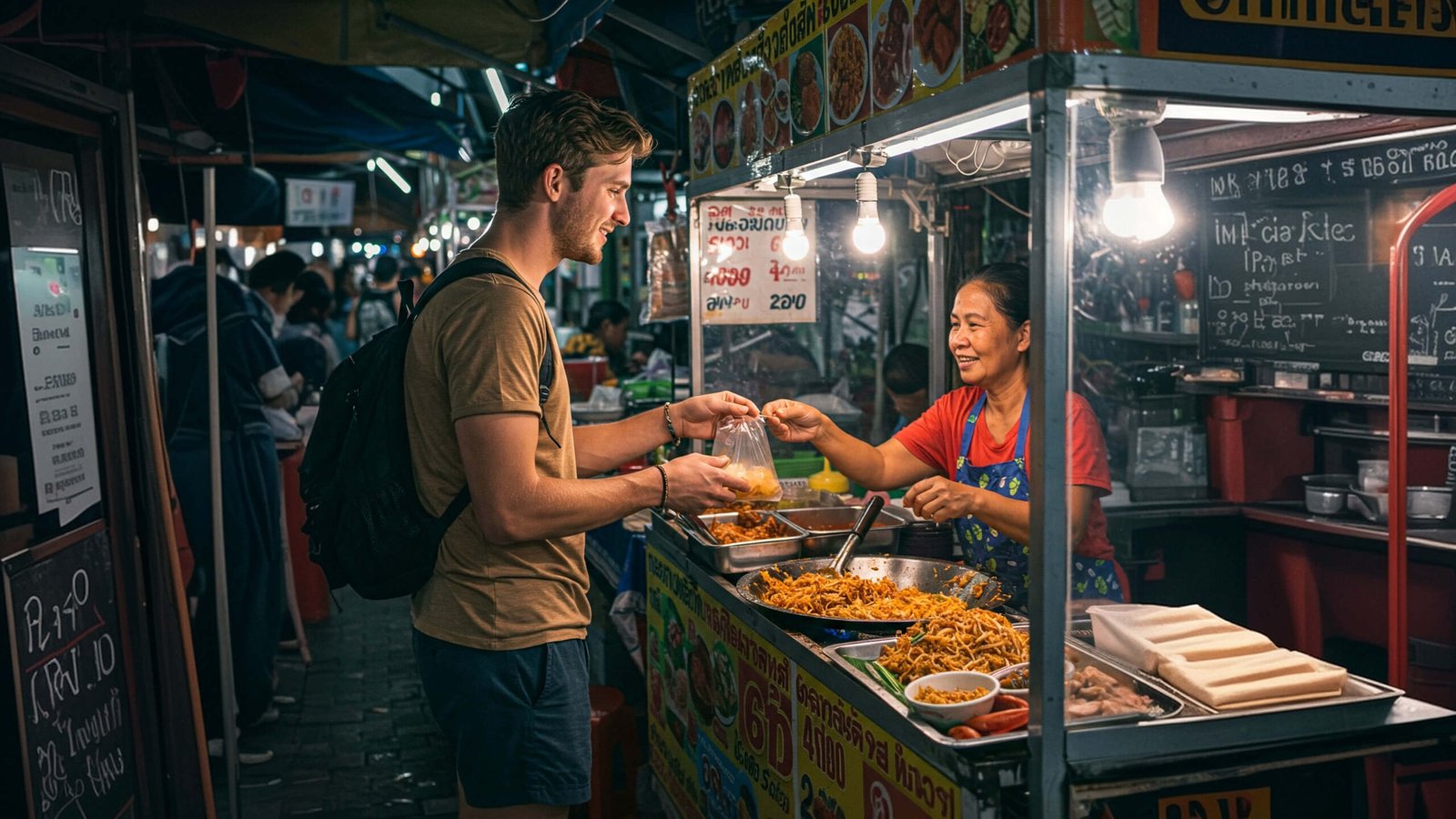
Street Food & Local Markets: This is where Thailand’s food culture truly shines and where budgets can be stretched furthest.

  • Costs: Individual dishes typically cost between $1 and $3 (฿30-฿110). It’s possible to eat full, satisfying meals for under $5. One estimate suggests budgeting around ฿150 ($4) per day if eating exclusively local food. Street food is widely considered safe, especially from busy stalls with high turnover, and offers unparalleled authenticity.   
  • Examples: Iconic dishes like Pad Thai can be found for around $1.50 (฿55) , while a simple plate of fried rice might cost ฿60 ($1.65). Countless snacks, skewers, soups, and sweets are available for minimal cost.   

Casual Dining: Local vs. Tourist-Oriented: Moving beyond street stalls into simple restaurants offers more comfort but varying costs.

  • Costs: Eating at basic, local-style restaurants (often small, family-run places) remains very affordable, with dishes often priced between $3-$5 (฿100-฿175). However, restaurants specifically catering to tourists, or those serving Western food, will have significantly higher prices, often $5-$10 (฿175-฿350) or more per dish. It’s noted that ordering a standard Thai dish in a tourist-focused restaurant or hotel can cost three to four times as much as the identical dish in a local eatery just down the street. Mid-range restaurants catering to both locals and tourists might fall in the $10-$20 per meal range.   

Upscale Restaurants & International Cuisine: Thailand also boasts a sophisticated fine dining scene and excellent international options.

  • Costs: Expect to pay $20-$50 or more per person per meal at upscale establishments. Renowned restaurants like Nahm in Bangkok might cost $52-$105 per person, while Pru in Phuket could range from $84-$157 per person. Even at these prices, high-end dining in Thailand can still offer better value than comparable experiences in major Western cities.   

Beverage Costs: Staying hydrated and enjoying drinks also factors into the daily budget.

  • Water: Buying bottled water is essential. The cheapest source is convenience stores like 7-Eleven, where large 1.5-liter bottles can cost around ฿12 ($0.30) or $1 for two. Purchasing water in restaurants is significantly more expensive, potentially $1-$3 for a small 0.5-liter bottle.   
  • Beer: Local Thai beers (Chang, Leo, Singha) are the most economical choice, costing around $1.50-$3 (฿60-฿120) per large bottle in shops or basic bars. Prices increase in restaurants and sky bars, potentially reaching $5-$8 (฿180-฿300) or more. Imported beers are generally more expensive.   
  • Wine & Cocktails: These are considerably pricier due to import taxes and markups. A glass of wine might cost around ฿180 ($5) , with bottles starting near $28 (฿586). Cocktails typically range from $8-$12 (฿300-฿450) or more, especially in upscale venues.   
  • Coffee & Soft Drinks: Readily available and relatively inexpensive. A coffee (cappuccino, etc.) costs around $1-$3 (฿68). Soft drinks like Coca-Cola are about $1 (฿22).   

Table 3: Food & Drink Daily Cost Estimates (Per Person, USD & THB – 2025)

Food & Drink Daily Cost Estimates (Per Person, USD & THB - 2025)

Note: Food costs assume 2-3 meals per day. Drink costs are illustrative; actual spending varies greatly with consumption habits.

Getting Around: Transportation Costs Explained

Navigating Thailand is generally affordable and offers a diverse range of options, from modern urban transit to traditional local methods. Making strategic transport choices based on budget, time, and comfort preferences is key to managing this expense category effectively. Choosing slower, overland options or utilizing public transport can yield significant savings compared to frequent flights and private hires.   

Navigating Cities & Islands:

  • Bangkok: The capital boasts efficient and cost-effective public transport.
    • BTS Skytrain & MRT Subway: Ideal for avoiding traffic in many core areas. Fares are distance-based, typically ranging from ฿16-฿52 ($0.45-$1.40) per trip, with a one-day pass available for ฿150 ($4.10). Budgeting $4-$9 (฿145-฿330) per day covers regular metro use.   
    • Metered Taxis: Plentiful and affordable if the meter is used. The flagfall is around ฿40 ($1.10), and the cost per kilometer is roughly $1 (฿36.5). Short trips within central areas often cost ฿60-฿90 ($1.65-$2.50). It is crucial to insist on the meter or agree on a fair price beforehand to avoid scams. Hailing taxis from designated stands near malls or having a hotel call one can sometimes lead to better experiences.   
    • Ride-Sharing (Grab/Bolt): Widely available and convenient. Bolt is often reported as being 20-30% cheaper than Grab.   
    • Tuk-Tuks: Iconic three-wheeled taxis offer a quintessential Bangkok experience but are often more expensive than metered taxis, especially for tourists. Prices must be negotiated firmly beforehand and can range from ฿50-฿300+ ($1.40-$8.20+) depending on distance and bargaining skills. They are more of a novelty than an economical transport choice.   
    • Motorbike Taxis: Useful for short distances or weaving through traffic, often costing $1-$2 (฿35-฿70) for brief trips. Use apps like Grab for booking in major cities. Safety is a consideration.   
  • Other Cities & Islands: Transport options vary.
    • Songthaews: Shared pick-up trucks with benches in the back, operating on set routes or available for private hire. A common and cheap way to get around many towns and islands.
    • Scooter Rental: Very popular for independent exploration, especially on islands and in cities like Chiang Mai. Daily rental costs range from $5-$10 (฿180-฿365) or ฿200-฿350. However, this requires confidence, appropriate licensing (International Driving Permit with motorcycle endorsement is often legally required), and awareness of traffic risks. Insurance coverage should be verified.   
    • Local Taxis/Tuk-Tuks: Available in most tourist areas; negotiation is usually required.

Traveling Between Destinations:

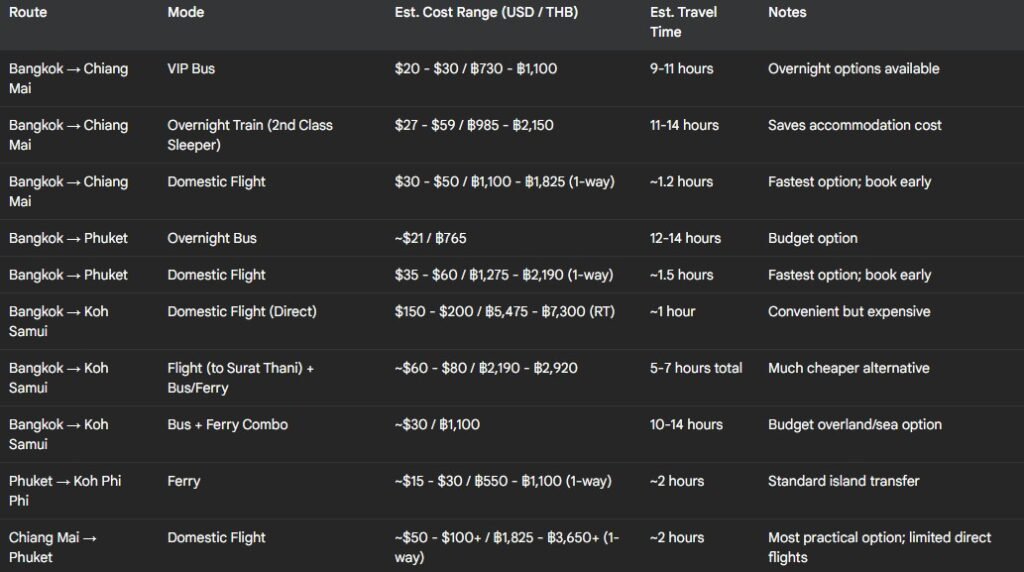
  • Buses: The most budget-friendly way to travel long distances. Various classes are available, with VIP buses offering more comfort (reclining seats, snacks, toilet) for a higher price. Costs average around ฿40-฿140 ($1.10-$3.85) per hour of travel, depending on the bus class. Examples: Bangkok to Chiang Mai ~$20-$30 (฿730-฿1,100) ; Bangkok to Phuket ~$21 (฿765). Online booking platforms like 12Go Asia are convenient. Overnight buses save on travel time during the day.   
  • Trains: Offer a more scenic and potentially comfortable alternative, particularly the overnight sleeper trains which also save on a night’s accommodation cost. Costs average ฿20-฿140 ($0.55-$3.85) per hour, depending on class. Examples: Bangkok to Chiang Mai overnight sleeper ~$38 (฿1,390) , second-class fares range from $27-$59 (฿985-฿2,150) or start around ฿690 ($19). Basic day trains are very cheap (฿35-฿50 / $1-$1.40).   
  • Ferries: Necessary for reaching islands not connected by bridges. Prices vary by route and company. Examples: Phuket to Koh Lanta $27-$54 (฿985-฿1,970) ; Koh Samui to Koh Tao $19 (฿695). Combination tickets (bus + ferry or train + bus + ferry) are available for seamless travel to islands like Koh Samui or Koh Phangan.   
  • Domestic Flights: The fastest way to cover long distances. Several budget airlines (AirAsia, Nok Air, Thai Lion Air, VietJet Air) compete on major routes, making flights potentially affordable if booked in advance. Examples: Bangkok to Chiang Mai $30-$50 (฿1,100-฿1,825) one-way ; Bangkok to Phuket $35-$60 (฿1,275-฿2,190) one-way. Flying directly to Koh Samui is notoriously expensive ($150-$200 / ฿5,475-฿7,300 round trip or ~฿4,200 / $115 one-way ) because Bangkok Airways owns the airport. A much cheaper alternative is flying to nearby Surat Thani (flights ~฿1,200 / $33 ) and then taking a bus and ferry combination to the island.   

Table 4: Sample Inter-City Transportation Costs & Times (Estimates for 2025)

Sample Inter-City Transportation Costs & Times (Estimates for 2025)

Note: Flight prices are highly variable based on booking time, airline, and season. Bus/Train/Ferry prices are more stable but can vary by operator and class.

Exploring the Kingdom: Budgeting for Activities & Attractions

Thailand offers a vast spectrum of activities, from serene cultural immersion to adrenaline-pumping adventures. Costs can range from completely free to several hundred dollars for specialized courses or exclusive tours. Budgeting for this category depends heavily on personal interests. While booking tours locally upon arrival can sometimes yield savings , popular activities or those with limited capacity (like ethical elephant sanctuaries) often require advance booking, especially during peak season.   

Cultural Immersion:

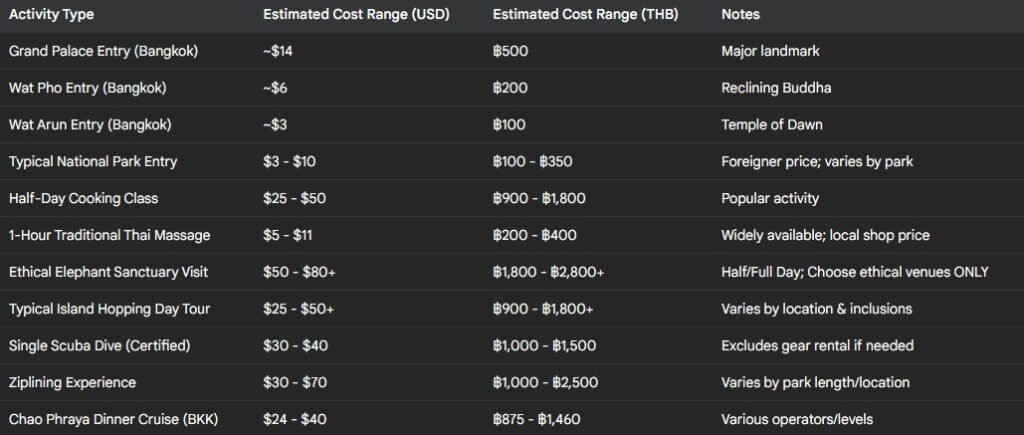
  • Temples (Wats): A cornerstone of Thai culture. Many temples are free to enter, though donations are welcomed. Major landmark temples often have modest entrance fees, typically in the $2-$6 (฿70-฿200) range. Notable examples include the Grand Palace in Bangkok (฿500 / ~$14), Wat Pho (Temple of the Reclining Buddha, ฿200 / ~$6), and Wat Arun (Temple of Dawn, ฿100 / ~$3).   
  • National Parks: Offer access to stunning natural landscapes, hiking trails, and waterfalls. Entrance fees are common, often ranging from $3-$10 (฿100-฿350) per person for foreigners. Specific parks like Khao Sok are popular for trekking and lake tours.   
  • Museums: Provide insights into Thai history and art. Entrance fees typically range from $4-$15 (฿145-฿550). The Jim Thompson House in Bangkok, showcasing traditional Thai architecture and art, costs ฿100 (~$3).   
  • Markets: Exploring vibrant night markets or local fresh markets is free and offers a fantastic glimpse into daily life. Floating markets are unique but often visited via paid tours.   

Adventure & Leisure:

  • Island Hopping Tours: A popular way to explore coastal beauty, typically involving boat trips to several islands for swimming, snorkeling, and beach time. Costs generally range from $25-$50 (฿900-฿1,800) or more for a full-day trip, depending on the region and inclusions.   
  • Diving & Snorkeling: Thailand is a world-class diving destination. A single fun dive costs around $30-$40 (฿1,000-฿1,500). Full certification courses (like PADI Open Water) are significantly more expensive, potentially ranging from $71-$716 (฿2,500-฿25,000) depending on location and level. Snorkeling gear rental or dedicated snorkeling tours might cost $15-$50.   
  • Cooking Classes: A fun, interactive way to learn about Thai cuisine. Half-day classes typically cost $25-$50 (฿900-฿1,800).   
  • Elephant Sanctuaries: Visiting elephants is popular, but it’s crucial to choose ethical sanctuaries that prioritize animal welfare (no riding, hooks, or forced performances). Visits to reputable sanctuaries usually cost $50-$80 (฿1,800-฿2,800) or more for a half-day or full-day experience.   
  • Jungle Trekking: Guided treks through national parks or forest areas, often lasting half a day to multiple days. Costs typically range from $30-$50 (฿1,000-฿1,800) for shorter treks.   
  • Muay Thai (Thai Boxing): Experiencing Thailand’s national sport can involve taking a class ($10-$15 / ฿350-฿500 ) or attending a live fight (ticket prices vary widely depending on the venue and fighters).   
  • Ziplining: Adventure parks offer treetop canopy tours via ziplines. Costs range from $30-$70 (฿1,000-฿2,500).   
  • Spas & Massages: Traditional Thai massage is incredibly affordable, typically costing $5-$11 (฿200-฿400) for an hour at local shops. More elaborate spa treatments at hotels or dedicated spas will be significantly more expensive. 
  • Other Attractions: Examples include observation decks like the Mahanakhon SkyWalk in Bangkok ($25 / ฿910 ), dinner cruises along the Chao Phraya River ($24-$40 / ฿875-฿1,460 ), and theme parks like Carnival Magic in Phuket ($90 / ฿3,285 ).   

Daily Activity Budget Estimation: Spending on activities is highly discretionary.

  • Budget travelers might average $5-$10 per day, focusing on free activities and low-cost temple entries.   
  • Mid-range travelers might average $15-$30 per day, allowing for regular participation in tours, classes, or paid attractions.   
  • Luxury travelers could easily average $50-$100+ per day, opting for private tours, premium experiences, and frequent indulgences like spa treatments.   

The wide range of available activities at different price points allows travelers to tailor their experiences to their budget. It is possible to have a rich cultural experience focusing on free or low-cost options, while those seeking specific adventures or indulgences can allocate funds accordingly. This scalability makes activities a flexible component of the daily budget.

Table 5: Cost Estimates for Popular Tourist Activities (USD & THB – 2025)

Cost Estimates for Popular Tourist Activities (USD & THB - 2025)

Location, Location, Location: Regional Cost Variations

A crucial factor influencing daily expenses in Thailand is the specific region visited. Costs can differ significantly between the bustling capital, the culturally rich north, the popular southern islands, and less-trodden paths.   

Bangkok: The Dynamic Capital As Thailand’s sprawling metropolis, Bangkok offers a vast range of price points. Luxurious hotels, rooftop bars, and high-end restaurants in prime areas like Sukhumvit or near the river can be expensive. However, budget accommodation, cheap eats, and affordable markets are also abundant. The city’s efficient public transportation network (BTS Skytrain and MRT subway) provides a cost-effective way to navigate large parts of the city, helping to manage daily transport budgets. Overall, while certain aspects can be pricey, Bangkok generally offers more value than the most popular southern islands like Phuket, though it may be slightly more expensive than northern cities like Chiang Mai for comparable standards.   

Chiang Mai & The North: Culture and Value Northern Thailand, with Chiang Mai as its hub, is consistently cited as being more affordable than Bangkok and significantly cheaper than southern beach destinations like Phuket or Koh Samui. Accommodation generally offers better value, with lower rates for comparable quality compared to the south. Food, both street food and restaurant dining, is also noted for being less expensive. This combination of cultural attractions, natural beauty (mountains, elephants, trekking), and lower costs makes the north a popular choice for budget travelers, backpackers, digital nomads, and those seeking a more relaxed atmosphere than the southern beaches.   

Phuket, Krabi & Andaman Coast: Island Prices This region, particularly Phuket, consistently ranks among the most expensive destinations for tourists in Thailand. The high concentration of tourists, island logistics (higher cost of transporting goods), and a focus on beach resorts and nightlife contribute to inflated prices. Accommodation rates, especially for beachfront properties or during peak season, are significantly higher than elsewhere. Food , drinks, tours, and even basic goods and services often come with a premium price tag. Travelers should allocate a considerably larger daily budget when visiting Phuket compared to Chiang Mai or even Bangkok.   

Koh Samui & Gulf Islands: The islands in the Gulf of Thailand, such as Koh Samui, Koh Phangan, and Koh Tao, also tend to be relatively expensive compared to the mainland, though perhaps with some variation. Koh Samui, known for its resorts and accessibility via a privately owned airport, often commands high prices for both flights and accommodation. Koh Phangan, famous for its Full Moon Parties, sees prices spike around party dates but might offer better value at other times, attracting a digital nomad community. Koh Tao is renowned as a diving hub, with costs influenced by dive tourism.   

Off the Beaten Path: Finding Savings Venturing away from the main tourist centers offers the most significant potential for cost savings. Regions like Isaan (Northeastern Thailand) , rural areas , and smaller towns such as Pai (north of Chiang Mai) provide a more local experience at much lower prices. Accommodation, food, and local transport costs can be substantially less than in Bangkok or the southern islands. This approach requires a more independent travel style and potentially more time for transit but rewards travelers with authentic cultural immersion and a lighter impact on the wallet.   

The clear divergence in costs between heavily touristed areas and the rest of the country highlights what can be termed a “tourist price bubble.” In hotspots like Phuket or Koh Samui, high demand, potentially higher operating costs, and a market geared towards international visitors allow businesses to charge premium prices, sometimes two to three times higher than in less saturated areas. In contrast, places with fewer tourists rely more on local customers, keeping prices closer to the general Thai cost of living. Understanding this regional variation is crucial; a trip split equally between Chiang Mai and Phuket will have a markedly different average daily cost than one spent entirely in either location alone. Travelers can strategically use this knowledge to balance their budget, perhaps spending more time in value-oriented regions to offset splurges in more expensive areas.

Essential Extras & Budgeting Wisdom

Beyond the core categories of accommodation, food, transport, and activities, several miscellaneous costs and smart budgeting strategies should be considered for a 2025 Thailand trip.

Accounting for Miscellaneous Costs:

  • SIM Cards/eSIMs: Staying connected is vital for navigation, booking, and communication. Tourist SIM packages are readily available at airports and convenience stores. While specific plan costs vary, budgeting around $10-$20 for a typical tourist package with data is reasonable.   
  • ATM Fees: Thailand is known for high fees charged by local banks for foreign card withdrawals, typically around ฿220 (roughly $6-$7) per transaction. This is in addition to any fees your home bank might charge. To minimize these costs, withdraw larger amounts less frequently or investigate travel-friendly bank accounts or cards that offer ATM fee rebates. Bringing some major currency (USD, EUR) in cash to exchange at local money changers (which often offer better rates than banks or airport kiosks) can also be more economical than frequent ATM use.   
  • Travel Insurance: Comprehensive travel insurance covering medical emergencies, trip cancellation, and lost belongings is highly recommended. Costs vary widely based on coverage level, duration, and traveler’s age/home country. While Thailand plans to implement a 300-baht tourism levy starting late 2025 that includes basic accident and life insurance , this is unlikely to replace the need for proper, comprehensive travel insurance.   
  • Vaccinations: Consult your doctor or a travel clinic well in advance regarding recommended vaccinations for Thailand (e.g., Tetanus, Hepatitis A). Costs depend on your home country’s healthcare system and existing immunization status.   
  • Laundry: Widely available and inexpensive, especially outside hotels. Local laundromats or services often charge by weight or item.   
  • Shopping & Souvenirs: Entirely discretionary, but factor in some budget if you plan to shop at markets or malls.
  • Tips: Tipping is not customary in the same way as in some Western countries, especially for street food vendors or local eateries. However, it is increasingly common and appreciated for good service in tourist-oriented restaurants, hotels (porters, housekeeping), tour guides, and spa therapists. Small amounts are generally sufficient.   

Expert Tips for Optimizing Your Budget:

  • Timing is Key: Travel during the shoulder season (approx. April-June, Sept-Oct) or low season (approx. July-Aug) to find lower prices for flights and accommodation. Be mindful that the low season coincides with the rainy season in many parts of the country, although rainfall patterns vary regionally.   
  • Eat Like a Local: Embrace street food and simple local restaurants for significant savings and authentic flavors.   
  • Smart Transport: Utilize efficient public transport like Bangkok’s BTS/MRT. Walk when feasible. Opt for overnight trains or buses for long distances to save on both fare and a night’s accommodation.   
  • Drink Wisely: Limit consumption of expensive imported alcohol, cocktails, or drinks in fancy bars. Buying local beer or other drinks at convenience stores is much cheaper.   
  • Travel Slower: Spending longer in fewer locations reduces costly inter-city transport days and may allow for negotiation of better rates on longer-term accommodation.   
  • Venture Beyond Hotspots: Incorporate less touristy destinations into your itinerary for lower costs and different experiences.   
  • Bargain Respectfully: Haggling is expected in many markets and sometimes for tuk-tuk fares. Do it with a smile and be reasonable. Prices in malls and established restaurants are fixed.
  • Book Strategically: Book international flights, domestic flights, and popular train routes well in advance for better prices. For tours, consider booking locally upon arrival for potential savings , but weigh this against the convenience and guaranteed availability of pre-booking popular options.   
  • Manage Cash: Minimize ATM fees by withdrawing larger sums or exchanging cash brought from home.

Planning Your Thailand Adventure in 2025

Thailand in 2025 remains an incredibly alluring destination, offering a rich tapestry of culture, adventure, relaxation, and culinary delights. It continues to provide experiences that cater to every budget, from the frugal backpacker to the luxury seeker.

However, the travel cost landscape has undeniably shifted. While overall inflation remains moderate, the strong resurgence of tourism has led to significant price increases in key sectors, most notably accommodation, particularly in popular tourist hubs and islands. The days of assuming rock-bottom prices across the board, especially for mid-range comfort in prime locations, require recalibration.

Success in navigating Thailand’s 2025 costs hinges on awareness, research, and strategic planning. Flexibility in choosing locations – balancing time in expensive hotspots with stays in more affordable regions like the north – can dramatically impact the overall budget. Conscious decisions about dining styles, favoring local eateries and street food over constant Western or upscale meals, offer substantial savings. Similarly, optimizing transportation choices, such as utilizing overnight trains or budget airlines booked in advance, can free up funds for desired activities.

Despite these adjustments, Thailand’s fundamental appeal endures. The value proposition, especially when compared to many other global destinations, remains strong. The warmth of its people, the beauty of its temples and beaches, and the explosion of flavors from its kitchens are as captivating as ever. By approaching budget planning with realistic expectations based on the current cost environment, travelers can confidently embark on their journey, ensuring an unforgettable and financially manageable adventure in the Land of Smiles throughout 2025.

April 14, 2025 0 comments
0 FacebookTwitterPinterestEmail
Why Cooler Getaways are the Top Travel Trend for Summer 2025
Budget TravelFamily TravelLuxury TravelSolo TravelTravel Tips

Why Cooler Getaways are the Top Travel Trend for Summer 2025

by Travel Geek April 7, 2025
written by Travel Geek

Summer vacation. For many, it brings to mind sunny beaches and warm weather. But for summer 2025, a different kind of trip is gaining popularity: the “cool-cation.” This trend sees more and more people choosing destinations with milder temperatures to escape the summer heat. Think Iceland, Norway, Canada, Scotland, and Ireland. These places are becoming the new go-to spots as travelers look for a break from rising global temperatures.

Why the Shift to Cooler Climates?

The main reason for this change in travel plans is the increasing heat in many parts of the world. As summers get hotter, people are looking for more comfortable places to spend their holidays. This is clearly seen in online searches. Data from Google Trends shows a huge jump – 300% in just one year – for searches related to “cooler holidays.” A survey of travelers in the UK also found that over 20% were thinking of changing their vacation plans because of very hot weather.

Extreme weather isn’t just changing where people want to go; it’s also affecting whether they can travel at all. Reports show that almost a third of all travelers have had to delay trips due to bad weather like wildfires, extreme heat, or floods. This number is even higher for younger travelers. These real-life events, like the heat and wildfires in Greece that forced thousands to leave, or the tourists in Rome who cut their trips short because of heatwaves, show why people are looking for more predictable and enjoyable vacations in cooler places. Beyond the immediate discomfort, there’s also a growing awareness of climate change, which might be influencing people to choose destinations seen as less affected by severe weather.

The Hot Destinations for Staying Cool

So, which places are seeing the biggest increase in interest? Iceland, Norway, Canada, Scotland, and Ireland are leading the way. Travel insurance data from Squaremouth shows significant growth in popularity for these countries. Iceland is at the top with over 30% more interest compared to last year. Norway follows with over 27%, Canada with over 25%, Scotland with over 21%, and Ireland with over 17%. Ireland has even moved into the top 10 most popular destinations for their customers.

Luxury travel experts at Virtuoso have also noticed this trend. They report a massive 263% increase in bookings for Scandinavia, which includes Iceland and Norway, for summer 2025. This shows that the desire for cooler destinations is appealing to all kinds of travelers.

There are specific reasons why these places are so popular. Iceland has become easier to reach with more affordable flights from the U.S. Norway’s “right to roam” law, which allows people to freely explore its nature, is a big draw for those who love adventure. And the summer weather in Iceland, averaging between 10 to 15°C (50 to 59°F), offers a welcome break from hotter climates.

While data from other sources like Skyscanner and VisitScotland confirms general travel interest, the clear numbers from Squaremouth and Virtuoso strongly support the rise of these “cool-cation” hotspots. Even though Tourism Ireland saw a slower start to the year, they expect more flights to become available for the summer, which could boost their numbers in line with the trend. Iceland is even expecting a record number of tourists in 2025, beating its previous high.

Beyond the Usual Suspects: Other Cool Options

While the five countries mentioned above are leading the charge, there are other places gaining popularity for cooler summer trips in 2025. These offer a variety of experiences.

For a truly icy escape, polar safaris to Antarctica, South Georgia, and parts of Canada are becoming more attractive. These trips offer unique chances to see wildlife and support conservation. The Baltic countries (Latvia, Lithuania, and Estonia) and Scandinavia are also popular. One travel company is even offering new walking tours in Northern Ireland, Donegal, and the Faroe Islands for those who want active vacations in milder weather. You could even consider a trip to Japan for the Sapporo Snow Festival, offering a different experience during a cooler time of year.

Even ski resorts in the Alps are becoming summer destinations for relaxation. Places like Chamonix in France and Cortina in Italy offer beautiful scenery and wellness activities like swimming, fishing, hiking, and spa treatments. These resorts are becoming year-round getaways.

Several cities with pleasant summer weather are also gaining attention. Edinburgh in Scotland and Zurich in Switzerland offer culture and comfortable temperatures. If you’re looking for a winter escape during the Northern Hemisphere’s summer, Santiago in Chile provides a cool option. Sweden and Latvia are also highlighted for their natural beauty and outdoor activities in moderate summer temperatures.

Travel experts also point to Banff in Canada, Lapland in Sweden and Finland, Alaska in the USA, and Eastern European cities like Vilnius and Krakow as top “cool-cation” spots. These places offer everything from stunning mountains and the Northern Lights to history and culture. Weather websites even provide temperature guides for places like Scandinavia, the Baltics, the UK, parts of Canada, and the USA to help travelers plan their cool getaways.

Interestingly, while London and Reykjavik are expected to see slightly fewer American visitors in summer 2025, Helsinki and Copenhagen are predicted to attract more. This suggests a shift in preferences even within cooler regions. Data also shows a big jump in demand for Iceland and Finland because of their cooler temperatures, while Greece, a traditionally hot destination, saw fewer summer tourists.

A Change in Summer Travel Habits

The summer travel plans for 2025 show a clear change from past years, especially when it comes to the popularity of traditionally hot places in Europe. The rise of “cool-cations” indicates that many travelers are choosing cooler climates over the intense heat often found in Southern Europe.

Travel insurance data suggests that the increasing popularity of “cool-cations” is drawing people away from popular European spots like Italy, France, and Spain. While Europe is still a major summer destination, there’s a noticeable move towards exploring regions beyond the usual crowded and hot cities. Places like the UK countryside and the Algarve in Portugal have seen more interest, suggesting a preference for less crowded and potentially cooler environments. The significant increase in bookings for cooler European destinations like Scandinavia and Iceland further supports this shift.

However, some data suggests that popular European cities like Dublin, Barcelona, and Rome are still attractive for travelers looking for good deals. This means that while some people prioritize cooler temperatures, traditional hotspots still appeal to those focused on affordability or specific cultural interests.

Looking at US travel to Europe, some cooler cities like Helsinki and Copenhagen are expected to see more visitors, while London and Reykjavik might see slightly fewer. This indicates a more complex change in popular European destinations rather than a complete move away from the continent’s traditional attractions.

More evidence of a shift from hot destinations comes from reports of a decrease in summer tourists for Greece, a place known for its heat, while cooler options like Iceland and Finland saw increases. This direct comparison shows how temperature is influencing travel choices. Also, reports indicate that Southern and Mediterranean destinations in Europe saw slower performance in late 2024, possibly due to the very hot summer they experienced. This suggests that hot summers might have a lasting impact on the appeal of these areas.

The Appeal of Chilly Adventures

The attraction of “cool-cations” goes beyond just escaping the heat. These destinations offer unique experiences and activities that are especially appealing for a refreshing summer trip. One major draw is the chance for outdoor activities in more comfortable temperatures. Cooler climates are often better for hiking, biking, kayaking, and exploring nature without the discomfort of extreme heat.

For example, polar safaris offer the chance to see amazing wildlife like penguins in Antarctica and polar bears in Canada. These trips often focus on conservation, which appeals to travelers who care about the environment. Walking tours in places like Northern Ireland and the Faroe Islands combine beautiful hikes with cultural experiences like whiskey tasting and sheepdog demonstrations. The Sapporo Snow Festival in Japan provides a unique cultural event in a cooler setting.

Many “cool-cation” spots, especially in the Alps, are focusing on wellness and relaxation. Activities like swimming in natural waters, fishing, hiking in stunning landscapes, paddleboarding, guided food tours, cheese tasting, outdoor yoga, and spa treatments are all highlighted as attractions. These appeal to travelers looking to relax and connect with nature in a peaceful environment.

In Sweden and Latvia, the appeal lies in exploring beautiful coastlines and archipelagos, along with opportunities for swimming, hiking, and fishing, as well as enjoying the city life in places like Stockholm and Riga. Other popular activities in “cool-cation” destinations include trying to see the Northern Lights in Lapland, exploring national parks in Alaska, and experiencing the history and culture of Eastern European cities. Travel companies promote “cool-cations” by highlighting experiences like seeing the midnight sun in Sweden, exploring clear lakes in Canada, relaxing in geothermal spas in Iceland, going on Arctic adventures, and experiencing the sauna culture in Finland. These examples show the wide range of activities that attract people to “cool-cation” destinations, catering to different interests beyond just escaping high temperatures.

Marketing the Mild: Getting Ready for More Visitors

Tourism boards and travel companies in “cool-cation” destinations are actively planning how to market their regions and prepare for the expected increase in visitors for summer 2025. For instance, Business Iceland has outlined its marketing plans for the year, which include attending major international travel shows and launching a new campaign called “Tourism for the Future.” This aims to strengthen Iceland’s image as a sustainable and attractive destination, highlighting its natural beauty, safety, well-being, and adventure opportunities. To handle the anticipated increase in arrivals, Keflavík International Airport in Iceland is also adding a new section with more boarding gates.

A local marketing calendar for Norway in the second part of 2025 highlights important dates, cultural events, and customs that can be used to attract tourists. This suggests that Norway will likely promote its cultural heritage and unique seasonal events. One travel company specializing in Norway is promoting summer vacations with a focus on coastal voyages, fjord tours, and self-drive trips, emphasizing the chance to see Norway’s beautiful scenery away from the summer crowds.

While Canada’s tourism strategy for 2024-2025 focuses on long-term development, this will ultimately help make Canada more appealing as a destination, including for “cool-cations.” Scotland’s 2025 marketing plan is centered around the theme “Good for the soul,” encouraging visitors to slow down and connect with nature. Key themes include “Refreshing spring breaks,” “Foodie delights,” and “Island escapes,” which align with the interests of many “cool-cation” travelers.

Tourism Ireland has launched ambitious marketing plans for 2025 to increase the value of tourism. Their strategy includes targeting travelers who seek deep and engaging experiences, using new flight routes, and building partnerships. A major focus is on sustainability, with the introduction of “Slow Tourism Month” to promote sustainable travel options. Their existing “Fill Your Heart with Ireland” campaign will also continue to attract visitors. These detailed marketing efforts show that “cool-cation” destinations are taking a proactive approach to take advantage of the growing trend and ensure they are ready for more visitors.

The Future of Frosty Getaways: Expert Opinions

Experts in the travel industry and observations about climate trends suggest that the popularity of “cool-cations” is not just a short-term trend but something that will likely continue for a long time. Travel + Leisure Asia predicts that “cool-cations” will keep growing in popularity.

One expert points out the direct link between climate change and the increasing appeal of “cool-cations,” stating that as global warming continues, these types of vacations are expected to become even more popular. Another expert believes that the growing interest in Scandinavian summers is not just a passing fad, suggesting a long-term shift in travel preferences towards these cooler climates. One travel company even calls “cool-cations” the “hottest new travel trend” for 2025, further emphasizing the idea of a significant and ongoing change in how people travel.

A global travel report suggests that climate and environmental challenges could lead to a decline in some traditional tourism in countries experiencing worsening conditions. This broader industry view indirectly supports the long-term growth of “cool-cations” as travelers look for more stable and comfortable climates for their vacations. While understanding the history of climate science and the impact of rising temperatures on things like glaciers is important for context, the direct opinions of experts in the travel industry point towards a continued and increasing demand for “cool-cation” experiences in the years to come.

In Conclusion

The evidence from recent travel industry reports and news clearly shows that “cool-cations” are becoming very popular for summer 2025. This trend is mainly driven by rising global temperatures and a greater awareness of climate change, which is motivating travelers to seek out destinations with cooler climates. Iceland, Norway, Canada, Scotland, and Ireland are leading this movement, with significant increases in travel interest and bookings. However, the appeal of cooler escapes extends beyond these main destinations to places like the Baltic countries, the Alps, parts of North America, and even specific events in Asia.

The data suggests a change in traditional summer travel patterns, with some travelers choosing cooler climates over the intense heat often associated with traditional European hotspots. While Europe remains a popular destination overall, there is a clear move towards exploring less crowded and more temperate regions both within Europe and beyond. The types of experiences that attract travelers to “cool-cations” are diverse, ranging from outdoor adventures and nature-based tourism to wellness retreats and cultural immersion, all enjoyed in more comfortable temperatures. Tourism boards in these destinations are actively promoting their unique offerings and preparing for the expected increase in visitors.

Experts in the travel industry agree that the “cool-cations” trend is not temporary but rather a long-term response to a changing climate. As global temperatures continue to rise, the desire for cooler and more predictable summer vacation destinations is likely to continue and grow. This changing travel scene presents both opportunities and challenges for the tourism industry, requiring those involved to adapt to these shifting preferences and potentially invest in and promote destinations that offer a break from the heat.

April 7, 2025 0 comments
0 FacebookTwitterPinterestEmail
Thailand Long-Term Visa Options: A Comprehensive Guide
AsiaDestinationsThailandTravel TipsVisa and Immigration

Thailand Long-Term Visa Options: A Comprehensive Guide

by Travel Geek April 2, 2025
written by Travel Geek

Thailand has emerged as a highly sought-after destination for individuals seeking extended stays abroad, attracting a diverse range of people drawn to its rich cultural heritage, tropical climate, relatively affordable cost of living, and high quality of life. The country has witnessed increasing interest from digital nomads embracing remote work, retirees looking for a comfortable and engaging environment, and investors seeking opportunities in a dynamic Southeast Asian economy. Recognizing this growing demand, the Thai government has introduced and refined various long-term visa options designed to cater to these specific demographics. This report provides a comprehensive analysis of the primary long-term visa categories available in Thailand for digital nomads, retirees, and investors, detailing their eligibility criteria, required documentation, duration of stay, application processes, associated fees, and highlighting recent policy changes. The aim is to serve as an informative resource for individuals considering making Thailand their long-term residence.

Long-Term Resident (LTR) Visa

Overview of the LTR Visa Program and its Objectives

Launched in September 2022, the Long-Term Resident (LTR) Visa program represents a strategic initiative by the Thai government to attract high-potential individuals to the Kingdom.1 This program aims to enhance Thailand’s attractiveness as a regional hub for both living and conducting business by offering a range of tax and non-tax benefits.2 The LTR Visa grants successful applicants the permission to stay in Thailand for up to ten years, with an initial grant of five years which can be extended for an additional five years upon meeting the stipulated qualifications.2 A significant advantage of this visa is the streamlined residency reporting requirement, where holders only need to report to immigration authorities once a year, a substantial reduction from the 90-day reporting required for many other long-term visa types.3 Furthermore, the LTR Visa program includes the potential for discounted personal income tax rates for certain categories of visa holders.3 The program is overseen and administered by the Thailand Board of Investment (BOI), which plays a crucial role in setting the eligibility criteria and facilitating the application process.1 The introduction of the LTR visa signifies a deliberate and proactive approach by the Thai government to attract specific types of long-term residents who can contribute to the nation’s economic growth and development through investment and expertise.

Detailed Analysis of the Four LTR Visa Categories

The LTR Visa program comprises four distinct categories tailored to different profiles of long-term residents: Wealthy Global Citizens, Wealthy Pensioners, Work-From Thailand Professionals, and Highly-Skilled Professionals.2

Wealthy Global Citizen

This category is designed for affluent individuals holding substantial assets. To be eligible, applicants must possess at least 1 million USD in assets.1 Notably, recent updates to the program have removed the previous requirement for a minimum annual income.9 In terms of financial commitment to Thailand, applicants are required to make a combined investment of at least 500,000 USD in Thai government bonds, direct investment in companies registered in Thailand, or Thai property.1 Additionally, all applicants in this category must have health insurance coverage of at least 50,000 USD or maintain a deposit of 100,000 USD.1 The LTR Visa granted under this category allows for a stay of up to 10 years, subject to renewal.2 The application process involves initial contact with the Board of Investment in Thailand to ascertain visa requirements.1 Subsequently, eligible applicants can proceed with the online application through the Thai e-Visa platform (www.thaievisa.go.th) after receiving an approval letter from the BOI.1 The removal of the income requirement for this category indicates a strategic shift towards prioritizing significant capital inflow into Thailand, potentially appealing to individuals with substantial wealth who may not have a consistent annual income stream. The focus on a substantial investment demonstrates a clear objective of attracting individuals who will make a significant financial contribution to the Thai economy.

Wealthy Pensioner

This category targets retirees aged 50 years and older who have a stable source of income.1 To qualify, applicants must demonstrate a minimum unearned or passive income of 80,000 USD per year at the time of application.1 However, the program offers flexibility for retirees with a passive income between 40,000 and 80,000 USD per year, provided they make an additional investment of at least 250,000 USD in Thai government bonds, direct investment in Thai companies, or Thai property.1 Similar to other LTR categories, applicants must also meet the health insurance or deposit requirement.1 Successful applicants are granted an LTR Visa valid for up to 10 years, renewable upon meeting the criteria.2 The application process mirrors that of the Wealthy Global Citizen category, starting with an inquiry to the BOI 1 followed by an online application via the Thai e-Visa system.1 The tiered financial requirements for this category acknowledge the diverse financial situations of retirees, allowing those with slightly lower but still considerable passive income to qualify through a supplementary investment. The emphasis on “unearned or passive income” is crucial, indicating that income derived from employment or active business activities is not considered for the primary income threshold.

Work-From Thailand Professional

This category is specifically designed to attract remote workers employed by well-established companies based overseas.1 A significant recent update has been the removal of any mandatory work experience requirement for this category.7 To be eligible, applicants must have earned a minimum average personal income of 80,000 USD per year in the two years preceding the application.1 For individuals with an income between 40,000 and 80,000 USD, they may still qualify if they hold a Master’s degree or higher, possess intellectual property rights, or have received Series A funding.1 The overseas employer must be either a public company listed on a stock exchange or a private company that has been in operation for at least three years with a combined revenue of at least 50 million USD in the last three years, a significant reduction from the previous requirement of 150 million USD.1 This category now also includes employees of wholly-owned subsidiaries of eligible multinational corporations, with the financial stability of the parent company being considered.7 The health insurance or deposit requirement also applies to this category.1 Successful applicants receive an LTR Visa valid for up to 10 years, renewable.2 The application process starts with the BOI 1 and continues online via the Thai e-Visa platform.1 The substantial reduction in the revenue requirement for overseas employers and the elimination of the work experience requirement significantly broaden the accessibility of the LTR visa for digital nomads and remote professionals. This indicates a clear and strong governmental effort to attract this growing segment of the global workforce. Including employees of subsidiaries acknowledges the operational structures of many international companies, further expanding the pool of potential applicants.

Highly-Skilled Professional

This category targets professionals and experts in specific industries deemed crucial for Thailand’s development, working for business entities, higher education institutions, research centers, specialized training institutions within Thailand, or Thai government agencies.1 Notably, there is no minimum personal income requirement for professionals working directly for Thai government agencies.1 Similar to the Work-From Thailand Professional category, the requirement for five years of work experience has been removed.7 Applicants generally need to demonstrate a minimum average personal income of 80,000 USD per year in the past two years, or between 40,000 and 80,000 USD with a Master’s degree or higher in science and technology or possess special expertise relevant to their job assignment in Thailand.1 The list of targeted industries has been expanded beyond traditional STEM fields to include areas like development and sustainability, disaster and risk management, and integrated innovation.7 The standard health insurance or deposit requirement applies.1 Successful applicants are granted an LTR Visa for up to 10 years, renewable.2 The application process involves initial engagement with the BOI 1 followed by an online application through the Thai e-Visa platform.1 The broadening of targeted industries and the removal of the work experience prerequisite suggest a strategic initiative to attract a more diverse range of highly skilled individuals to contribute to various sectors of the Thai economy. The specific exemption for professionals working for Thai government agencies underscores the importance of attracting talent to the public sector.

Dependents

Holders of the LTR Visa in any of the four main categories are permitted to bring their dependents to Thailand. Initially, this included a spouse and children under the age of 20, with a maximum of four dependents per LTR Visa holder.1 However, recent updates have significantly expanded the definition of dependents and removed the numerical limit. Now, the rights of the principal LTR holder extend to include parents and all legal dependents, with no restriction on the number.7 Dependents are also subject to health insurance requirements, needing coverage of at least 50,000 USD, social security benefits in Thailand, or a deposit of at least 25,000 USD per dependent.2 The elimination of the dependent limit and the expanded definition greatly enhance the appeal of the LTR visa for individuals with larger families or those wishing to bring extended family members, positioning Thailand as a more welcoming long-term destination for families.

General Requirement for all LTR Categories

A fundamental requirement applicable to all applicants across the four LTR Visa categories is the provision of health insurance with a minimum coverage of 50,000 USD. Alternatives to this include having social security benefits that cover medical treatment in Thailand or maintaining a deposit of at least 100,000 USD.1 This requirement underscores the Thai government’s commitment to ensuring that long-term residents have adequate means to cover potential healthcare costs and do not place an undue burden on the national public health system.

Benefits and Privileges of the LTR Visa

The LTR Visa offers a comprehensive package of benefits designed to facilitate long-term living in Thailand. These include a 10-year renewable visa, granting significant stability.2 Visa holders are also permitted to work in Thailand, opening up professional opportunities.4 Highly-Skilled Professionals under this visa category benefit from a significantly reduced personal income tax rate of 17% on their employment income, making Thailand a more attractive destination for top talent.3 To further enhance convenience, LTR Visa holders enjoy fast-track immigration services at international airports 4 and are only required to report their residence to immigration once a year, compared to the usual 90-day reporting.3 The visa also allows for unlimited multiple re-entries into Thailand.5 Additionally, LTR Visa holders benefit from a tax exemption on income sourced from outside Thailand 4 and receive facilitated work permit and immigration services at the One Stop Service Center.4 The combination of these benefits makes the LTR visa a highly attractive option for individuals who meet the eligibility criteria, offering a stable, financially advantageous, and administratively streamlined pathway to long-term residency in Thailand.

Application Process and Fees

The application process for the LTR Visa involves an initial step of applying for qualifications endorsement through the online platform of the Thailand Board of Investment (ltr.boi.go.th).1 Applicants are required to submit all necessary supporting documents online.2 The BOI typically notifies applicants of the endorsement results within 20 working days.2 Once the qualifications are endorsed, applicants can proceed to apply for the LTR Visa itself, which can be done at Royal Thai Embassies or Consulates overseas or at the Thailand Investment and Expat Services Center (TIESC) in Bangkok.2 The standard government fee for the 10-year LTR visa with multiple entry is 50,000 Baht (approximately 1,500 USD) if collected in Thailand.2 However, the fee may vary if the visa is collected at an overseas embassy or consulate.2 Some sources also mention a fee of 1,600 USD 1, suggesting potential variations based on application location or currency exchange rates. For those LTR Visa holders who intend to work in Thailand, there is an additional processing fee of 3,000 Baht per year for maintaining a digital work permit.5 The two-stage application process, involving the BOI for qualification and immigration authorities for visa issuance, is designed to ensure that only eligible individuals who can contribute to Thailand’s economy and society are granted this long-term residency permit.

Retirement Visa (Non-Immigrant Visa “O-A”)

Eligibility Criteria

The Non-Immigrant Visa “O-A” (Long Stay) is a popular option for individuals aged 50 years and over who wish to retire in Thailand for an extended period without the intention of working.1 To be eligible, applicants must be at least 50 years old on the day of application.15 They must not be prohibited from entering the Kingdom under the provisions of the Immigration Act B.E. 2522 (1979) 15 and must have no criminal record in Thailand or their country of nationality or residence.15 Applicants are also required to hold the nationality of or have permanent residence in the country where they submit their application.15 Furthermore, they must not have any of the prohibitive diseases specified in the Ministerial Regulation No. 14 B.E. 2535, which include Leprosy, Tuberculosis, drug addiction, Elephantiasis, and the third phase of Syphilis.15 A crucial condition for this visa is that employment of any kind within Thailand is strictly prohibited for its holders.14

Financial Requirements

Applicants for the Non-Immigrant Visa “O-A” must demonstrate sufficient financial resources to support themselves during their stay in Thailand. This can be done in one of three ways: by providing proof of a pension or other regular income from a source outside of Thailand amounting to no less than 65,000 Baht per month 14; by having a deposit of at least 800,000 Baht in a Thai bank account for a minimum of two months prior to the application 13; or through a combination of monthly income and savings in a Thai bank account that totals at least 800,000 Baht annually.13 These financial requirements aim to ensure that retirees can maintain themselves without relying on public funds or engaging in unauthorized employment.

Required Documentation and Application Process

To apply for the Non-Immigrant Visa “O-A”, several documents are required. These include a passport with a validity of at least 18 months 15, three completed visa application forms 15, and three recent passport-sized photographs (4 x 6 cm) taken within the past six months.15 Applicants must also submit a personal data form.15 To demonstrate financial capability, they need to provide either a copy of their bank statement showing the required deposit along with an original letter of guarantee from the bank, or an original income certificate verifying their monthly income.15 Additionally, a letter of verification from their home country confirming that they have no criminal record is required; this letter must be valid for no more than three months and should be notarized.15 A medical certificate issued from the country where the application is submitted, showing that the applicant does not have any prohibitive diseases, is also necessary; this certificate must also be valid for no more than three months and notarized.15 If the applicant has an accompanying spouse who is not eligible for the “O-A” visa, a marriage certificate must be provided and notarized to allow the spouse to be considered for a temporary stay under a Category “O” visa.15 The application can be submitted either at the Royal Thai Embassy or Royal Thai Consulate-General in the applicant’s home country or at the Office of the Immigration Bureau in Thailand.15

Duration of Stay and Renewal Conditions

The Non-Immigrant Visa “O-A” grants the holder permission to stay in Thailand for one year from the date of entry.14 This visa can be renewed annually, provided the holder continues to meet all the eligibility and financial requirements.17 A key condition for maintaining this visa is the requirement for holders to report their address to the Thai Immigration Bureau every 90 days.17 This ensures that the immigration authorities have up-to-date information on the whereabouts of long-term residents. The Retirement Visa offers a well-trodden path for individuals over 50 with sufficient financial means to enjoy their retirement in Thailand. The annual renewal process and the 90-day reporting are standard immigration procedures for long-term stays, ensuring continued compliance with Thai regulations. The explicit prohibition of employment is a crucial aspect that distinguishes this visa from other long-term options.

Investment Visa

Overview of Investment-Linked Visa Options

Thailand offers visa options that allow foreigners to reside in the country for an extended period based on investments made within Thailand.18 These visas typically require the applicant to initially hold a Non-Immigrant visa 18, often the Non-Immigrant B visa for business purposes.18 The underlying principle is to attract foreign capital and stimulate economic growth by granting long-term stay privileges to investors.

Types of Qualifying Investments

Several types of investments can qualify a foreigner for an Investment Visa in Thailand. These include the purchase or lease of a condominium project with a total value of at least 10 million Baht.18 Another option is to maintain a balance of at least 10 million Baht in a fixed-deposit account with a bank that is majority-owned by Thai nationals.18 Investing in Thai government and/or state enterprise bonds with a total value of 10 million Baht also qualifies.18 It is also important to note the investment pathway under the LTR visa’s Wealthy Global Citizen category, which requires a minimum investment of 500,000 USD in a combination of Thai government bonds, direct investment in Thai companies, or Thai property.1

Minimum Investment Amounts and Other Requirements

The standard Investment Visa pathway generally requires a minimum investment of 10 million Baht, which is roughly equivalent to USD 270,000, although this can fluctuate based on currency exchange rates.18 For the LTR Visa’s Wealthy Global Citizen category, the required investment is significantly higher at a minimum of 500,000 USD.1 For the 10 million Baht investment option, applicants typically need to provide proof that the investment was made after October 25, 2008 19 and that the funds were transferred into Thailand.18 Investments in property under the 10 million Baht threshold might be restricted to new properties purchased directly from a developer.19 A prerequisite for obtaining an extension of stay based on investment is usually holding a valid Non-Immigrant visa.18

Duration of Stay and Conditions for Renewal

An Investment Visa obtained through a 10 million Baht investment is typically renewable on an annual basis, provided that the qualifying investments are maintained.18 Holders of this visa are also required to report their address to the immigration authorities every 90 days.18 If an investor wishes to work in Thailand, they will need to obtain a separate work permit.18 Family members, including the spouse and children of the investor, may also be eligible to apply for long-term stay under this visa category.18 Thailand provides various avenues for obtaining long-term residency through investment, with different financial thresholds and investment types. The annual renewal linked to the continued maintenance of the investment ensures an ongoing financial contribution to the country. The LTR visa’s Wealthy Global Citizen category offers an alternative investment pathway with a higher investment requirement but potentially more comprehensive benefits.

Destination Thailand Visa (DTV) for Digital Nomads

Eligibility Criteria

Introduced in July 2024, the Destination Thailand Visa (DTV) is a relatively new visa category specifically designed to cater to the growing population of foreign remote workers, digital nomads, and freelancers who wish to live and work from Thailand.14 The eligibility criteria for the DTV include being over 20 years of age.20 While primarily aimed at remote workers, the DTV is also open to individuals pursuing long-term studies or engaging in activities that promote “Thai Soft Power,” such as Thai cooking classes, music festivals, Muay Thai training, sports programs, or undergoing medical treatments.20 Spouses and children of DTV holders are also eligible to apply for this visa.20

Financial Requirements and Required Documentation

The financial requirements for the DTV are relatively accessible compared to some other long-term visa options. Applicants need to demonstrate savings of at least 500,000 THB (approximately USD 13,500) held for the three months preceding the application.20 For remote workers, proof of a foreign employment contract or a professional portfolio showcasing their work is required.20 Individuals applying based on other activities need to provide a letter of acceptance from the relevant institute (for studies/activities) or a medical center appointment letter (for medical treatment).20 Standard required documents include a valid passport with at least six months of validity remaining and passport-size photographs taken within the last six months.21

Duration of Stay and Extension Possibilities

The Destination Thailand Visa is valid for a period of five years from the date of issuance.14 It allows for an initial stay of up to 180 days per entry, which can be extended for an additional 180 days at the Thai Immigration Office, resulting in a total of up to 360 consecutive days of stay per entry.14 The visa also permits unlimited multiple entries into Thailand during its five-year validity.20 This structure offers significant flexibility for digital nomads who may need to travel in and out of the country for work or personal reasons.

Application Process and Fees

Applications for the DTV can be submitted at a Thai Embassy or Consulate in the applicant’s home country or online through Thailand’s official e-visa system (www.thaievisa.go.th).16 It is important to note that this visa cannot be applied for while the applicant is already in Thailand.16 The application fee for the DTV is approximately 400 USD or 10,000 THB.16 Additionally, within 30 days of arrival in Thailand, DTV holders may be required to apply for a residence permit.21 The introduction of the DTV marks a significant step by the Thai government to formally recognize and accommodate the growing community of digital nomads. The relatively lower financial requirements compared to the LTR visa make it a more accessible option for many remote workers. The flexibility of multiple entries and the potential for a near year-long continuous stay per entry provide substantial benefits for those wishing to base themselves in Thailand long-term while working remotely. The post-arrival requirement for a residence permit is a key procedural detail for applicants to be aware of.

Thailand Elite Visa

Overview of the Program and its Membership Tiers

The Thailand Elite Visa is a long-term visa program offered to members of the Thailand Privilege Card program.13 It falls under the Tourist Visa category, specifically as a Privilege Entry Visa (“PE”).17 This program provides a range of membership tiers, each with varying benefits and associated costs, designed to attract high-net-worth individuals seeking long-term residency in Thailand.13 The available tiers include BRONZE, GOLD, PLATINUM, DIAMOND, and RESERVE, with the Bronze card being a limited-time offer until June 30, 2025.13

Benefits and Privileges Offered to Members

Members of the Thailand Elite program enjoy a variety of exclusive benefits and privileges. The visa validity period depends on the chosen membership package, ranging from 5 to 20 years.13 It is a multiple-entry visa with an extendable one-year length of stay per entry.17 Unlike many other visa types, the Thailand Elite Visa allows holders to stay in Thailand continuously without the need to leave the country every 90 days.17 Members also receive assistance with the mandatory 90-day reporting to the Thai Immigration.17 Upon arrival in Thailand, Elite Visa holders benefit from expedited immigration formalities and passport control processing.17 Depending on the specific tier, members may also have access to VIP airport services, including lounge access and personal assistance on arrival and departure.22 A dedicated call center is available to provide assistance in various languages.23 Additionally, members often receive discounts and special offers at participating hotels, restaurants, shopping malls, and leisure facilities.23 Notably, certain tiers of the Thailand Elite Visa, such as those with higher membership fees, may also offer the potential to apply for a work permit through the Flexible Plus Program, provided specific investment requirements are met.22

Membership Fees and Validity Periods

The membership fees for the Thailand Elite Visa program vary significantly depending on the chosen tier and the validity period. The Bronze card, offering 5 years of residency, has a fee of 650,000 THB (approximately 18,000 USD).22 The Gold card, also valid for 5 years, costs 900,000 THB (approximately 25,000 USD).24 The Platinum card provides 10 years of residency for a fee of 1.5 million THB (approximately 42,000 USD) for the main applicant, with an additional fee of 1 million THB (approximately 28,000 USD) per dependent.24 The Diamond card offers 15 years of residency at a cost of 2.5 million THB (approximately 70,000 USD) for the main applicant, plus 1.5 million THB (approximately 42,000 USD) per dependent.24 The most exclusive tier, the Reserve card, is issued by invitation only and grants a 20-year privilege entry visa for a fee of 5 million THB (approximately 140,000 USD), with an additional fee of 2 million THB (approximately 55,000 USD) per dependent.24 These fees are generally one-time membership fees, although some tiers may have additional costs for family members.22 The Thailand Elite Visa program offers a premium long-term residency option focused on providing unparalleled convenience and exclusive benefits. While it involves a substantial upfront financial commitment through the membership fee, it eliminates the need for ongoing financial qualifications or frequent visa renewals, making it an attractive choice for high-net-worth individuals seeking a hassle-free long-term stay with VIP privileges. For some, its less complex criteria may make it more appealing than the LTR visa.

Other Relevant Visa Options (Brief Overview)

Non-Immigrant Visa “B” (Business/Work)

The Non-Immigrant Visa “B” is the standard visa for individuals seeking to work or conduct business in Thailand.16 It typically grants an initial stay of up to 90 days for a single-entry visa or up to one year for a multiple-entry visa.17 Obtaining this visa usually requires sponsorship from a Thai entity or employer, along with a letter of approval from the Ministry of Labour.14 For those intending to work, a work permit is mandatory.14 While not a direct long-term stay solution for the primary demographics of this report without further steps, the Non-Immigrant B visa is often a crucial initial visa for investors looking to establish and manage businesses in Thailand or for digital nomads seeking formal employment within the country, potentially serving as a stepping stone towards other longer-term visa options or permanent residency.

Marriage Visa (Non-Immigrant Visa “O”)

The Marriage Visa, another category under the Non-Immigrant Visa “O”, is designed for individuals who are legally married to a Thai national.13 Applicants are required to meet specific financial criteria, such as having 400,000 THB in a Thai bank account or a monthly income of 40,000 THB, or a combination of both totaling 800,000 THB annually.13 The process typically involves first obtaining a 90-Day Non-Immigrant O Visa from a Thai embassy or consulate outside of Thailand, followed by an application for an extension to a one-year Marriage Visa at the Thai Immigration Office upon arrival.16 While not directly targeted at digital nomads, retirees, or investors in the general sense, the Marriage Visa is a significant long-term stay option for those with marital ties to Thailand, offering a pathway to extended residency with distinct financial requirements that are generally lower than those for the Retirement Visa.

Special Programs and Initiatives

The Thai government has actively introduced and updated several programs and initiatives to attract long-term residents. The Long-Term Resident (LTR) Visa program itself is a prime example of a targeted initiative aimed at attracting specific categories of high-potential individuals, including wealthy individuals, pensioners, remote professionals, and highly skilled workers.1 The Destination Thailand Visa (DTV) represents a more recent and specific program designed to attract the growing global community of digital nomads and remote workers by offering a flexible long-term stay option with relatively accessible requirements.14 The Board of Investment (BOI) plays a pivotal role in promoting foreign investment and offers various incentives, including facilitating the application process for the LTR visa and providing tax benefits for certain long-term residents who meet their criteria.1 These incentives can include tax exemptions, reductions in import duties, and streamlined procedures for obtaining work permits and visas for foreign experts, particularly in targeted industries and regions like the Eastern Economic Corridor (EEC).6 Lastly, the Thailand Privilege Card program (Elite Visa), backed by the government, serves as an initiative to attract high-net-worth individuals seeking long-term residency with a focus on premium benefits and convenience, without the immediate requirement for active investment or employment within Thailand.13 These special programs and initiatives underscore a deliberate and evolving strategy by the Thai government to position Thailand as an attractive and competitive destination for long-term residents from around the world, recognizing the economic and social benefits they can bring.

Application Process and Key Considerations

General Steps for Visa Application

Applying for a long-term visa in Thailand typically involves several key steps. The first step is to thoroughly research and identify the most suitable visa category based on individual circumstances and the specific eligibility criteria for each option. Once a category is chosen, the next crucial step is to gather all the required documentation. This includes ensuring that all documents are valid, complete, and meet the specific requirements of the chosen visa type, which may involve obtaining notarizations or official translations. For certain visa types, such as the LTR and DTV, the application process can be initiated and completed online through the official Thai e-Visa platform (www.thaievisa.go.th). For other visa categories or if online application is not available, applicants will need to prepare their application and submit it in person or by mail at the Royal Thai Embassy or Consulate-General in their country of residence. Specifically for the LTR visa, the process begins with registering and submitting an application for qualifications endorsement, along with supporting documents, to the Thailand Board of Investment (BOI) via their online platform (ltr.boi.go.th). A critical step in the application process is paying the associated visa fees. It is important to note that these fees can vary depending on the visa category, the number of entries requested, and the location where the application is submitted or the visa is ultimately collected. Payment methods may also differ, with online applications often requiring credit card payments, while embassies may accept cheques, cash, or debit cards. After submitting the application, there will be a processing period, and the time taken for the application to be reviewed and decided upon can vary depending on the visa type and the specific embassy or consulate handling the case. If the application is approved, applicants will need to either collect their visa from the embassy or consulate or download the e-Visa confirmation if they applied online. Finally, upon arrival in Thailand, it is essential to be prepared to comply with any post-arrival requirements, such as reporting to immigration authorities, applying for a residence permit (as may be the case for DTV holders), or obtaining a work permit if planning to work in Thailand.

Importance of Accurate Documentation and Meeting Eligibility Criteria

The accuracy and completeness of the documentation provided are paramount to a successful visa application. Applications are subject to thorough review by the Thai authorities, and any instances of incomplete, inaccurate, or fraudulent information can lead to significant delays in processing or, ultimately, to the application being rejected. Similarly, it is imperative that applicants meet all the specific eligibility criteria for the visa category they are applying for, as failure to do so will inevitably result in the application being denied. To ensure a smooth and successful process, it is highly recommended that potential applicants carefully review the official requirements as outlined on the websites of the Royal Thai Embassies/Consulates, the Thai Immigration Bureau, and the Thailand Board of Investment, depending on the visa type. Given the complexities involved, particularly with newer visa programs like the LTR and DTV, or for more involved categories like the Investment Visa, seeking advice from reputable immigration lawyers or consultants can be highly beneficial. These professionals can provide guidance on the specific documentation needed, help navigate the application process, and ensure that all requirements are met, thereby increasing the chances of a positive outcome.

Information on Visa Fees for Different Categories

The fees associated with long-term visas for Thailand vary depending on the specific visa category. For the Long-Term Resident (LTR) Visa, the fee is approximately 1,600 USD, or 50,000 THB if collected within Thailand; however, it is advisable to verify the current fee with the BOI and the e-Visa platform. The Non-Immigrant Visa “O-A” (Retirement) typically costs around 200 USD or 5,000 THB for a multiple-entry visa, but applicants should confirm the exact fee with the specific embassy or consulate where they are applying. A Tourist Visa (Single Entry), which might be relevant for initial entry or for some DTV applicants, has a fee of approximately 40 USD or 1,000 THB, while a Multiple Entry Tourist Visa (METV) costs around 200 USD or 5,000 THB. The Destination Thailand Visa (DTV) has an application fee of approximately 400 USD or 10,000 THB. For the Non-Immigrant Visa “B” (Business/Work), a single-entry visa costs approximately 80 USD or 2,000 THB, and a multiple-entry visa is around 200 USD or 5,000 THB. The Thailand Elite Visa operates on a membership fee model, with costs ranging from approximately 18,000 USD to 140,000 USD depending on the chosen membership package and its associated benefits. It is crucial to remember that these visa fees are subject to change without prior notice and can also vary based on the country where the application is made and fluctuations in currency exchange rates. Therefore, potential applicants should always consult the latest fee schedule available on the official websites of the relevant Thai authorities before submitting their application.

Recent Changes and Updates in Thailand’s Visa Policies

Thailand’s visa policies have been subject to several notable changes and updates in recent times, reflecting the government’s efforts to attract specific groups of long-term residents and adapt to evolving global trends. A significant development was the introduction of the Destination Thailand Visa (DTV) in July 2024.14 This new visa category specifically targets foreign remote workers, digital nomads, and freelancers, offering a stay of up to 180 days per entry with the possibility of a 180-day extension, and a total validity of five years. Another major set of updates was approved in January 2025 for the Long-Term Resident (LTR) Visa program.7 These adjustments aim to broaden the program’s appeal to a wider range of foreign experts, investors, and executives. Key changes include the removal of the minimum annual income requirement for the “Wealthy Global Citizens” category, a reduction in the corporate revenue requirement for overseas employers of “Work-from-Thailand Professionals,” the inclusion of employees of wholly-owned subsidiaries under the “Work-from-Thailand Professionals” category based on the parent company’s financials, the elimination of the five-year work experience requirement for both “Highly Skilled Professionals” and “Work-from-Thailand Professionals,” an expansion of the targeted sectors for “Highly Skilled Professionals” to include non-STEM fields, and the removal of the previous limit on the number of dependents that LTR visa holders can bring to Thailand. In contrast to these efforts to attract long-term residents, there has been an expected reduction in the visa-free stay period for tourists from 60 days back to 30 days, which was anticipated to be implemented soon as of March 2025.14 This change follows concerns raised about illegal employment and unauthorized businesses operating under the longer visa-free period. Finally, the implementation of the planned tourist tax of 300 Baht has been delayed once again for 2025.31 These recent changes and updates indicate a dynamic shift in Thailand’s visa policies, with a clear focus on attracting skilled professionals, wealthy individuals, and remote workers through dedicated visa programs with increasingly flexible requirements, while also addressing concerns related to short-term tourist stays. Staying abreast of these evolving regulations is crucial for anyone considering a long-term move to Thailand.

Comparative Analysis of Long-Term Visa Options

Table: Comparison of Key Long-Term Visa Options for Digital Nomads, Retirees, and Investors

Comparison of Key Long-Term Visa Options for Digital Nomads, Retirees, and Investors

Qualitative Comparison

For Digital Nomads: When comparing options for digital nomads, the Destination Thailand Visa (DTV) stands out as the most directly targeted and generally accessible visa. Its financial requirements, primarily focused on savings, are lower than those of the LTR Visa (Work-From Thailand Professional), which requires a significant personal income and employment with a qualifying overseas company. While the DTV offers a substantial stay of up to 360 days per entry, the LTR visa provides the potential for a much longer residency of up to 10 years and importantly, permits working in Thailand. For high-earning digital nomads who prioritize convenience and a premium experience, the Thailand Elite Visa, despite its significant upfront cost, offers long-term residency without the need to demonstrate ongoing income or employment, along with exclusive benefits and streamlined immigration processes.

For Retirees: Retirees considering a long-term stay in Thailand have two primary options: the well-established Non-Immigrant Visa “O-A” (Retirement Visa) and the LTR Visa (Wealthy Pensioner) category. The Retirement Visa has been a popular choice due to its relatively straightforward eligibility criteria, primarily based on age and demonstrating sufficient income or savings. The LTR Visa (Wealthy Pensioner) offers the advantage of a potentially much longer stay (up to 10 years) but comes with stricter financial requirements, especially for those with lower passive income who would need to make a substantial investment to qualify. The Thailand Elite Visa also presents an option for retirees seeking a hassle-free long-term stay with premium benefits, provided they are willing to pay the membership fee, as it does not impose strict ongoing financial requirements beyond the initial fee.

For Investors: Investors looking for long-term residency in Thailand have options that directly link to their financial contributions. The Investment Visa based on a 10 million THB investment provides a direct pathway to annual visa extensions as long as the investment is maintained. The LTR Visa (Wealthy Global Citizen) category is geared towards high-net-worth individuals with substantial assets and requires a minimum investment of 500,000 USD in specific areas, offering a longer potential stay and other benefits such as streamlined reporting. The Thailand Elite Visa, particularly the tiers that include the Flexible Plus Program, could also be relevant for certain investors who meet the program’s investment requirements, as it offers the possibility of obtaining a work permit in addition to long-term residency and premium services.

Advantages and Disadvantages: Each of these long-term visa options has its own set of advantages and disadvantages. The LTR visa generally offers the longest potential stay and, in some categories, the right to work, but it also tends to have the most stringent eligibility criteria. The DTV is specifically designed for digital nomads with more accessible financial requirements but has a limitation on the maximum continuous stay per entry. The Retirement Visa is a more established and accessible option for many retirees but explicitly prohibits working. The Investment Visa requires a significant financial commitment that must be actively maintained. Finally, the Thailand Elite Visa provides unparalleled convenience and premium benefits but entails a high upfront membership cost. The choice of which visa is most suitable depends heavily on the individual’s specific circumstances, financial situation, long-term goals, and personal priorities.

Conclusion and Recommendations

Thailand presents a diverse and evolving array of long-term visa options tailored to the needs of digital nomads, retirees, and investors. For digital nomads, the newly introduced Destination Thailand Visa (DTV) appears to be the most directly accessible and flexible option, while the LTR Visa (Work-From Thailand Professional) offers a longer-term solution with the right to work for those who meet its more demanding criteria. Retirees can choose between the well-established Non-Immigrant Visa “O-A” (Retirement Visa), which requires demonstrating sufficient financial resources, and the LTR Visa (Wealthy Pensioner), which offers a potentially longer stay for those with higher income or significant investments. Investors have pathways through the dedicated Investment Visa (based on a 10 million THB investment) and the LTR Visa (Wealthy Global Citizen), both requiring substantial financial commitments. The Thailand Elite Visa stands out as a premium option providing long-term residency and exclusive benefits for those willing to pay the significant membership fee.

Prospective applicants are strongly advised to carefully evaluate their individual circumstances, financial capabilities, and long-term objectives to determine the most appropriate visa category for their needs. Given the dynamic nature of immigration policies, it is crucial to consult the official websites of the Royal Thai Embassies/Consulates, the Thai Immigration Bureau, and the Thailand Board of Investment for the most current and accurate information regarding eligibility criteria, required documentation, application procedures, and associated fees. For those who find the application processes complex or have specific questions related to their individual situations, seeking professional advice from reputable immigration lawyers or consultants is highly recommended to ensure a smooth and successful visa application experience.

April 2, 2025 0 comments
0 FacebookTwitterPinterestEmail
Boost Your Career with Adventure Travel
Budget TravelSolo TravelTravel Tips

Boost Your Career with Adventure Travel

by Travel Geek April 1, 2025
written by Travel Geek

We often see travel as a way to relax and take a break from our jobs. However, going on an adventure trip can actually help your career grow in ways you might not expect.

Think about it: when you’re exploring a new place or trying a challenging activity, you often face unexpected situations. Learning to navigate these situations can make you a better problem-solver. This skill is really valuable in any job.

Many adventure activities also involve working with others. Whether you’re hiking a trail as a group or learning a new sport with others, you’ll need to communicate and cooperate. These experiences can significantly improve your collaboration skills, which are essential for teamwork in the workplace.

Have you ever felt a little scared or unsure before trying something new? Adventure travel often pushes you outside your comfort zone. When you successfully complete a challenging activity, it can give you a big boost in confidence. This confidence can then carry over into your professional life, making you more willing to take on new challenges at work.

More and more people are realizing that these kinds of travel experiences offer great opportunities for personal growth. The skills and insights you gain from adventure travel can benefit you both in your career and in your personal life.

So, if you’re looking for ways to develop professionally, consider planning an adventure trip. The lessons you learn and the skills you build might be more helpful for your career than you realize.

Why Adventure Travel Helps Your Career:

  • Improved Problem-Solving: When you travel to unfamiliar places or participate in adventurous activities, you often encounter unexpected problems. Figuring out how to overcome these challenges strengthens your problem-solving abilities. For example, if your flight gets delayed, you need to quickly find alternative transportation or accommodation. This kind of quick thinking and adaptability is highly valued in the workplace.
  • Enhanced Collaboration: Many adventure trips involve teamwork. Activities like rafting, hiking in a group, or even navigating a new city with friends require communication, cooperation, and shared decision-making. These experiences help you become a better team player, which is crucial for success in most careers.
  • Increased Confidence: Stepping outside your comfort zone is a common part of adventure travel. Whether it’s trying a new food, speaking a different language, or engaging in a physically challenging activity like rock climbing, overcoming these challenges builds self-assurance. This newfound confidence can empower you to take on more responsibility and tackle difficult projects at work.
  • Development of Soft Skills: Adventure travel naturally fosters the development of important soft skills. These include communication, adaptability, resilience, and leadership. For instance, if you get lost while hiking, you need to communicate effectively with your group to find your way back. Unexpected changes in plans during a trip teach you to be adaptable. Overcoming physical or mental challenges builds resilience. Taking initiative in unfamiliar situations can also develop your leadership potential.

Examples of Adventure Travel and Career Skills:

  • Hiking or Trekking: Improves problem-solving (navigating trails), collaboration (working with a group), and resilience (overcoming physical challenges).
  • Scuba Diving or Snorkeling: Enhances communication (using hand signals), teamwork (buddy system), and confidence (facing underwater environments).
  • Rock Climbing or Bouldering: Builds problem-solving (finding routes), confidence (achieving challenging climbs), and focus (concentrating on the task).
  • Kayaking or Canoeing: Develops collaboration (paddling in sync), problem-solving (navigating waterways), and resilience (dealing with weather conditions).
  • Exploring a New City: Improves problem-solving (finding your way around), communication (interacting with locals), and adaptability (adjusting to a new culture).

By engaging in these kinds of adventure travel experiences, you’re not just having fun; you’re actively developing valuable skills that can help you advance your career. So, the next time you’re planning a trip, consider making it an adventure – your career might thank you for it.

April 1, 2025 0 comments
0 FacebookTwitterPinterestEmail
Travel Mistakes You're Probably Making
Budget TravelFamily TravelLuxury TravelSolo TravelTravel Tips

Travel Mistakes You’re Probably Making (And How to Fix Them)

by Travel Geek March 21, 2025
written by Travel Geek

We’ve all planned a trip. You imagine fun times and cool experiences. Then, something goes wrong. A small mistake turns into a big headache. The good thing is, most travel problems are easy to avoid. This post will cover common travel mistakes and how to fix them. If you want trips with less stress, keep reading.

Overpacking: Too Much Stuff

One big mistake? Packing too much. It’s easy to think, “What if I need this?” You pack for every possible thing, not just what you need. This happens when you don’t plan well. Also, people like having lots of choices.

Here’s the problem: too much stuff makes your bag heavy. It also costs money. Airlines charge fees for heavy bags. Carrying a big bag makes travel harder.

The bag size matters. If you start with a big bag, you fill it. Even if you don’t need it all. Try using a small bag. Only use a big bag if you really need it.

A good trick? Lay out everything you plan to pack. Then, take half of it away. Use clothes that mix and match. Check if your hotel has things like shampoo or hair dryers. See if you can wash clothes where you stay. Smart packing saves money and makes travel easier.

Baggage Rules: Know the Limits

Another mistake? Ignoring bag rules. Every airline has different rules for bag size and weight. If your bag is too big or heavy, you pay fees at the airport.

Always check your airline’s bag rules before you pack. Weigh your bag at home. This helps avoid surprises at the airport.

Passport Problems: Check the Date

Imagine this: You get to the airport, ready for your trip. Then, they say you can’t go. Your passport is too close to its end date.

Many countries want your passport to be good for six months after you travel. Check your passport date early. Also, make copies of your passport. Keep some on your phone and some on paper. If you lose your passport, copies help.

Weather Woes: Plan for Rain or Sun

Don’t forget to check the weather. You don’t want to be stuck in the rain without a jacket. You don’t want to be hot in jeans. Check the weather before you go. Pack the right clothes. Wear layers. Layers work in any weather.

Money Mistakes: Exchange Rates and Banks

Money problems can ruin a trip. One mistake? Changing money at the airport. Airport rates are bad. You get less money. Use a card with low fees. Or, get money from an ATM where you go. ATMs usually have better rates.

Tell your bank you’re traveling. Banks might stop your card if they see charges in other countries. A quick call to your bank stops this problem.

Local Customs: Show Respect

Every place has its own rules. Some places want you to tip. Other places think tipping is rude. Some places want you to wear certain clothes when you visit holy places.

Learn about local customs. This shows respect. It also stops awkward situations.

Rushing Around: Slow Down and Enjoy

It’s easy to try to see everything. But always being on the go makes you tired. You don’t enjoy the trip. Instead of seeing everything, pick a few things. Give yourself time to enjoy each place.

Travel Insurance: Protect Yourself.

It is very important to consider travel insurance. Things can go wrong when you travel. Travel insurance can cover costs if you get sick, lose your luggage, or have to cancel your trip. Look into different travel insurance options before your trip.

Digital Copies of Important Documents:

Beyond passport copies, make digital copies of other documents. This includes tickets, reservations, and medical information. Store them securely online. This makes it easy to access them if you lose the physical copies.

Printable Checklist:

(Include a downloadable checklist here. List all the tips from the blog post in a simple, easy-to-read format.)

Recommended Travel Products:

(Add a section with links to products that help prevent these mistakes. Examples: packing cubes, travel wallets, portable chargers.)

March 21, 2025 0 comments
0 FacebookTwitterPinterestEmail
Hidden Costs of Travel
Budget TravelFamily TravelLuxury TravelSolo TravelTravel Tips

Hidden Costs of Travel: A Complete Guide to Saving Money

by Travel Geek March 17, 2025
written by Travel Geek

Travel is a great way to see new places and have fun. But trips often cost more than you think. You plan for flights and hotels. Then, surprise! Extra fees pop up. These hidden costs can make your trip much more expensive. Knowing about them helps you plan better and save money.

I’ve traveled a lot over the past ten years. I’ve learned the hard way about extra costs. Once, I booked a cheap flight to Spain. The price looked good. But when I went to check in, I found out I had to pay $50 for my suitcase. Another time, my hotel in Florida added a $30 “resort fee” each night, even though I didn’t use the pool or gym. These experiences taught me to look closely at the details.

Airline Fees: More Than Just the Ticket

Airlines often show low ticket prices. But that price might not include everything. Bags cost extra to check. Picking your seat? That’s another fee. Even snacks and blankets can cost more than you think.

  • Tip: Check the airline’s rules about bags before you book. Pack light so you can use a carry-on bag for free.
  • Example: Many budget airlines charge between $30 and $75 for a checked bag.

Hotel Costs: Read the Fine Print

Hotels sometimes add “resort fees.” These are charges for things like the pool or gym, even if you don’t use them. Cleaning fees can also appear, especially with rentals. Parking at hotels can be pricey. And don’t forget taxes. They add to your bill.

  • Tip: Read the fine print before you book. See what fees are added to the room rate.
  • Resource: Websites like Consumer Reports have guides to understanding hotel fees.

Food: More Than Just Meals

Food is a big part of travel. But it can cost a lot. Eating at airports is almost always expensive. Restaurant bills might include service charges or tips you didn’t expect. Even a quick drink can cost more in tourist areas.

  • Tip: Pack your own snacks for travel days. When eating out, check your bill closely for extra charges.

Getting Around: Beyond the Main Trip

Moving around in a new place also has costs. Getting to and from the airport can be expensive, especially if you use taxis. Local buses or trains are often cheaper. If you rent a car, remember gas, tolls, and parking fees.

  • Tip: Think about how you will get around before you go. Public transport is often a good option.
  • Example: In many European cities, a day pass for public transport costs less than $10.

Phone and Money: Extra Charges Abroad

Using your phone’s data in another country can lead to high roaming charges if you don’t have a plan. Changing money can also cost you. Exchange rates change, and some places charge fees to swap currency. Using ATMs in other countries can also come with fees.

  • Tip: Tell your phone company and bank about your travel plans. See if they have options to lower these costs. Consider using cards that don’t charge foreign transaction fees, consider using international ESim like Airalo or Drimsim.
  • Resource: Many travel credit cards offer no foreign transaction fees. Check with your bank.

Other Costs: Easy to Miss

Visas to enter some countries cost money. You might need vaccinations for certain places, and those are not free. Travel insurance is a good idea, but it’s another cost. And who can resist buying souvenirs? These little buys add up fast. Even things you buy before you go, like new clothes for a trip, are travel costs.

Plan Ahead, Save Money

Travel can be amazing. Being aware of these hidden costs helps you plan a trip that’s fun and fits your budget. By looking out for these extra fees, you can avoid surprises and enjoy your travels more.

March 17, 2025 0 comments
0 FacebookTwitterPinterestEmail
Common Tourist Mistakes
Budget TravelFamily TravelLuxury TravelSolo TravelTravel Tips

What to Do When You Lose Everything Abroad While on Holidays

by Travel Geek March 8, 2025
written by Travel Geek

Losing your belongings while traveling abroad can be a distressing experience. Imagine finding yourself in an unfamiliar environment without essential items like your passport, money, or phone. It’s a situation that can quickly turn a dream vacation into a nightmare. But don’t panic! While undoubtedly stressful, this situation can be managed by taking the right steps. This guide will provide a comprehensive plan of action to help you navigate this challenging experience and get back on track to enjoying your holiday.

Immediate Actions

First and foremost, take a deep breath and try to remain calm. Panicking won’t help, and a clear head will enable you to think rationally and make informed decisions. Here’s what you should do immediately:

  • Assess the Situation: Take stock of what exactly is missing. Is it your entire bag with all your belongings, or just specific items like your wallet or phone? Knowing what’s gone will help you prioritize your next steps.
  • Retrace Your Steps: Before assuming the worst, try to retrace your steps and think about where you might have last had your belongings. Could you have left your bag in a taxi, at a restaurant, or in your previous accommodation?   
  • Contact the Last Known Places You Visited: If you suspect you might have left your belongings somewhere, contact the last known places you visited with your passport in hand. This could include the airport you traveled through, the airline you flew with (in case you left it onboard), your previous hotel, any museums or restaurants you visited, or even your last taxi or rideshare driver.   
  • Ensure Your Safety: If you believe your belongings were stolen, report the theft to the local police immediately. Obtain a copy of the police report, as you may need it for insurance claims or replacing documents.   
  • Contact Your Accommodation Provider: If you’re staying in a hotel or other accommodation, inform them about the situation. They may be able to offer assistance, such as providing contact information for local authorities or helping you communicate if you’ve lost your phone.

Essential Contacts

Once you’ve taken the initial steps to ensure your safety and have a grasp of the situation, it’s crucial to contact the following entities:

  • Your Country’s Embassy or Consulate: This is your primary point of contact for assistance in a foreign country. They can help you with replacing your passport, providing emergency financial assistance, and offering advice on local resources. They can also help you contact family or friends back home
  • Your Bank and Credit Card Companies:Report the loss or theft of your cards immediately to prevent unauthorized charges. They can cancel your cards and potentially arrange for emergency funds or a replacement card.
  • Your Insurance Company: If you have travel insurance, contact your provider as soon as possible to understand what’s covered under your policy. They can guide you through the claims process and advise on any immediate assistance they can offer.
  • Your Airline or Travel Agent: If your travel documents were lost or stolen, contact your airline or travel agent to discuss options for replacing your tickets or making necessary changes to your itinerary.

Replacing Lost or Stolen Documents

Replacing essential documents is a top priority when you lose everything abroad. Here’s a breakdown of how to replace common travel documents:

  • Passport: Contact your country’s nearest embassy or consulate to report your passport lost or stolen and apply for a replacement. You’ll typically need to provide proof of citizenship, identification, and a passport photo. In urgent situations, they may issue a limited-validity emergency passport to allow you to travel home. To replace a lost or stolen passport abroad, you’ll need to submit two forms: DS-64 (Statement Regarding a Lost or Stolen Passport) and DS-11 (Application for a U.S. Passport). Even if you cannot present all of the required documents, consular staff will do their best to help you obtain a new passport quickly. When applying for a replacement, it’s crucial to provide accurate information, as false statements on passport applications can have serious consequences, including fines and imprisonment.   
  • Driver’s License: The process for replacing a driver’s license varies depending on your home country. In some cases, you may be able to apply for a replacement by mail or online. However, if you’re abroad, you might need to contact your local Department of Motor Vehicles for instructions.

Getting Emergency Financial Assistance

Finding yourself without money in a foreign country can be daunting. Here are some avenues for securing emergency financial assistance:

  • Contact Family and Friends: Reach out to family or friends who can wire you money through services like Western Union or MoneyGram. These services typically allow for quick and easy transfer of funds, which can be a lifesaver when you need immediate access to cash.   
  • Explore Credit Card Options: If you have credit cards that weren’t lost or stolen, inquire about emergency cash advances or increasing your credit limit. This can provide you with a temporary source of funds to cover essential expenses.
  • Contact Your Bank: See if your bank can assist with a wire transfer or emergency funds. However, keep in mind that overseas bank transfers can take several days to process, so this option may not be suitable for immediate needs.   
  • U.S. Department of State: In some cases, the U.S. government may provide loans to destitute U.S. citizens abroad to help them return home. These loans typically cover transportation, lodging, and basic needs. If you receive a repatriation or evacuation loan, you can repay it using your bank account, debit card, or credit card through Pay.gov.

Contacting Family and Friends

Losing your belongings and finding yourself stranded in a foreign country can be an isolating experience. Beyond the practical assistance they can offer, reaching out to family and friends can provide emotional support and reassurance during this difficult time. If you’ve lost your phone or don’t have access to communication, your country’s embassy or consulate can help you get in touch with your loved ones back home.

Important Tips and Considerations

  • Keep Copies of Important Documents: Before embarking on your trip, take the time to make photocopies or digital scans of your passport, driver’s license, credit cards, and other essential documents. Store these copies separately from the originals, either in a secure online location or with a trusted person back home. Having these copies readily available can significantly expedite the replacement process if your documents are lost or stolen.
  • Carry a Small Amount of Emergency Cash: Keep a small amount of cash separate from your main wallet. This can be a lifesaver in case you lose your primary source of funds. Imagine needing to make a quick phone call or grab a taxi, but you’ve lost your wallet. Having a small stash of emergency cash can help you navigate these situations and avoid further stress.
  • Familiarize Yourself with Local Resources: Before your trip, research local emergency numbers, police stations, and the location of your country’s embassy or consulate. Having this information readily available can save valuable time in an emergency.
  • Stay Aware of Your Surroundings: Be mindful of your belongings, especially in crowded areas or tourist hotspots, to minimize the risk of theft. Pay attention to your surroundings and keep your bags close to you at all times. Consider using anti-theft bags or wallets to deter pickpockets.

Losing everything abroad can be a distressing experience, but it’s not insurmountable. By staying calm, taking decisive action, and utilizing available resources, you can overcome this challenge and salvage your holiday. Remember to prioritize your safety, contact essential entities like your embassy or consulate, and take steps to replace lost documents and secure financial assistance.

The embassy or consulate of your home country plays a crucial role in assisting you during this challenging situation. They can help you replace your passport, provide emergency financial assistance, and offer valuable advice on local resources. In addition to contacting the embassy, it’s essential to report the loss or theft of your credit cards and contact your insurance company if you have travel insurance.

Proactive planning can significantly mitigate the impact of losing your belongings. Keeping copies of important documents and carrying a small amount of emergency cash can be invaluable in these situations. By staying aware of your surroundings and taking precautions to prevent theft, you can further reduce the risk of this happening in the first place.

Ultimately, facing this situation requires resilience and resourcefulness. By staying calm, thinking clearly, and utilizing the available resources, you can navigate this difficult experience and get back to enjoying your time abroad.

March 8, 2025 0 comments
0 FacebookTwitterPinterestEmail
The Truth About Travel Insurance: What They Won't Tell You
Travel InsuranceTravel Tips

The Truth About Travel Insurance

by Travel Geek March 6, 2025
written by Travel Geek

Travel insurance: it’s often presented as a must-have for any trip, a safety net that will protect you from financial ruin if the unexpected happens. But is it really all it’s cracked up to be? While travel insurance can certainly be beneficial in certain situations, there’s a lot the insurance companies don’t necessarily want you to know. This article delves into the truth about travel insurance, exposing the potential downsides, loopholes, and limitations that could leave you high and dry when you need it most.

The Allure of Travel Insurance: Promises and Pitfalls

Travel insurance can seem like a lifesaver, promising to reimburse you for trip cancellations, medical emergencies, lost luggage, and a host of other travel woes. And indeed, these benefits can be invaluable in certain situations. Imagine breaking your leg while skiing in the Alps and facing exorbitant medical bills, or having to cancel a non-refundable cruise due to a sudden illness. In these cases, travel insurance can save you thousands of dollars.   

However, the devil is in the details. Many travelers purchase travel insurance with a false sense of security, assuming they’re covered for any eventuality. But the reality is that travel insurance policies are riddled with exclusions, limitations, and loopholes that can significantly reduce your coverage.   

Unmasking the Exclusions: What Travel Insurance Doesn’t Cover

Before you buy travel insurance, it’s crucial to understand what it doesn’t cover. Here are some common exclusions that could leave you with unexpected expenses:

  • Pre-existing conditions: Most travel insurance policies exclude coverage for pre-existing medical conditions. This means any illness or injury you had before the policy’s effective date will likely not be covered. This can be a major issue for travelers with chronic health problems, so be sure to check if your policy offers any waivers or special provisions for pre-existing conditions. For example, some policies may offer coverage for the acute onset of a pre-existing condition, but this often excludes chronic or congenital conditions.   
  • Expected events: If you cancel your trip due to a foreseeable event, such as a hurricane that was predicted before you booked your trip, your claim will likely be denied. Travel insurance is designed to cover unforeseen events, not those you could have reasonably anticipated.  
  • Medical emergencies abroad: It’s crucial to have adequate medical coverage when traveling abroad, as most domestic health insurance plans do not provide full coverage, and some, like Medicare, offer no coverage at all outside the United States. Without travel insurance, you could be personally responsible for expensive medical bills if you get sick or injured overseas.   
  • Dangerous activities: Engaging in risky activities like skydiving, bungee jumping, or even skiing can void your coverage, especially if you don’t have a specific rider for these activities. Always check your policy to see what activities are excluded or restricted. For example, some policies may cover scuba diving but only to a certain depth or with a certified dive master.   
  • Alcohol or drug use: If you’re injured or have an accident while under the influence of alcohol or drugs, your claim will likely be denied.   
  • Mental health issues: Many policies exclude coverage for mental health conditions, such as anxiety or depression, even if they cause you to cancel your trip.   

Limitations and Loopholes: The Fine Print Trap

Even if your claim falls within the covered reasons, you could still face limitations and loopholes that reduce your reimbursement. Here are some common traps to watch out for:

  • Coverage limits: Each benefit has a maximum coverage limit, which could be significantly lower than your actual expenses. For example, your baggage coverage might only reimburse you up to $500 per bag, even if your lost luggage was worth much more.   
  • Deductibles and co-pays: Just like health insurance, some travel insurance policies have deductibles and co-pays that you’ll have to pay out of pocket before the insurance kicks in.   
  • Claim denials: Even if you think you have a valid claim, the insurance company could still deny it for various reasons. Common reasons for claim denials include not fully understanding the policy terms and conditions, not planning ahead for foreseeable events like storms, canceling a trip without first seeing a doctor, and not having the right documentation to support your claim.   
  • Appealing a denied claim: If your claim is denied, you can usually file an appeal with the insurance company. This involves providing additional documentation and a written explanation of why you believe your claim should be covered. If the appeal is unsuccessful, you may be able to take your complaint to an independent body like the Financial Ombudsman Service.   
  • Delayed payments: Even if your claim is approved, it could take weeks or even months to receive your reimbursement, leaving you in a financial bind.   

The Claims Process: A Labyrinth of Paperwork and Frustration

Filing a travel insurance claim can be a frustrating and time-consuming process. You’ll need to gather extensive documentation, such as medical records, police reports, and receipts, and submit them within a specific timeframe. Even a minor error or missing document could result in your claim being denied. To avoid this, it’s crucial to gather all necessary documentation before submitting your claim and to complete claim forms accurately.   

Moreover, dealing with the insurance company can be a challenge. You might face long wait times, unhelpful customer service representatives, and a general lack of transparency. Some travelers have even reported feeling like the insurance company was deliberately trying to obstruct their claim.   

Alternatives to Traditional Travel Insurance

Before you shell out for a travel insurance policy, consider these alternative options:

  • Credit card benefits: Many credit cards offer travel protection benefits, such as trip cancellation/interruption insurance and baggage delay insurance. While these benefits are often limited, they can be a good option for short domestic trips or if you don’t have any pre-existing conditions.   
  • Government assistance programs: For certain types of travel, such as international travel or travel during emergencies, government programs can provide some level of protection or assistance. The Smart Traveler Enrollment Program (STEP) allows U.S. citizens and nationals to enroll their trip with the Department of State, which can help them receive alerts and assistance in case of emergencies abroad. FEMA also offers transportation assistance programs for survivors of natural disasters, which may include travel to or from temporary housing.   
  • Specialized travel medical insurance: If you’re primarily concerned about medical coverage, consider specialized travel medical insurance plans like Atlas Travel Insurance or SafetyWing. These plans often offer more comprehensive medical coverage at a lower cost than traditional travel insurance policies.   

Understanding Travel Insurance Costs

Travel insurance prices can vary widely depending on several factors. The most significant factor is the cost of your trip, as policies typically cost around 4% to 10% of the total trip expenses. Your age also plays a role, as older travelers generally pay more due to higher medical risks. The type of policy and the coverage limits you choose will also affect the price. Comprehensive plans with higher coverage limits will naturally be more expensive than basic plans with lower limits.   

Evaluating Provider Reliability

When choosing travel insurance, it’s essential to consider the financial stability and reputation of the provider. A company with a strong financial rating is more likely to be able to pay out claims when needed. For example, WorldTrips is a member of the Tokio Marine HCC group of companies, which has an A++ (Superior) rating from A.M. Best. Allianz also has a strong financial rating of A+ from A.M. Best.   

Beware of Travel Insurance Scams

Unfortunately, travel insurance scams are becoming increasingly common. One type of scam is holiday booking fraud, where travelers believe they’ve paid for a genuine holiday but later find out it doesn’t exist. These scams often involve fake websites or companies that offer deals that seem too good to be true. To avoid these scams, it’s essential to do your research, check customer reviews, and be wary of companies that ask for payment by bank transfer or cash. 

Learning from Others: Customer Reviews

Reading customer reviews can provide valuable insights into the effectiveness of different travel insurance providers and policies. Some travelers have positive experiences, reporting quick and efficient claims processing and helpful customer service. For example, one traveler shared their experience with Travel Insured International, stating that they were reimbursed for out-of-pocket expenses within five weeks after their flight was canceled. Another traveler praised Generali Global Assistance for their quick claim processing and helpful customer service after they had to change their flight tickets due to COVID-19.   

However, other travelers have had negative experiences, reporting claim denials, long wait times, and unhelpful customer service. One traveler expressed frustration with Generali Global Assistance after their claim was denied due to a misinterpretation of the policy terms. Another traveler complained about the slow claims processing and unhelpful customer service of Travel Insured International.   

These reviews highlight the importance of carefully researching travel insurance providers and reading policy details before making a purchase.

Choosing the Right Travel Insurance: A Critical Evaluation

If you decide that travel insurance is right for you, it’s crucial to choose a policy that meets your specific needs and travel plans. Here are some key factors to consider:

  • Coverage limits: Make sure the coverage limits are high enough to cover your potential expenses, especially for medical emergencies and trip cancellations.
  • Covered reasons: Carefully review the list of covered reasons to ensure it includes the events you’re most concerned about.
  • Exclusions: Pay close attention to the exclusions and limitations to avoid any surprises.
  • Claim process: Choose a company with a reputation for efficient and fair claims processing.
  • Customer reviews: Read online reviews from other travelers to get an idea of the company’s customer service and claims handling.
  • Timely purchase: It’s generally advantageous to purchase travel insurance early, ideally within a week of making the first payment on your trip. This can ensure you have the widest coverage window and may make you eligible for time-sensitive benefits like pre-existing condition waivers.   

Travel insurance can be a valuable tool for protecting your trip investment, but it’s not a foolproof solution. By understanding the limitations, exclusions, and potential pitfalls, you can make an informed decision about whether travel insurance is right for you and choose a policy that provides adequate coverage for your needs. Remember to carefully research different providers, compare policies, and read the fine print before making a purchase. Pay close attention to coverage limits, covered reasons, and exclusions. Consider alternatives like credit card benefits or government assistance programs, and don’t forget to factor in the cost of the insurance when budgeting for your trip. Finally, learn from the experiences of other travelers by reading customer reviews, and be prepared for the claims process by gathering necessary documentation and completing forms accurately.

March 6, 2025 0 comments
0 FacebookTwitterPinterestEmail
How to Protect Your Luggage
PackingSafetyTravel Tips

How to Protect Your Luggage: Avoid Lost & Stolen Bags

by Travel Geek March 2, 2025
written by Travel Geek

Did you know that millions of bags are lost, stolen, or damaged by airlines every year? Mishandled luggage can turn an exciting trip into a stressful nightmare. But don’t worry—there are simple and effective ways to protect your belongings while traveling.

In this guide, we’ll cover the best strategies to keep your luggage safe, from choosing the right suitcase to using tracking devices and security locks. Let’s dive in!

1. Choosing the Right Luggage

Your suitcase is your first layer of protection against theft and damage. A hard-shell suitcase made from polycarbonate or aluminum is more durable and resistant to rough handling than soft-sided luggage. If you prefer soft-sided luggage, ensure it’s made from tear-resistant material with reinforced zippers.

Why does zipper quality matter? Some zippers can be opened easily with just a pen! To prevent this, choose suitcases with double-coil zippers or zipperless designs for added security.

Make Your Luggage Stand Out (But Not Too Much!)

A standard suitcase blends in with hundreds of others, making it easier for someone to grab it—accidentally or intentionally. Instead, personalize your bag with a colorful luggage strap, stickers, or a unique luggage tag to make it easily recognizable.

However, avoid expensive-looking luggage, as it can attract unwanted attention from thieves. The key is to make your bag identifiable without making it a target.

2. Securing Your Luggage

Once you’ve chosen the perfect suitcase, add extra layers of security:

  • TSA-approved locks: These allow security officers to inspect your bag without breaking the lock.
  • Cable locks: Secure multiple zippers together, making it harder for thieves to access your bag.
  • Zip ties: A simple, low-cost deterrent against opportunistic theft.
  • Luggage straps with built-in locks: Adds security and prevents the suitcase from bursting open.
  • Security seals or tamper-evident tape: Provides proof if your bag has been tampered with.
  • Luggage wrapping: Many airports offer plastic-wrapping services to protect against theft and damage.

Most luggage theft is opportunistic, meaning thieves go for easy targets. Adding even one of these security measures can deter potential theft.

3. Using Luggage Trackers

Airlines lose bags all the time. A GPS luggage tracker can help you locate your bag in real time, even if the airline can’t. Some great options include:

  • Apple AirTag – Ideal for iPhone users.
  • Tile Pro – Works for both iPhone and Android.
  • Samsung SmartTag – Best for Samsung users.
  • LugLock – A dedicated GPS tracker that works internationally (subscription required).

Having a tracker in your suitcase allows you to monitor its location, giving you peace of mind throughout your trip.

4. Airport Procedures & Baggage Claim Tips

Arriving at the Airport

  • Arrive at least 3 hours before international flights and 2 hours before domestic flights to avoid rushed mistakes.
  • If your trip includes a layover, aim for at least a 1-hour layover to ensure your bag is safely transferred.
  • Take photos of your luggage before checking it in—this helps if it gets lost or damaged.

Baggage Claim Safety

  • Keep your baggage claim sticker in a safe place—it’s the only proof that your suitcase belongs to you.
  • Stand a few meters away from the baggage carousel so you have a clear view of bags as they arrive.
  • Always double-check luggage tags before picking up a bag that looks like yours.
  • If your bag is missing, go straight to the lost baggage counter and provide photos or GPS tracker information.

5. Packing Essentials for Safety

Never check in items that you can’t afford to lose. Keep these valuables in your carry-on:

✅ Jewelry and cash
✅ Electronics and important documents
✅ Medications
✅ A change of clothes and basic toiletries (in case your checked bag is delayed or lost)

Final Thoughts

Losing your luggage can be stressful, but by choosing the right suitcase, securing it properly, and using tracking devices, you can minimize the risks. With a little preparation, you can travel with confidence, knowing that your belongings are safe.


March 2, 2025 0 comments
0 FacebookTwitterPinterestEmail
Newer Posts
Older Posts

Follow Us

Facebook Twitter Instagram Pinterest Youtube Tiktok

Recent Posts

  • Asia Fuel Crisis 2026: Should You Cancel Your Travel Plans?

    March 31, 2026
  • Guide to Crossing the Thailand-Laos Border via Friendship Bridge IV

    March 28, 2026
  • How to See the Best of Nizwa, Oman in One Day

    March 27, 2026
  • Is Cancel For Any Reason (CFAR) Travel Insurance Worth It?

    March 26, 2026
  • What to Pack: 7 Travel Items That Actually Matter in 2026

    March 25, 2026

Categories

  • Destinations (77)
    • Africa (7)
      • Egypt (2)
      • Kenya (2)
      • Morocco (3)
      • Namibia (1)
      • Rwanda (1)
      • South Africa (2)
      • Tanzania (1)
      • Zambia (1)
    • Asia (66)
      • Bhutan (1)
      • Cambodia (1)
      • China (2)
      • Indonesia (7)
      • Laos (1)
      • Malaysia (2)
      • Maldives (1)
      • Nepal (2)
      • Thailand (58)
      • Turkmenistan (1)
      • Vietnam (3)
    • Europe (12)
      • Bulgaria (1)
      • Croatia (1)
      • Georgia (3)
      • Greece (2)
      • Iceland (1)
      • Ireland (1)
      • Italy (1)
      • Montenegro (1)
      • Norway (1)
      • Portugal (2)
      • Scotland (1)
      • Spain (1)
      • Switzerland (1)
      • Turkey (5)
    • Middle East (5)
      • Jordan (1)
      • Oman (1)
      • UAE (2)
    • North America (5)
      • Canada (1)
      • Mexico (1)
      • USA (4)
    • Oceania (3)
      • Australia (1)
      • New Zealand (2)
    • South America (7)
      • Argentina (1)
      • Bolivia (2)
      • Chile (4)
      • Costa Rica (3)
      • Dominica (1)
      • Ecuador (1)
      • Peru (2)
  • Travel Gear (64)
    • Clothing (15)
    • Luggage (10)
    • Photography Gear (7)
    • Security Gear (8)
    • Travel Accessories (21)
    • Travel Electronics (10)
  • Travel Tips (217)
    • Budget Travel (42)
    • Family Travel (35)
    • Food and Dining (16)
    • Health and Wellness (48)
    • Luxury Travel (24)
    • Packing (12)
    • Safety (19)
    • Solo Travel (33)
    • Sustainable Travel (12)
    • Transportation (45)
    • Travel Insurance (14)
    • Visa and Immigration (13)

Subscribe to our newsletter and be the first to know about our latest and greatest news, exclusive offers, and funny cat videos (yes, we promise to include those too)..

We don’t spam! Read our privacy policy for more info.

You’ve been successfully subscribed to our newsletter!

  • About Us
  • Destinations
  • Travel Tips
  • Travel Gear
  • Contact Us
  • Terms and Conditions
  • Privacy policy
  • Refund and Cancelation Policy

© Copyright 2026 FitcationHQ

FitcationHQ
FitcationHQ
  • Home
  • Travel Planning
  • Destinations
    • Africa
      • Egypt
      • Kenya
      • Morocco
      • Mozambique
      • Namibia
      • Rwanda
      • South Africa
      • Tanzania
    • Asia
      • Bhutan
      • Cambodia
      • China
      • Indonesia
      • Laos
      • Malaysia
      • Maldives
      • Nepal
      • Thailand
      • Turkmenistan
    • Europe
      • Bulgaria
      • Croatia
      • Georgia
      • Greece
      • Iceland
      • Ireland
      • Italy
      • Montenegro
      • Norway
      • Portugal
      • Scotland
      • Turkey
    • Middle East
      • Jordan
      • UAE
    • North America
      • Canada
      • USA
    • Oceania
      • New Zealand
    • South America
      • Argentina
      • Bolivia
      • Chile
      • Costa Rica
      • Ecuador
      • Peru
  • Travel Tips
    • Budget Travel
    • Family Travel
    • Food and Dining
    • Health and Wellness
    • Luxury Travel
    • Packing
    • Safety
    • Solo Travel
    • Transportation
    • Travel Insurance
    • Sustainable Travel
    • Visa and Immigration
  • Travel Gear
    • Luggage
    • Clothing
    • Photography Gear
    • Security Gear
    • Travel Accessories
    • Travel Electronics

Shopping Cart

Close

No products in the cart.

Close