
Thailand is still one of the best places on earth to travel. The food, the beaches, the culture — none of that has changed. But the scam scene has, and it’s evolved faster than most travel guides have kept up with.
This isn’t a scare piece. It’s a practical briefing. The more you know going in, the less likely you are to lose money, lose your passport, or spend your holiday dealing with a mess that could have been avoided.
Here’s what’s actually happening in 2026, broken down by when and where it hits you.
Before You Even Board the Plane
The Fake Visa Website Problem
Thailand introduced a new digital arrival card in May 2025 called the TDAC (Thailand Digital Arrival Card). It replaced the old paper form you used to fill out on the plane. You now have to register online at least three days before you arrive.
The official site is tdac.immigration.go.th and it’s completely free.
The problem? Fake websites have flooded the search results. Sites like tdac.info and others have paid to appear above the real government site. They look official — same language, same layout — but they charge you between $20 and $90 USD to “process” your card. You’re paying for something that costs nothing.
The Thai government estimates at least 10% of foreign arrivals have accidentally used one of these fake sites. Beyond losing money, you’re handing over your passport number, travel dates, and personal details to unknown operators who may sell that data on.
What to do: Go directly to tdac.immigration.go.th. Bookmark it. Don’t google “TDAC application” and click the first result.
The Fake ETA That Doesn’t Exist
Thailand announced an Electronic Travel Authorization (ETA) system a couple of years ago, then quietly shelved it in favour of the TDAC. But plenty of websites are still selling fake ETA processing services — including a site called eta.in.th — targeting tourists who missed the memo.
If you’re a visa-exempt visitor, you do not need an ETA. You need the TDAC, and that’s free.
The Moment You Land
eSIM Scams and Airport SIM Gouging
Getting a local SIM is usually your first task after clearing customs. This is where two different problems hit you.
Online eSIM fraud: If you bought an eSIM before traveling from an unofficial provider, you may have handed over your passport details, banking card number, and CVV to a fraudulent site. Travelers have reported losing hundreds of dollars in a single transaction before their trip even started. Stick to eSIMs from your home carrier, AIS, DTAC, or True Move — Thailand’s major operators.
Airport SIM overpricing: Airport vendors know you’re tired, jet-lagged, and just need data. They sell “tourist packages” at two to three times the real price. A 7-day SIM that costs under $10 at a 7-Eleven is sold for $30 at the arrival hall. Some SIMs are also provisioned with far less data than advertised — you’ll burn through it in 48 hours and be back at the counter.
What to do: Wait until you’re in the city and buy from a 7-Eleven or an official carrier store. Prices are clearly marked and consistent.
Biometric SIM Registration — What’s New
As of August 2025, all SIM registrations in Thailand require a live facial scan matched against your passport. You’ll blink or turn your head during registration — this is now mandatory. Copies and screenshots of your passport are not accepted.
It sounds annoying, but it’s actually a meaningful step toward stopping scammers from registering SIMs in your name using stolen photos.
Getting Around Bangkok (and Everywhere Else)
The Classic Scams That Still Work
The “closed temple” trick: Someone near the Grand Palace or Wat Pho will tell you it’s closed today — Buddhist holiday, cleaning day, royal ceremony. It’s not closed. They want to put you in a tuk-tuk and take you to a gem shop or tailor where they earn commission. This has been running for decades and still catches thousands of visitors every year.
Modified taxi meters: Some taxi drivers use tampered meters that tick up faster than they should. Others refuse to use the meter at all and name a flat rate. Always insist on the meter at the start of the ride. If they won’t use it, get out and find another cab.
The drinking setup: A tuk-tuk driver stops at a 7-Eleven and actively encourages you to grab a beer for the ride. Then he drives you through a police checkpoint. The “fine” you pay on the spot gets split between the driver and the officers involved. Don’t drink in tuk-tuks.
The Grab and Bolt Problem
App-based rides were supposed to fix the taxi scam issue. In tourist-heavy areas like Phuket, Krabi, and Koh Samui, local taxi networks have responded by pressuring and sometimes assaulting app drivers who pick up in their zones.
The result: your Grab driver matches with you, then calls asking you to cancel the app booking and pay cash instead. Once you do, you’re off the record, untracked, and paying whatever rate they decide.
What to do: Don’t cancel in-app rides under pressure. If a driver insists, cancel yourself, rate accordingly, and book again — or try a different service. In some areas (Phuket especially), it’s genuinely easier to negotiate a metered taxi from a hotel desk than fight the app.
Paying for Things
QR Code Fraud (“Quishing”)
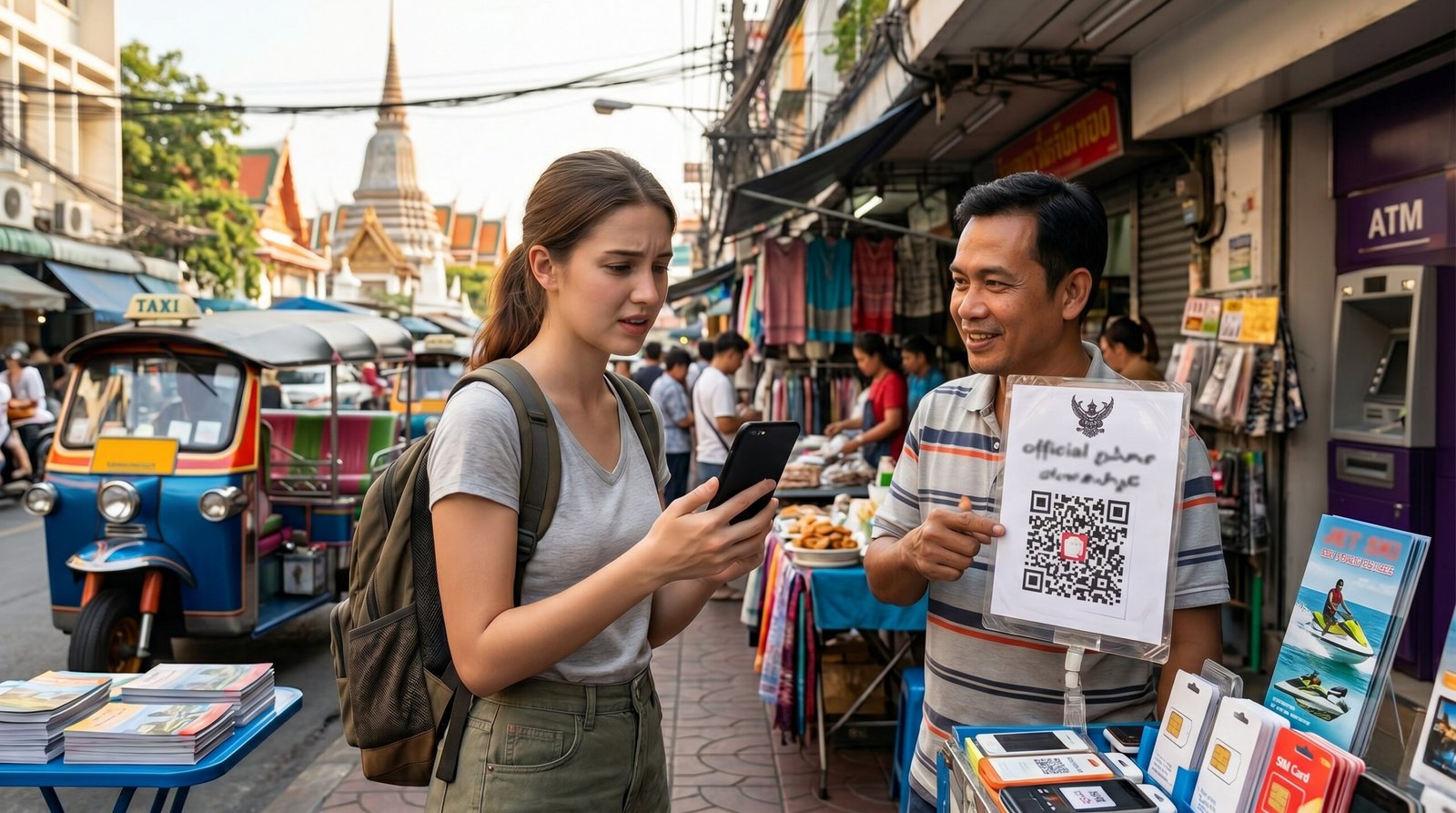
Thailand runs heavily on QR code payments through PromptPay. Scammers print fake QR codes and stick them over the real ones at taxi ranks, restaurant counters, and hotel desks.
You scan what looks like a payment code, enter your banking details on a fake page, and confirm. Your money goes to someone else.
What to do: Before scanning any QR code for payment, look for signs it’s been stuck over another sticker. Peel at the corner if you’re suspicious. Better yet, use cash for street vendors and small transactions.
The Hotel Booking Scam
This one is clever and hard to spot. Fraudsters hack into hotel booking systems and get your actual reservation details — your name, check-in date, room type, booking reference. They then contact you via WhatsApp or email posing as the hotel, saying there’s a problem with your payment and asking you to click a link to re-enter your card.
Because they have real details about your booking, it feels completely legitimate.
What to do: If anyone contacts you about a payment issue before your stay, call the hotel directly using the number on their official website. Never click payment links from WhatsApp messages, even if they know your booking details.
ATM Skimming
Not new, but still happening. Small devices installed inside ATM card slots record your card details; a hidden camera captures your PIN. You often won’t notice until your account is drained days later.
What to do: Use ATMs inside banks or large convenience stores (7-Eleven, Family Mart) rather than standalone machines on dark streets. Cover the keypad when you type your PIN. Check your account daily.
The High-Pressure Scams
The “Dubai Herbs” Medical Scam
This runs primarily in Patong (Phuket) and central Pattaya. Someone approaches you on the street — often presenting themselves as an expat or businessperson — and starts a friendly conversation. They steer it toward your health: hair, weight, joints, energy levels.
They walk you into a shop selling honey, ginger, and oils as premium health products. Once inside, the pressure intensifies. People have left having spent between 14,000 and 25,000 THB ($380–$680 USD) on products worth almost nothing.
These shops have permanent premises, which tells you they’re not worried about being shut down. When victims call the police, they typically get a partial refund rather than an arrest.
What to do: If a stranger on the street steers you toward any kind of health, gem, or clothing recommendation within minutes of meeting you, walk away. Friendly strangers near tourist attractions almost always earn commission.
The Spiritual Healer Scam
Less reported but deeply serious. Some people operating as fortune tellers or spiritual healers in Thailand use psychological manipulation to extract large sums of money. In the worst documented cases, this has escalated to sexual assault framed as part of the “ritual.” Victims rarely report it due to shame, and courts have historically not been sympathetic.
This is one to avoid entirely. If you’re looking for genuine wellness or spiritual experiences, go through reputable, licensed businesses — spas, yoga retreats, established meditation centres.
Renting Vehicles
The Passport Hostage Situation
Do not hand over your original passport as collateral for a jet ski, scooter, or motorbike rental. This is standard practice at many coastal shops, and it creates an uneven power dynamic that scammers exploit.
The process is predictable: you return the vehicle, the operator finds damage that wasn’t there before (sometimes hidden under water-soluble paint or stickers, revealed after washing), and you’re presented with a repair bill of hundreds or thousands of dollars. Because they have your passport, you can’t leave without paying.
What to do:
- Photograph or video the entire vehicle before you take it, with the rental operator present
- Never hand over your original passport — offer a photocopy instead
- If they won’t accept that, rent elsewhere
- If you’re already in this situation, call the Tourist Police on 1155 rather than paying a fake “police officer” who arrives on scene
Digital Threats You Can’t See
Voice Cloning Calls
You may receive a short call from an unknown number shortly after activating your Thai SIM. The caller says hello, maybe asks if you speak English, then hangs up. This can be a voice sample capture — your few seconds of audio fed into AI software to clone your voice.
That clone is then used to call your family back home, claiming you’ve been arrested or injured and need money wired immediately.
What to do: Don’t engage with unknown local numbers. Let them go to voicemail. If you do answer, say as little as possible before hanging up.
Public Wi-Fi
“Evil twin” networks — fake Wi-Fi hotspots with names like “Starbucks_Guest_Free” — intercept everything you transmit. Passwords, banking sessions, emails.
What to do: Use a VPN whenever you’re on public Wi-Fi. This is non-negotiable in Thailand in 2026.
If Things Go Wrong
The Tourist Police in Thailand operate separately from the regular police and are generally more reliable for dealing with tourist incidents.
Tourist Police Hotline: 1155 (free, 24 hours)
Download the Thailand Tourist Police i-lert-u app before you go. It sends your GPS location automatically when you press the SOS button and supports multiple languages including English, French, German, and Arabic. You can also upload photos and video directly through the app.
If you’ve been scammed, document everything — screenshots, receipts, photos of the people involved — before you do anything else.
A Few Things Worth Knowing About Thailand Right Now
The Thai government has been tightening up on foreign visitors following some high-profile incidents of tourist misbehaviour. Visa-free stays have been cut from 60 days to 30 days for many nationalities. Enforcement of business rules for foreigners has increased.
The tone has shifted. You’ll still be welcomed warmly by most people — Thai hospitality is real — but the broad assumption that anything goes for foreign visitors is genuinely fading. Respecting local rules and norms matters more than it used to, and it’ll serve you well.
The Short Version
- Before you leave: Only use tdac.immigration.go.th for your arrival card. It’s free.
- At the airport: Buy your SIM from a city store, not the arrival hall.
- Getting around: Use metered taxis or app rides, don’t cancel in-app for cash deals.
- Paying: Check QR codes before you scan. Never click payment links from WhatsApp.
- Vehicles: Never leave your real passport as collateral.
- Staying safe: Download the Tourist Police app and save 1155 in your phone before you arrive.
- If something goes wrong: Call 1155, document everything, don’t pay fake on-the-spot fines.
Thailand is still absolutely worth visiting. Go in with your eyes open, and you’ll have a great time.

Adrenaline junkie with a passion for exploring off-the-beaten-path destinations and finding unique ways to stay active. Expect stunning scenery, challenging workouts, awesome travel tips and a whole lot of fun. Let’s get sweaty and explore the world together!