
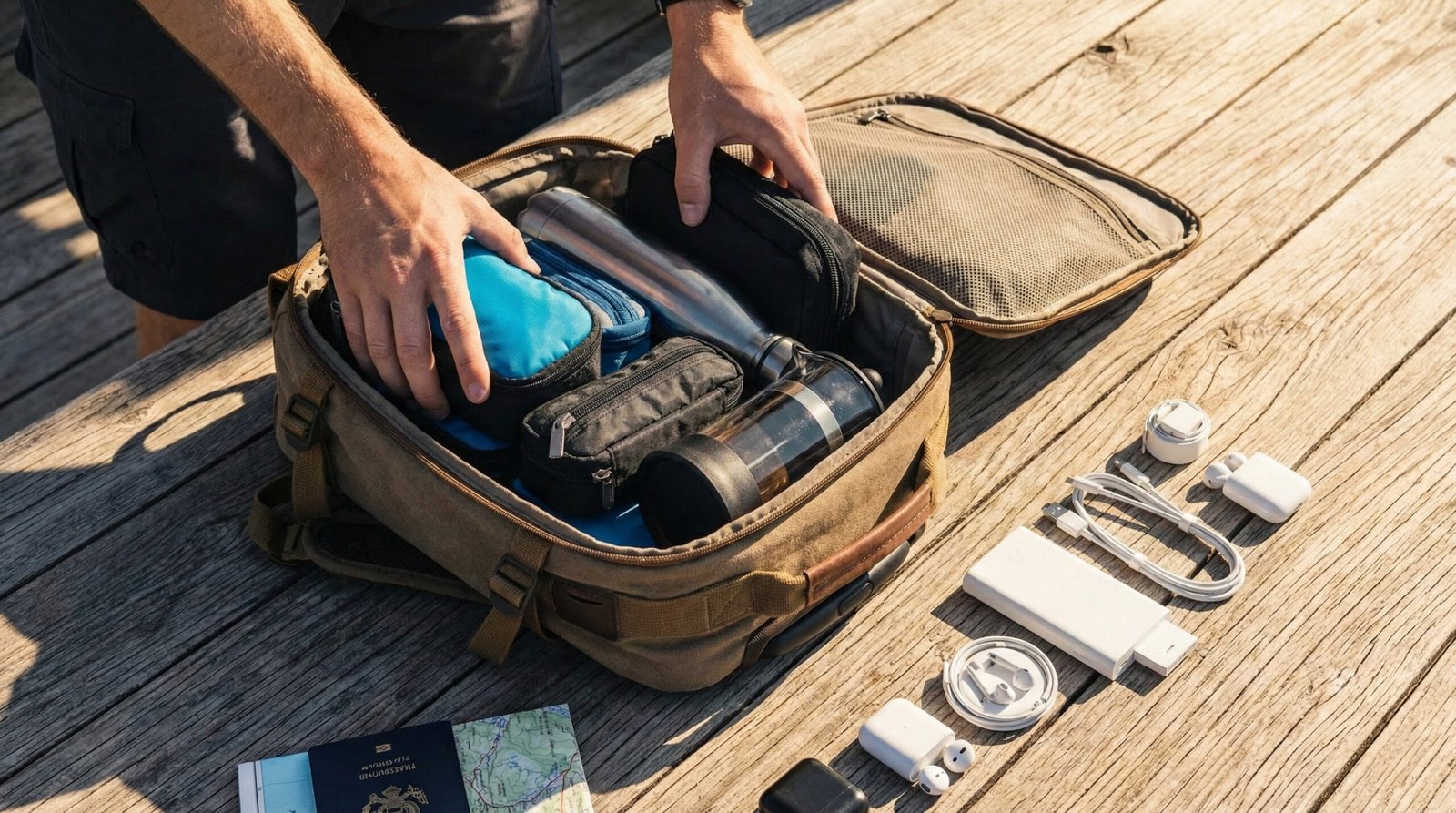
Travel gets expensive fast. It’s not just the big ticket items like flights or hotels that drain your bank account. It’s the little things. A bottle of water here, a baggage fee there, a roaming charge you didn’t expect. These small costs add up to hundreds of dollars before you know it.
After years of living out of a suitcase, I realized that spending a little money upfront on the right gear actually keeps money in my pocket later. It sounds backward, but buying specific accessories protects you from the “tourist tax”—those high prices companies charge because they know you have no other choice.
Here are 10 travel items that will actually save you cash on your next trip.
1. Filtered Water Bottle (LifeStraw or Brita)
Buying water is one of the biggest wastes of money when you travel. In tourist hotspots like Rome or New York, a single bottle can cost $2.50 or more. If you drink three or four a day, that’s $10 gone. Over a two-week trip, you could easily spend $175 just on water.
A filtered bottle like a LifeStraw or Brita lets you fill up from almost any tap. The filter removes the bad taste and, more importantly, the bacteria. You get safe, clean water for free.
The Math:
Cost of Bottle: ~$50
Savings: ~$175 on bottled water
Net Gain: $125
2. eSIM App (Airalo or Holafly)
Using your home phone plan abroad is a financial trap. Carriers like AT&T or Verizon often charge $10 a day for an “international pass.” For a 14-day trip, that is $140 just to check maps and send texts.
The fix is an eSIM. If your phone is relatively new, it likely supports this digital SIM card. You download an app, buy a data plan for the country you are visiting (usually around $20 for plenty of data), and activate it instantly. You keep your regular number for texts but use the cheap local data for everything else.
The Math:
Cost of eSIM Plan: ~$25
Savings: ~$140 in roaming fees
Net Gain: $115
3. Digital Luggage Scale
We have all seen someone frantically repacking their suitcase on the dirty airport floor because their bag was two pounds over the limit. Airlines love these fees. An overweight bag can cost you $100 or more at the check-in desk.
A tiny digital scale costs about the same as a sandwich. Weigh your bag at the hotel before you leave. If it’s too heavy, move stuff to your carry-on or throw away that heavy shampoo bottle. It’s a simple check that saves you from a massive fine.
The Math:
Cost of Scale: ~$12
Savings: Avoids a $100+ fee
Net Gain: $88
4. Universal GaN Adapter
Airport electronics stores are a rip-off. They know you are desperate if you forgot your charger, so they charge $40 or $50 for a basic plug adapter.
Buy a good Universal GaN Adapter before you leave. “GaN” just means it’s smaller and handles power better. A good one has regular outlets and multiple fast-charging USB ports. You can charge your laptop, phone, and watch all at once from a single plug. This is huge in older hotels that only have one outlet in the room.
The Math:
Cost of Adapter: ~$35
Savings: Avoids buying overpriced gear at the airport ($45+)
Net Gain: $10 (Plus you can charge everything at once)
5. Compression Packing Cubes
Checked bag fees are soaring. It can cost $75 just to check a bag one way. For a round trip, that is $150. If you can fit everything into a carry-on, you save that money immediately.
Compression packing cubes are the secret. They have a second zipper that squishes your clothes down tight, removing all the extra air. You can fit about 30% more clothes into your bag. This often makes the difference between needing a big checked suitcase and sticking with a free carry-on.
The Math:
Cost of Cubes: ~$35
Savings: ~$150 in checked bag fees
Net Gain: $115
6. Scrubba Wash Bag
Packing less means you have to do laundry. But hotel laundry services are astronomically expensive (think $5 for one pair of socks), and spending hours in a laundromat isn’t a vacation.
The Scrubba Wash Bag is basically a flexible, portable washing machine. It weighs almost nothing. You put your dirty clothes, water, and soap inside, seal it, and rub it for three minutes. The little nubs inside clean your clothes just like a machine. You can wash a day’s worth of clothes in your hotel sink for free.
The Math:
Cost of Bag: ~$55
Savings: ~$100 in laundry fees
Net Gain: $45
7. Laundry Detergent Sheets
You can’t use the Scrubba bag without soap. But carrying liquid detergent is messy and not allowed through airport security if the bottle is too big. Buying full bottles at your destination is wasteful.
Detergent sheets are the answer. They look like dryer sheets but dissolve in water to become soap. They are dry, light, and pack flat. At about 25 cents a load, they are much cheaper than the single-serve packets laundromats sell for $2.
The Math:
Cost of Sheets: ~$15
Savings: ~$20 vs. buying laundromat packets
Net Gain: $5
8. AeroPress Go
Coffee prices are a good way to see how expensive a city is. In places like Copenhagen or Zurich, a simple latte can cost $7. If you drink two cups a day, you are spending over $150 on coffee in two weeks.
The AeroPress Go is a travel coffee maker that packs into its own mug. It makes fantastic coffee. Buy a bag of local beans for $10, and your morning coffee costs pennies instead of dollars.
The Math:
Cost of AeroPress: ~$50
Savings: ~$121 vs. coffee shops
Net Gain: $71
9. Quick-Dry Microfiber Towel
If you stay in hostels or budget accommodations, you know the drill: they often charge you to rent a towel. It might be $5 or more. It feels like a hidden fee.
Bring your own microfiber towel. It folds up smaller than a t-shirt and dries incredibly fast. It prevents that mildew smell in your bag and saves you from renting a towel every time you move to a new place.
The Math:
Cost of Towel: ~$10
Savings: ~$20 in rental fees
Net Gain: $10
10. Reusable Cutlery & Shopping Bag
Eating every meal at a restaurant destroys your budget. In Europe, grabbing bread, cheese, and fruit from a supermarket is much cheaper—often $8 vs. $30 for a sit-down meal.
The problem is usually how to eat it. A simple set of reusable cutlery and a fold-up shopping bag solves this. You can shop at a local market without paying for plastic bags, and you can enjoy a picnic in a park without needing to find a restaurant.
The Math:
Cost of Set: ~$15
Savings: ~$140 by swapping some dinners for picnics
Net Gain: $125
The Breakdown: How Much Do You Actually Save?
Here is the total summary for a standard 14-day trip. The “Net Savings” column shows how much you save after paying for the gear.
Item | Cost to Buy | What You Save | Net Money in Pocket |
|---|---|---|---|
Filtered Water Bottle | $50 | $175 (Buying water) | +$125 |
eSIM App | $25 | $140 (Roaming fees) | +$115 |
Luggage Scale | $12 | $100 (Overweight fees) | +$88 |
Universal Adapter | $35 | $45 (Airport markup) | +$10 |
Compression Cubes | $35 | $150 (Bag fees) | +$115 |
Scrubba Wash Bag | $55 | $100 (Laundry) | +$45 |
Detergent Sheets | $15 | $20 (Soap packets) | +$5 |
AeroPress Coffee | $50 | $121 (Cafe prices) | +$71 |
Microfiber Towel | $10 | $20 ( rentals) | +$10 |
Cutlery/Eco-Bag | $15 | $140 (Picnic vs. Dining) | +$125 |
TOTAL | ~$297 | ~$1,011 | ~$714 |
The Bottom Line: By spending about $300 on this gear, you keep over $700 in your pocket on just one trip. If you travel with a family, the savings on water, baggage, and data can easily jump to over $2,500.

Adrenaline junkie with a passion for exploring off-the-beaten-path destinations and finding unique ways to stay active. Expect stunning scenery, challenging workouts, awesome travel tips and a whole lot of fun. Let’s get sweaty and explore the world together!